The alpha, twice a week
That was 3 min.
Get the best new moments in your inbox every Wednesday and Saturday. It's free.
Check your inbox
We sent a link to your address. Click it to finish signing up. Not there in a minute? Look in spam.
or
Wall Street Week · 3 min · Nov 21, 2026
Gaming is splitting between dominant publishers and lean indies
 Joost van Dreunen
Researchers describe a market where a handful of publishers command more revenue, while small indie teams can still thrive.
The episode’s best minutes
Full analysis- 15:59Gaming is splitting between dominant publishers and lean indies3 min
- 28:18Employers are using plan design to contain health-cost increasesPro pick 7 min
- 39:23AI makes cybersecurity a governance problem as well as a technical onePro pick 7 min
- 3 more moments in the full episode
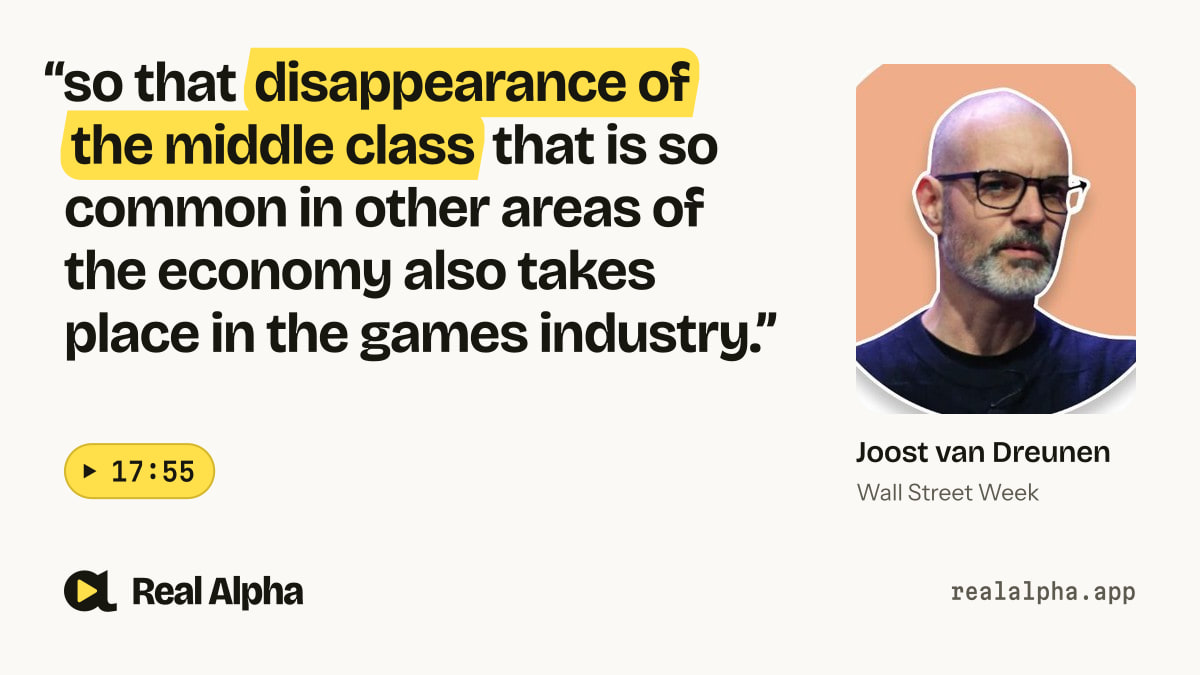
“so that disappearance of the middle class that is so common in other areas of the economy also takes place in the games industry.”
 Joost van Dreunenat 17:55 · Wall Street Week
Takeaways
- The top 10 gaming companies account for roughly $100 billion in consumer spending.
- Five major console publishers capture nearly three quarters of publishing revenue.
- Some indie games can deliver strong returns on budgets below $10 million.
About this segment
Researchers describe a market where a handful of publishers command more revenue, while small indie teams can still thrive. The contrast shows why the industry's middle is under pressure but not gone.

Co-founder & CEO, ALDORA
Built SuperData Research, sold to Nielsen, and founded ALDORA, while teaching the business of games at NYU Stern.
- DW
David Westin, Host
From “Gaming Blockbuster, Healthcare Costs, Cybersecurity Meets AIGaming Blockbuster, Healthcare...”, Nov 21, 2026. Watch the full episode
Thanks. We'll look at and fix what's off.
Transcript
From the transcript Wall Street Week publishes with the episode.
- 16:02
And how has the industry evolved in its structure? Is there more consolidation? Is there more concentration than there has been in the past?
- 16:09
The structure's evolved very rapidly and in what I would call fits and starts. If you think about the way this industry has moved, new platforms have come online. After PC gaming, consoles became a major phenomenon in the introduction of mobile video games, which are apps people play on their phones. You saw a new $ 100 billion market come online, which didn't exist before. But I think we're in the midst of the early innings of a major change again to this market.
- 16:37
It's not just the size of the gaming market that's changing. It's also the nature of the games themselves. and the companies creating them.
- 16:45
So multiplayer online games, that's really the defining characteristic today. And that means that you can play with your brother in Europe and your friend in Korea, and it's no problem.
- 16:55
What about the major players? How have they changed over time? The games industry has consolidated in a big way over the last 10 years, predominantly, of course, because of cheap capital becoming available during the pandemic. and also the cost of a saturated market in terms of marketing expense. So what that means is that the top 10 companies of the games industry today account for roughly $ 100 billion in consumer spending. It gives them an incredible amount of market power.
- 17:22
According to Van Droijnen's research, the top 10 companies collect 56% of publishing revenue, up from 45% in 2020. On consoles, the five largest publishers now capture nearly three quarters of publishing revenue.
- 17:38
They've been consolidating because they've realized that in order to stay above the line, they need to be so large that they leave everybody else behind. And so you see this bifurcation where you have a dwindling set of companies at the top, titles at the top, IPs and franchises at the top. and then a whole bunch of nothing, and then there's all the indies and everybody else. And so that disappearance of the middle class that is so common in other areas of the economy also takes place in the games industry.
- 18:05
Tuosto sees things differently. While the traditional mid-sized publisher may be under pressure, he argues that a new middle is being built around smaller permanent teams, lower development budgets, direct digital distribution, and financing tied to individual games.
- 18:22
The independent game space is growing the fastest of any of the subcategories within games. So you see games that cost less than $ 30, games like Mecha Chameleon that are not necessarily household names, but that are absolutely exploding. And you'll see games like Stardew Valley is one example that in its ninth year has more revenues, more players than it had in its first year. And these aren't games that tend to compete on graphics So the return on investment for games like this that might require sub 10 million, certainly, in terms of total development budget, maybe even a lot smaller than that, can be absolutely extraordinary.
- 19:00
Even the way games are being marketed is changing as executives take a page out of the legacy media playbook