The alpha, twice a week
That was 2 min.
Get the best new moments in your inbox every Wednesday and Saturday. It's free.
Check your inbox
We sent a link to your address. Click it to finish signing up. Not there in a minute? Look in spam.
or
Big Technology Podcast · 2 min · Jan 16, 2026
Enterprise AI adoption may take decades despite infrastructure spend
 Arthur Mensch
 says infrastructure may be slightly overbuilt because enterprise adoption requires custom software and organizational change.
In this episode
Full analysis- 1:39Model commoditization shifts value downstream4 min
- 15:55Open models give enterprises control over critical AI4 min
- 39:57AI can automate complex shipping and factory workflows6 min
- 11:12Enterprise AI can unlock growth beyond labor savings5 min
- 25:39Open-model gaps are shrinking as AI shifts toward specialists7 min
- 6:48Enterprise AI needs fixed workflows alongside agents4 min
- 45:51AI systems improve through feedback, not just code fixes3 min
- 51:42Enterprise AI adoption may take decades despite infrastructure spend2 min
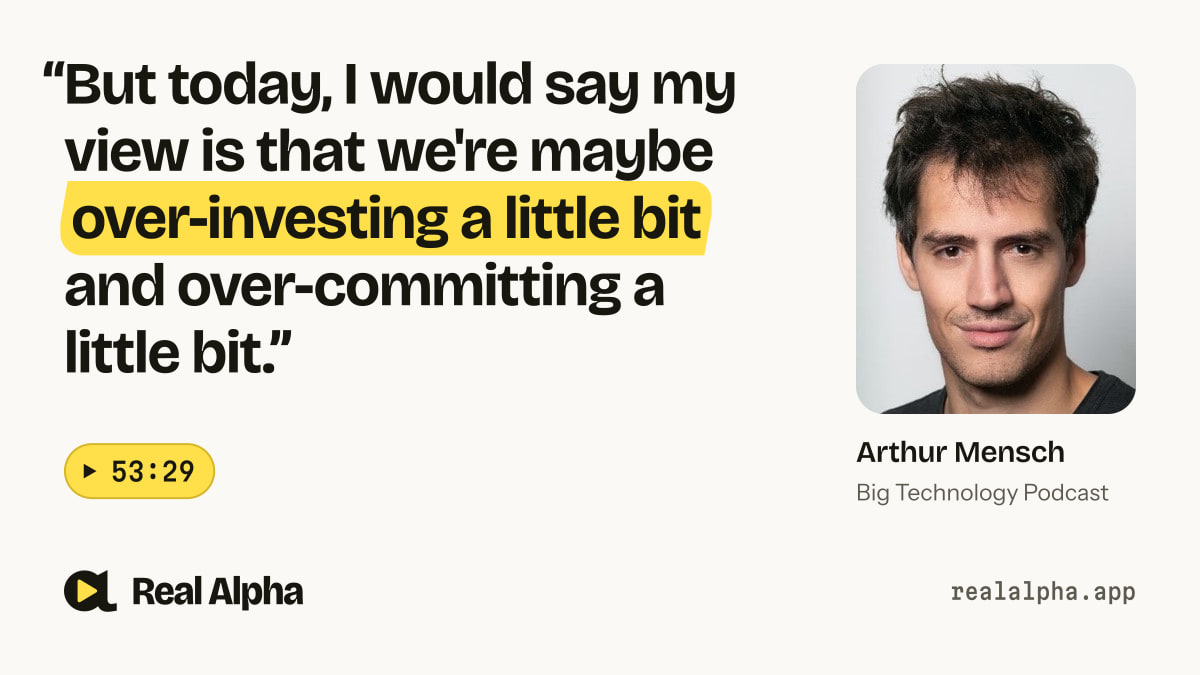
“But today, I would say my view is that we're maybe over-investing a little bit and over-committing a little bit.”
 Arthur Menschat 53:29 · Big Technology Podcast
Takeaways
- Off-the-shelf software may not deliver immediate productivity gains.
- Custom builds and organizational changes take time.
- Broad AI adoption could take 20 years.
About this segment
Arthur Mensch says infrastructure may be slightly overbuilt because enterprise adoption requires custom software and organizational change. He still expects AI across the economy, but says the shift could take 20 years.

Arthur Mensch is CEO and co-founder of Mistral.
Co-founded and leads Paris-based Mistral AI as CEO; named to Time's 100 Most Influential People in AI.

Alex Kantrowitz, Host · Founder, Big Technology
Former BuzzFeed News senior tech reporter and author of Always Day One.
From “Who Wins if AI Models Commoditize? — With Mistral CEO Arthur Mensch”, Jan 16, 2026. Watch the full episode
Answers “Is AI a bubble?” See all 30 answers
Answers “What will AI look like in the next few years?” See all 169 answers
Thanks. We'll look at and fix what's off.
Transcript
Transcribed by machine (Whisper) from the episode’s audio, so a word may be off here and there.
- 51:46
Clearly potential, but also just like a shit ton of investment. What do you think about the bubble question? Are we in a bubble right now? Well, we're in a setting where we need a lot of infrastructure. So we need to invest. And that's what we do in Europe, for instance. But then the viscosity of adoption in enterprise is slow, is high. in that it takes time to understand how to build the software.
- 52:13
It takes some building. You can't buy off-the-shelf solutions and then trust that you're going to make immense progress in your productivity. That has been the disappointment that a lot of enterprises went through in the last two years. So there's some building to be done. You need to maybe buy the primitives, buy a certain number of factorized functions, but then you need to bring your own knowledge onto it.
- 52:36
So it takes some time. You need to learn how to build. and then you need to learn how to reorganize and that takes even longer because the the teams are going to change you need less management because you need less infrastructure to circulate information because AI allows to information to circulate faster. You need, certain functions are going to disappear. Certain functions are going to grow. So there's just a lot of work to be done on reorganizing things, and it will take years.
- 53:04
And so the question is, the infrastructure investments that are being made today, are they going to create long-term value in two years, in five years, or in 10 years? And that does define whether some people are losing money or making money. That's the problem. And we don't really know. So maybe people are over-investing. Maybe people are under-investing. Some people will certainly lose money. Some people will certainly miss opportunities as well.
- 53:36
But today, I would say my view is that we're maybe over-investing a little bit and over-committing a little bit. Not Mistral, but some others. Because we see how complex it is to actually create value in enterprises. But eventually we'll get there. Eventually the entire economy is going to run on AI systems. That's for sure. But it might take 20 years because it's actually fairly complex. All right.
- 54:00
The website is mistrawl.ai.