The alpha, twice a week
That was 5 min.
Get the best new moments in your inbox every Wednesday and Saturday. It's free.
Check your inbox
We sent a link to your address. Click it to finish signing up. Not there in a minute? Look in spam.
or
TBPN · 5 min · Sep 26, 2025
Enterprise coding agents need to cover the full workflow
 Matan Grinberg
 says automating code alone shifts bottlenecks to testing, review and documentation.
In this episode
Full analysis- 1:37:20China’s drone edge comes from deep component process knowledge8 min
- 2:10:14Police drones can extend coverage and verify calls fasterPro pick 9 min
- 2:47:10Invisible builds custom AI applications instead of selling more SaaS7 min
- 1:51:35Delian favors AI leaders and businesses insulated from the cycle6 min
- 2:20:38Flock's product expansion is outpacing customer adoption6 min
- 48:00Radiology is a poor proxy for near-term AI job losses5 min
- 2:37:39Enterprise coding agents need to cover the full workflow5 min
- 2:57:37Recruiting search improves when it looks beyond LinkedIn4 min
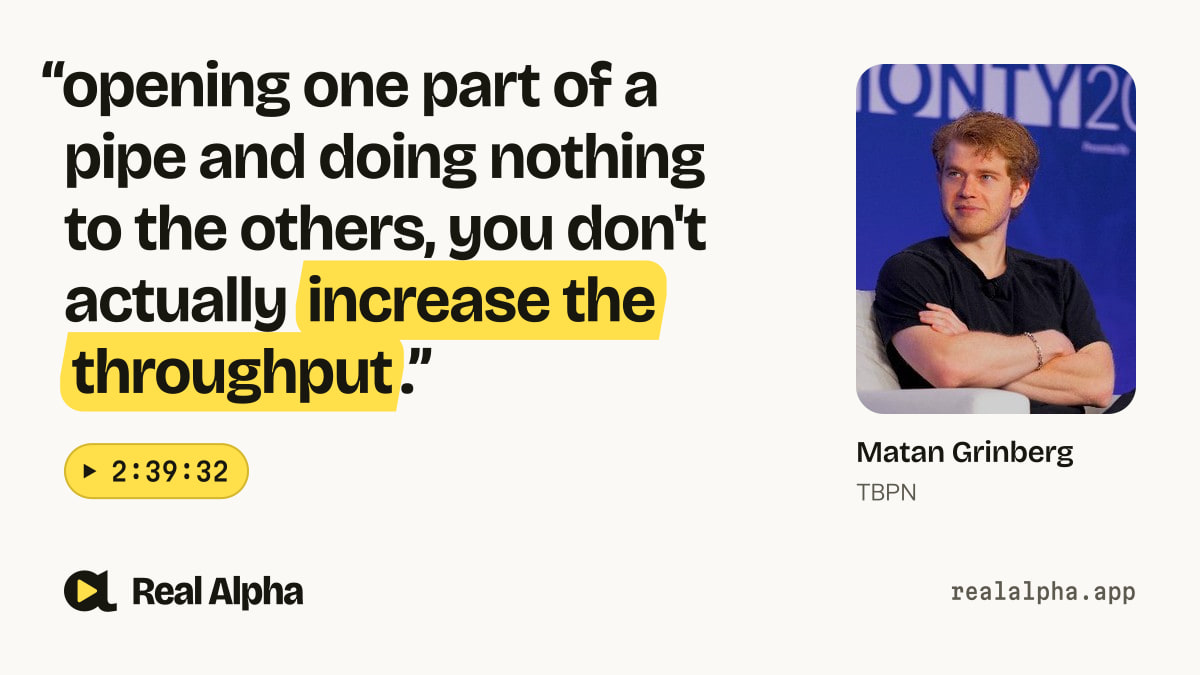
“opening one part of a pipe and doing nothing to the others, you don't actually increase the throughput.”
 Matan Grinbergat 2:39:32 · TBPN
Takeaways
- Enterprise software development includes more than writing code.
- Code-only automation can shift bottlenecks to testing and review.
- People outside engineering were already using the agents without formal budget.
About this segment
Matan Grinberg says automating code alone shifts bottlenecks to testing, review and documentation. Factory's pitch is that enterprise agents must cover the full software-development lifecycle.

Co-founder & CEO, Factory

John Coogan, Host · Co-host, TBPN
Co-founded Soylent and Lucy; OpenAI bought his show TBPN in April 2026.

Jordi Hays, Host · Co-host, TBPN
Founded Branded Native; co-founded fintech Capital, which Rho bought.
From “Thursday, September 25th”, Sep 26, 2025. Watch the full episode
Thanks. We'll look at and fix what's off.
Transcript
From the transcript TBPN publishes with the episode.
- 2:37:52
How are you viewing the market and the customer landscape? Automated software engineering, that feels niched down from years ago, which was just the the the transformer based LLMs can write code. But as we actually dig in, we see that the needs of a Fortune 100 customer may be different than a mid market company, which is different than a start up, which is different than an SMB, which is different than a solo vibe coder, solopreneur. Where are you seeing opportunity in the market? How bifurcated is the market?
- 2:38:25
It seems like you've wanted to be very general on the model side. Are you also trying to be general on the customer size side?
- 2:38:31
Yeah. Great question. I mean, I think the the thing that a lot of the other tools have missed is the fact that the further you go into the large enterprise, the less overlap there is between software development and coding. Mhmm. So for example, if you're a solo developer, your software development is basically just coding. You're not really doing code review. You're not doing that much in the way of documentation or testing or design docs. And so where we focus and why we call Droids software development agents as opposed to coding agents is that we focus on that whole end to end software development life cycle, which is really where a lot of enterprises are missing. Like, there's study there's the famous study that came out from MIT that said something along the lines of 95% of AI adoption efforts are failing in the enterprise.
- 2:39:15
I remember. Yeah. Exactly. And so, I mean, it it it kinda makes sense. Like, if you think about software development as
- 2:39:21
a as a pipeline Sorry. I I You guys I love hitting you with the surprise sound effect. We'll get some more positive.
- 2:39:28
We're not bearish on you. It's just No. No. No. No. Was good. It was perfect. It was probably just too good. But, you know, software development is a pipeline. Right? And if you focus on only one part of that pipeline Yeah. Namely code generation Yeah. And you expand that I used to be a physicist. I don't know if you guys are big on fluid mechanics, but opening one part of a pipe and doing nothing to the others, you don't actually increase the throughput.
- 2:39:49
Sure. You just create new bottlenecks. Interesting. And so the reason why a lot of these efforts are failing for software development is they're focusing on just coding, but then that just punts the problem down to testing or code review or documentation. And that's why a lot of the other tools out there aren't seeing kind of the adoption and the real business outcomes that we are with, the droids.
- 2:40:10
How do you see coding agents fitting into the consumer world? I this might not be a business at all, but I noticed that the you know, I've seen incredible results just from asking a question that you could hit deep research with. But, if I ask it to Claude code or Codex, it can build an entire HTML web page with JavaScript widgets and bar charts, and it just produces it instantiates the information in a much cooler, just interesting way. And I'm wondering how you're seeing crossover from advances in automated AI coding into a consumer world where they might not even know that they asked for code, but they got code. It's already happening a little bit when you hit o three Pro.
- 2:40:58
It'll write some code to give you the answer. You don't even see it unless you unfurl the reasoning tokens. But how do you see that playing out in, like, kind of the mid to long term?
- 2:41:08
Great question. I think this is something that, people aren't yet fully aware of, but this is actually the very first statement of our announcement, which is the best agents for software development are becoming the best agents for everything. And the reality is because basically every problem can be broken down into some sort of software development problem, and you can actually take it from Anthropic themselves. Literally yesterday, Alex Albert, the guy who runs DevRel at Anthropic, tweets out, you know, the best coding model will be the best model for many types of knowledge work. Code is how computers operate.
- 2:41:45
Anything you do on a computer can be done through code. And this is really why factory being the number one software development agent is really going to then lead to a lot of other tasks, and we're already seeing this in the enterprise. So we sell explicitly to developers, but already PMs, designers, even people on the operation side, so, like, finance, biz ops, that sort of thing. Yeah. We find that they're, like, sneaking their way in even though they didn't actually, you know, put any budget towards it, and they're starting to use droids kind of, behind the back of some of the VPs of engineering.
- 2:42:16
And this is really something that we've expected because of this fact that that code is really the language that computers speak. And if you want a computer to do something for you, you will eventually, through some means, need code.
- 2:42:29
Couple couple questions. What what models are you guys getting the most leverage out of today? Is it a mix? Are you are you focused on You you said earlier, I think you're focused on a variety being trying to be model agnostic, but I'd be curious where who who you're paying out on the back end.