The alpha, twice a week
That was 2 min.
Get the best new moments in your inbox every Wednesday and Saturday. It's free.
Check your inbox
We sent a link to your address. Click it to finish signing up. Not there in a minute? Look in spam.
or
The Real Eisman Playbook · 2 min · Oct 19, 2026
Equity wealth now poses more economic risk than housing
 Danny Moses
 says household wealth has shifted toward equities, making a stock-market decline a bigger risk to the economy than housing.
In this episode
Full analysis- 16:50AI financing echoes the warehouse lines behind subprime4 min
- 22:38Private equity's fundraising model is colliding with exits6 min
- 5:04Small Fed and Treasury moves cannot offset the debt backdrop3 min
- 8:30Equity wealth now poses more economic risk than housing2 min
- 11:05Real AI demand does not guarantee profitable infrastructure3 min
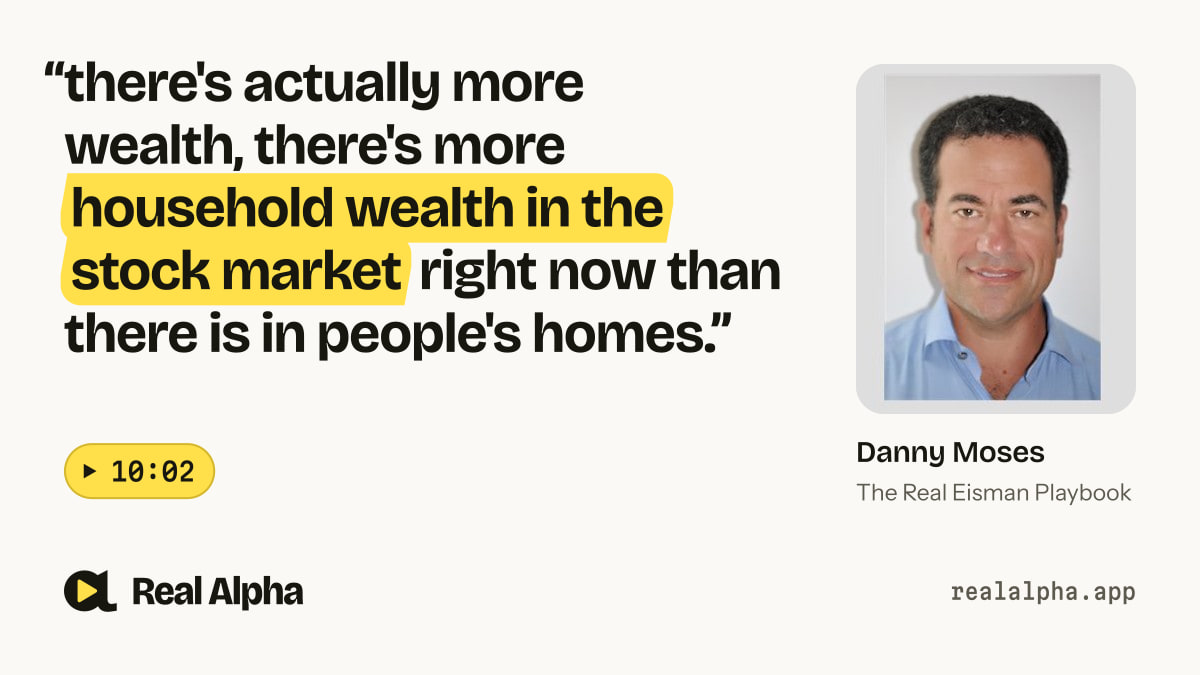
“there's actually more wealth, there's more household wealth in the stock market right now than there is in people's homes.”
 Danny Mosesat 10:02 · The Real Eisman Playbook
Takeaways
- Household wealth in stocks now exceeds household wealth in homes.
- That makes a market drop a larger economic risk than housing.
- He connects weak lower-end spending to the K-shaped economy.
About this segment
Danny Moses says household wealth has shifted toward equities, making a stock-market decline a bigger risk to the economy than housing. He ties that exposure to a K-shaped economy with weaker activity below the affluent end.

Danny Moses is a former Big Short partner and host of On The Tape.
Spotted the housing bubble before the crisis and helped execute the trade chronicled in The Big Short.

Steve Eisman, Host
From “Big Short Reunion w/ Danny Moses: Rising Rates, AI & Private Equity | The Real Eisman Playbook Ep 80”, Oct 19, 2026. Watch the full episode
Thanks. We'll look at and fix what's off.
Transcript
Transcribed by machine (Whisper) from the episode’s audio, so a word may be off here and there.
- 8:33
One thing that I would be very nervous about right now is just the whole housing sector. I think as of now, mortgage rates are 7.5%. People are not buying homes at mortgage rates of 7.5%. They're just not. So, it's a big negative. I think there's a demographic shift that has occurred since COVID. Yeah. This generation, our kids' age, whether they buy a home or not, it's just different. They don't think of it like...
- 9:01
Like we used to. I was giving a speech yesterday, and somebody way in the back, a young person, raised their hand and asked, is it a good idea to buy a house? And I said, nicely, I said, listen, if you find a house that you really like, and you can afford it, and you can afford the payments, include all the other payments, like the taxes and stuff, God bless, buy the house. But don't expect to make money buying the house.
- 9:34
I think those days are completely over. Did you ever tell the story that from in 2008, so during the crisis that was going on, we all went down to Orlando, not the Vegas trip, the Orlando trip, the second year, it was an ASF, it was a fixed income conference, and you gave up to give a speech, and you said, you said you were going to pass out Prozac before you spoke. Oh, I remember this. And I think you made a comment or something, turn to your left, turn to your right, one of those people won't have a job.
- 9:59
A job, right. So, again, kind of along those lines of what part of the cycle are we in here, there's actually more wealth, there's more household wealth in the stock market right now than there is in people's homes. So, what's interesting is that you shifted the risk, the stock market going down poses more of a risk to the economy right now- Than housing. Than housing. That is very interesting. Yeah, and then the K-shaped economy, obviously.
- 10:24
You can see the high end of the K, the housing, who cares what rates are people are buying in cash or whatever it might be. But underneath, there are not a lot of transactions going on. The bottom part of the K, people are not buying. It's bad. It's not easy. But the top part of the K continues to carry the economy. It's amazing the spending that still goes on. All right. So, let's turn to AI. OK.
- 10:44
We could probably talk about this for the next three hours.