The alpha, twice a week
That was 3 min.
Get the best new moments in your inbox every Wednesday and Saturday. It's free.
Check your inbox
We sent a link to your address. Click it to finish signing up. Not there in a minute? Look in spam.
or
Bloomberg Surveillance · 3 min · Oct 23, 2026
Family health coverage costs top $28,000 a year
 John Tozzi
Employer family premiums topped $28,000, and workers’ share is rising faster than employers’ contributions.
In this episode
Full analysis- 12:31Long-term ownership can beat short-term market noisePro pick 3 min
- 14:58Tilson favors a minimum tax over a state wealth tax3 min
- 25:18Robinhood users are adding long-term buckets alongside trading4 min
- 32:36Family health coverage costs top $28,000 a year3 min
- 22:21Gen Z investors are more likely to change portfolios before midterms3 min
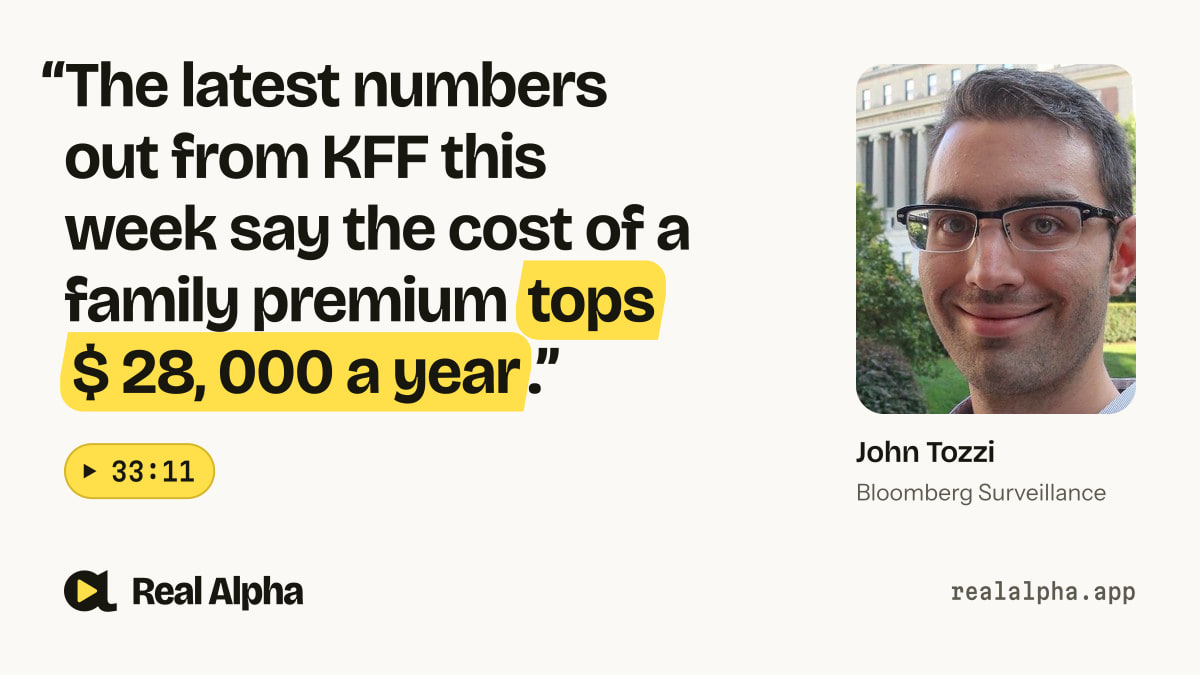
“The latest numbers out from KFF this week say the cost of a family premium tops $ 28, 000 a year.”
 John Tozziat 33:11 · Bloomberg Surveillance
Takeaways
- Family premiums average more than $28,000 a year.
- Workers’ premium contributions rose about 9% this year.
- The average family-plan deductible is around $4,000.
About this segment
Employer family premiums topped $28,000, and workers’ share is rising faster than employers’ contributions. A typical family deductible is about $4,000, adding costs beyond premiums.

Health care reporter, Bloomberg
Reports on health insurance, hospitals, medical services and policy for Bloomberg News.
From “Affordability In Focus Ahead of Midterms; US National Wealth Tax Debate | Bloomberg Money”, Oct 23, 2026. Watch the full episode
Thanks. We'll look at and fix what's off.
Transcript
From the transcript Bloomberg Surveillance publishes with the episode.
- 32:38
family's employer-provided health care plan has reached an average $ 28, 303 this year. I looked up three years in a row, roughly, Eight percent, eight percent, eight percent. I think that's like a 25 percent. Yeah, definitely versus previous years. And the numbers bear that out. Bloomberg's U.S. health deputy team leader, John Tazi, joins us now with more. So this is U.S. employers making employees contribute more to their health insurance through higher premiums and higher deductibles as well.
- 33:09
Yeah, I mean, this is a trend we've seen going on for a long time. The latest numbers out from KFF this week say the cost of a family premium tops $ 28, 000 a year.
- 33:20
What's interesting, too, is the share of that. So that's split between what the employer contributes and what the workers contribute. But the share of workers. Contribution is going up even faster than the employers. I think that was about 9 percent this year.
- 33:34
Which is easily double the rate of inflation. And small businesses are doing this more than some of the big employers. And most of this country is made up of small businesses. Yeah.
- 33:44
I mean, small employers always have a little bit kind of harder time providing health care for their workers. They don't have the scale and buying leverage and sophistication that a big company does. So it's always affordability.
- 33:59
John, I remember the day Marlboro Cigarettes raised the price seven cents or whatever, and they reached a tip point where America said no. Are we anywhere near from 16,000 and Uwe Reinhart in Princeton years ago, out to, you know, from your Columbia, the great work at Columbia University and others, are we anywhere near like if we top 30,000 where America says enough and there's literally a revolt?
- 34:22
Yeah, I don't know. I mean, I think when you look at this, this is sort of the employer space where, you know, 160 odd million Americans get their coverage from employers. It's part of their compensation. Right. So, you know, relatively tight job market. You know, this is how this is part of how companies are paying their workers. What it means is that there's less less cash in people's paychecks because more and more of that money is going to the health benefit.
- 34:48
And a lot of employers are also opting not to even participate in a group health insurance plan. They're just giving money over to the employee and say, manage it yourself.
- 34:55
And I think it was last week, Tom Purcelli at Wells Fargo saying the benefit wages mix is in real time changing. John, I look at this and I go back to what I hear from people, which is fury over higher deductibles. Where are we? If it's $ 28, 000, what's the average deductible that people will see?
- 35:14
Yeah, so the average deductible right now for a family plan is around $ 4, 000. Cash? Yeah. After tax? Yeah, I mean, that's what you would be paying out before your health plan starts kind of picking up the tab for the care. that you need. Now, some things are covered before the deductible, right? Preventive care should be covered. But it is a lot of money. And when you think about low-income households, you think about households that don't have a lot of savings.
- 35:40
That is a big. Like, Scarlett, my math in my head is six grand pre-tax. Yeah, easily. This is like we've hit a tip point.
- 35:48
We've been heading towards this point for a while now. Well, in any case, this is something that we'll continue monitoring. And I know your team is on top of all that. John, thank you so much. John Tozzi, Bloomberg's U.S. Health Deputy Team Leader.