The alpha, twice a week
That was 3 min.
Get the best new moments in your inbox every Wednesday and Saturday. It's free.
Check your inbox
We sent a link to your address. Click it to finish signing up. Not there in a minute? Look in spam.
or
Bloomberg Surveillance · 3 min · Oct 23, 2026
Gen Z investors are more likely to change portfolios before midterms
A survey found Gen Z investors are far more likely than boomers to adjust portfolios around the midterms.
In this episode
Full analysis- 12:31Long-term ownership can beat short-term market noisePro pick 3 min
- 14:58Tilson favors a minimum tax over a state wealth tax3 min
- 25:18Robinhood users are adding long-term buckets alongside trading4 min
- 32:36Family health coverage costs top $28,000 a year3 min
- 22:21Gen Z investors are more likely to change portfolios before midterms3 min
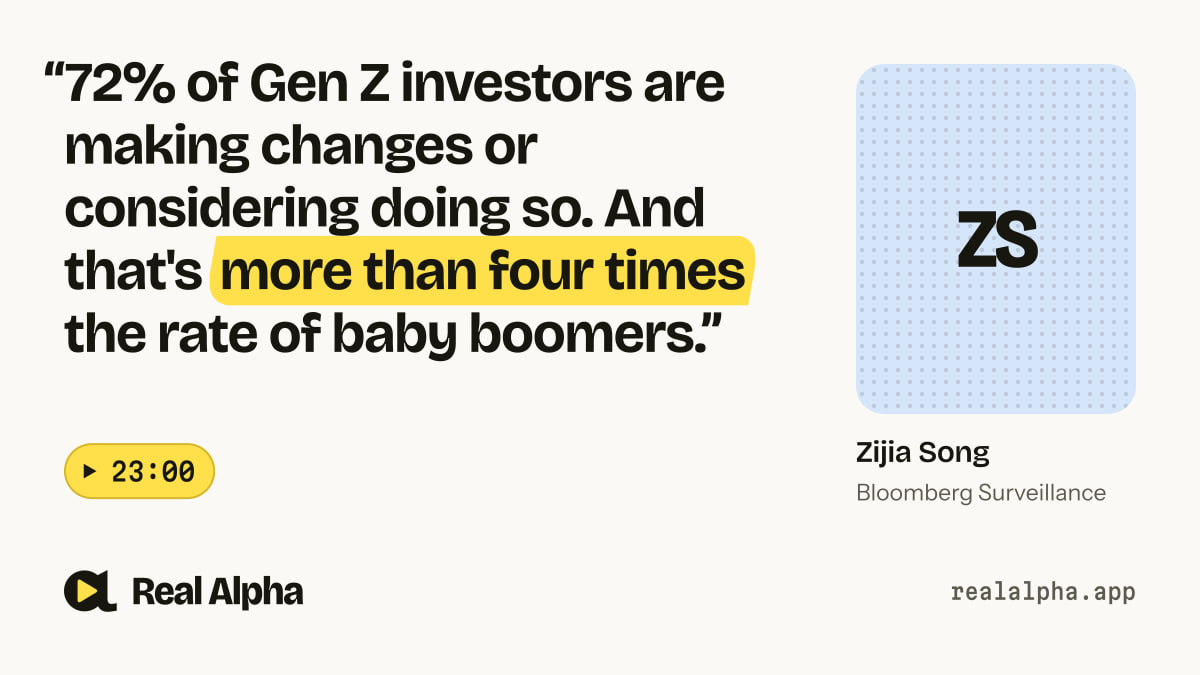
“72% of Gen Z investors are making changes or considering doing so. And that's more than four times the rate of baby boomers.”
Takeaways
- 72% of Gen Z investors are changing or considering changing positions.
- That rate is more than four times the rate for baby boomers.
- The S&P 500 rose in the 12 months after every midterm since 1950.
About this segment
A survey found Gen Z investors are far more likely than boomers to adjust portfolios around the midterms. Advisors generally urge staying put, and the S&P 500 has risen in the year after every midterm since 1950.
From “Affordability In Focus Ahead of Midterms; US National Wealth Tax Debate | Bloomberg Money”, Oct 23, 2026. Watch the full episode
Thanks. We'll look at and fix what's off.
Transcript
From the transcript Bloomberg Surveillance publishes with the episode.
- 22:24
Let's take a look at what our money team here have been working on. And one article that caught my eye is on how different generations are approaching the upcoming midterm elections and how they're investing around it. 27 percent of Gen Z investors have consulted a financial advisor about election related risks. That is more than double that of baby boomers, which are at 12 percent. This is all according to a recent survey from the Nationwide Retirement Institute.
- 22:49
Bloomberg's Zijia Song wrote this story, and she joins us now. So, Zijia, they're concerned, Gen Z is, about this election. Affordability, obviously, top of mind for them. Are they making changes to their investments? They are.
- 23:01
Actually, this recent survey shows that 72% of Gen Z investors are making changes or considering doing so. And that's more than four times the rate of baby boomers. And part of that reason is because Their anxiety is spilling into actions. And unlike baby boomers, they haven't gone through like the dot-com bubble or financial crisis.
- 23:20
So they don't really know how to deal with this anxiety. And that's why they're making more actions. Like 24% are actually moving to lower risk conservative investments and some more are diversifying into other assets.
- 23:33
Interesting. So what are strategists that you talk to saying about how boomers versus Gen Z versus Gen X dealing with pre-election anxiety?
- 23:42
Yeah, I actually talked to a lot of financial advisors about how you can trade election or how to position yourself before the midterms. And a lot of boomers have worked with financial advisors a lot. So they are more inclined to stay the course, which is what majority of financial advisors advise to do. It's just to do nothing. And historically, we've seen that S & P 500 actually had positive returns in the following 12 months following every midterm election since 1950.
- 24:11
This is great. I feel ancient sitting next to you. You're killing me here. If we go down 35%, which does occur, how will the young troops respond?
- 24:21
Well, you have to keep in mind that the younger folks, they also have a longer investment horizon. Really? Yeah. So if you stay in the market, the long-term return of S & P, of the broader markets, is always positive. They'll bounce back. But that anxiety is real. And that's why a lot of Gen Zs are more inclined to even trade elections or... try to seize on the moment nowadays.
- 24:45
Sometimes taking action may not be the best course of action. All right, Bloomberg's Suja Song, thank you so much. You can, of course, read her work on Bloomberg.com.