The alpha, twice a week
That was 2 min.
Get the best new moments in your inbox every Wednesday and Saturday. It's free.
Check your inbox
We sent a link to your address. Click it to finish signing up. Not there in a minute? Look in spam.
or
Wall Street Week · 2 min · Oct 30, 2026
Federal borrowing costs show up in household loans
 Natasha Sarin
 connects rising U.S. debt and borrowing rates to mortgage and car-loan costs.
The episode’s best minutes
Full analysis- 26:55Federal borrowing costs show up in household loans2 min
- 16:40Data centers need local standards and federal safeguards2 min
- 32:58Tax reform and enforcement could raise more revenuePro pick 3 min
- 4 more moments in the full episode
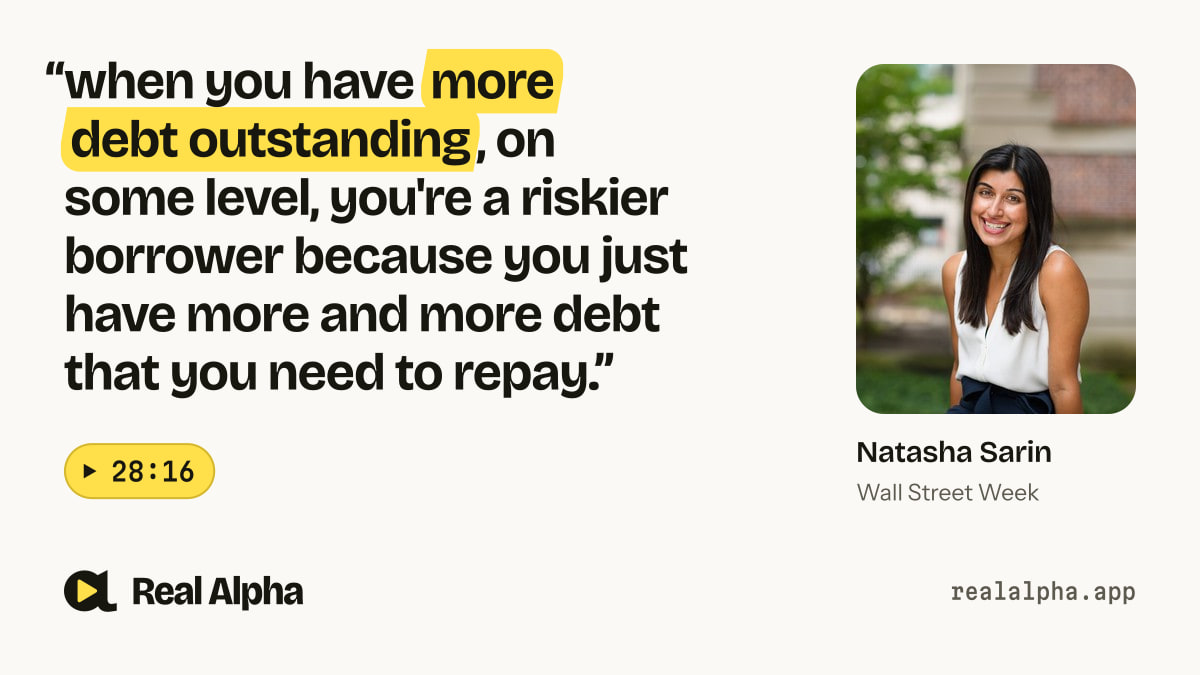
“when you have more debt outstanding, on some level, you're a riskier borrower because you just have more and more debt that you need to repay.”
 Natasha Sarinat 28:16 · Wall Street Week
Takeaways
- More government debt can increase borrowing costs.
- Mortgage rates are tied to the rate the U.S. pays to borrow.
- Higher rates can add thousands in costs for an average family.
About this segment
Natasha Sarin connects rising U.S. debt and borrowing rates to mortgage and car-loan costs. Her research estimates the average family pays thousands of dollars extra.

President & Co-Founder, The Budget Lab at Yale
Focused Treasury work on closing the tax gap and co-founded Yale’s nonpartisan Budget Lab.
- DW
David Westin, Host
From “Affordability Crisis, Data Center Divide, Debt Hits Households, Capitalism on the Ballot | Wall...”, Oct 30, 2026. Watch the full episode
Thanks. We'll look at and fix what's off.
Transcript
From the transcript Wall Street Week publishes with the episode.
- 26:58
I wish we heard more about it because the fiscal state of here in the United States is not great. And it is deteriorating. We're in a situation where debt to GDP is over the next decade is projected to rise to 130 percent or our national debt has crossed 40 trillion dollars. It's actually 33 trillion if you exclude intergovernmental transfers. Like all of this feels kind of meaningless on some level to real people. But those numbers are connected really tangibly to like costs that households are facing and in this affordability discourse that's really driving the midterms very significantly. Part of the reason why here in the United States we're now flirting with mortgage rates above 7% is because the rate at which households are able to get mortgages is very closely tied to the rate at which the United States is able to borrow to fund
- 27:56
its fiscal position. So make that connection between, on the one hand, the government's ability to borrow which affects interest rates, and somebody, for example, going to buy a house. I mean, what is the threat, real threat, of various buyers not being willing to buy U.S. Treasuries?
- 28:14
There are a lot of factors at play here, but one of them is that when you have more debt outstanding, on some level, you're a riskier borrower because you just have more and more debt that you need to repay. That's particularly true if you think about a lot of debt that's short-term, the way that the United States has structured its debt. in recent history such that you're also pretty exposed to the fact that you're going to have to roll over that debt at potentially a higher interest rate as interest rates move up as the Fed is trying to tamper inflation. And so the result of that and the work that we've done is we say that you are actually seeing the nexus between that interest rate that the government is paying on its borrowing and your car loan and your mortgage to the tune of thousands
- 29:03
of dollars of excess cost for the average family.