The alpha, twice a week
That was 3 min.
Get the best new moments in your inbox every Wednesday and Saturday. It's free.
Check your inbox
We sent a link to your address. Click it to finish signing up. Not there in a minute? Look in spam.
or
Wall Street Week · 3 min · Oct 30, 2026
Tax reform and enforcement could raise more revenue
 Natasha Sarin
Paul Ryan argues tax reform could increase revenue but says spending must also be addressed.
The episode’s best minutes
Full analysis- 26:55Federal borrowing costs show up in household loans2 min
- 16:40Data centers need local standards and federal safeguards2 min
- 32:58Tax reform and enforcement could raise more revenuePro pick 3 min
- 4 more moments in the full episode
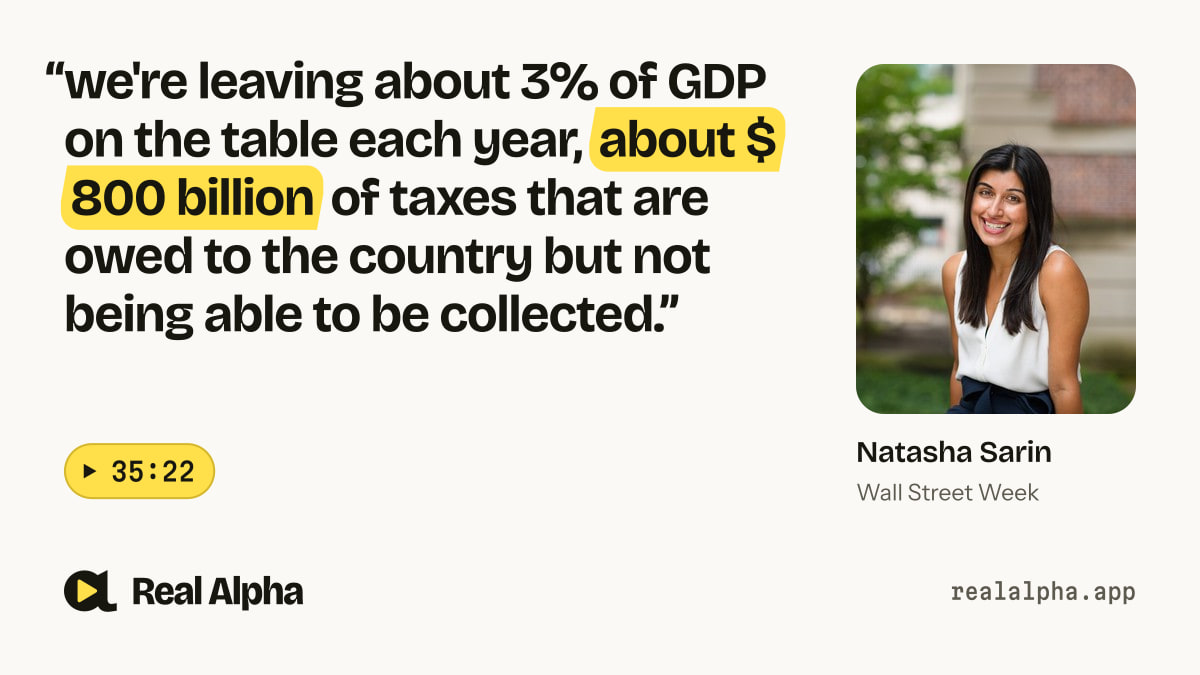
“we're leaving about 3% of GDP on the table each year, about $ 800 billion of taxes that are owed to the country but not being able to be collected.”
 Natasha Sarinat 35:22 · Wall Street Week
Takeaways Pro pick
- Ryan estimates tax revenue could reach about 20% of GDP.
- He says spending must be addressed to fix the deficit.
- Sarin says about $800 billion in owed taxes goes uncollected each year.
One of Pro's picks, open to you here. Try Pro free for 7 days
One of Pro's picks. The rest of the summary and the 3 takeaways are in Real Alpha Pro; the video, the quote and the transcript stay free.
Read it with Pro, 7 days freeAbout this segment
Paul Ryan argues tax reform could increase revenue but says spending must also be addressed. Natasha Sarin points to tax enforcement and changes for large companies as ways to raise funds.

President & Co-Founder, The Budget Lab at Yale
Focused Treasury work on closing the tax gap and co-founded Yale’s nonpartisan Budget Lab.
- DW
David Westin, Host
From “Affordability Crisis, Data Center Divide, Debt Hits Households, Capitalism on the Ballot | Wall...”, Oct 30, 2026. Watch the full episode
Thanks. We'll look at and fix what's off.
Transcript
From the transcript Wall Street Week publishes with the episode.
- 33:00
of which got implemented, as I recall. And it did lead to growth. I think there's no question about that. Did it lead to a reduced deficit?
- 33:08
So I think we are on a trajectory to better revenues. But let me just say this. I think you could probably get more revenues from the current tax code if you reform the tax system than we have today. We're at a little over 17% of GDP for our tax code. Historically, it's been closer to 18. I think through tax reform, you could probably get the revenue system up to about 20% of GDP without sacrificing economic growth. But there's no way you could probably get beyond that, in my opinion, without really damaging the economy.
- 33:38
And the problem is our spending is at 24% of GDP and going higher. So you really can't chase your spending line with a revenue line, although you could probably get more revenue with a better tax system. I'm a big fan of the cash flow tax. I think that's a smarter way to do it. I think it's more pro-growth. It's actually very pro-labor. And I think you can get probably better revenues, but you can't fix this problem unless you address spending.
- 34:03
What are the options for getting our arms around that? And start on the revenue side with taxes.
- 34:09
My colleague Kim Klossing and I just put out a paper with the Aspen Economic Strategy Group that offers a way to raise $ 15 trillion dollars To meet an extraordinary fiscal moment in like kind of ordinary ways. For the 2% of the most profitable companies, often multinationals that operate across jurisdictions, you raise the rate somewhat to 28% or maybe 30%. And also, you think seriously, particularly for multinationals, about doing a version of what we tried to do in the Biden administration, which was trying to figure out how you deal with the problem of profit shifting, that essentially there's a huge incentive in the system to move or book profits in places where tax rates are very low. Just those two things alone are going to raise you over a trillion dollars. If you add to that undoing a
- 35:02
lot of the damage that's been done to our tax system over the course of the last not just few years, decades, but certainly the last couple of years as you've watched 40% of the IRS workforce be depleted by Doge and its aftermath, there is a ton of revenue to be had by a tax system that's able to do better even at current tax rates. Because it turns out that right now we're leaving about 3% of GDP on the table each year, about $ 800 billion of taxes that are owed to the country but not being able to be collected.
- 35:35
You've served in government. You know the way it works in Washington. Do you see a world in which there's political will on either side of the aisle to address some of these difficult issues?
- 35:44
I have both pessimism and optimism, and I'm trying to be optimistic. So let's lean into optimism. I don't think that some of the interventions that you've seen over the course of the last few months, the Japanese yen intervention or the buybacks of some long-dated bonds, they're not like that meaningful on some level to the scale of the problem. Ultimately, the only thing you can do about the fact that yields are rising, rising, rising, is think seriously about our fiscal problems. And my hope is that in some sense, the conditions that we're already starting to see in this economy are going to force some of these conversations that in a low interest rate environment, people just weren't that interested in having.