The alpha, twice a week
That was 8 min.
Get the best new moments in your inbox every Wednesday and Saturday. It's free.
Check your inbox
We sent a link to your address. Click it to finish signing up. Not there in a minute? Look in spam.
or
All-In · 8 min · Jul 11, 2025
Food automation can cut kitchen labor below 10% of revenue
 Travis Kalanick
 explains how automated kitchens assemble meals and reduce labor costs.
The episode’s best minutes
Full episode- 6:35Food automation can cut kitchen labor below 10% of revenuePro pick 8 min
- 21:03Compute-first learning is overtaking human-engineered AIPro pick 8 min
- 46:22AI browsers may be a costly detour from better products8 min
- 3 more moments in the full episode
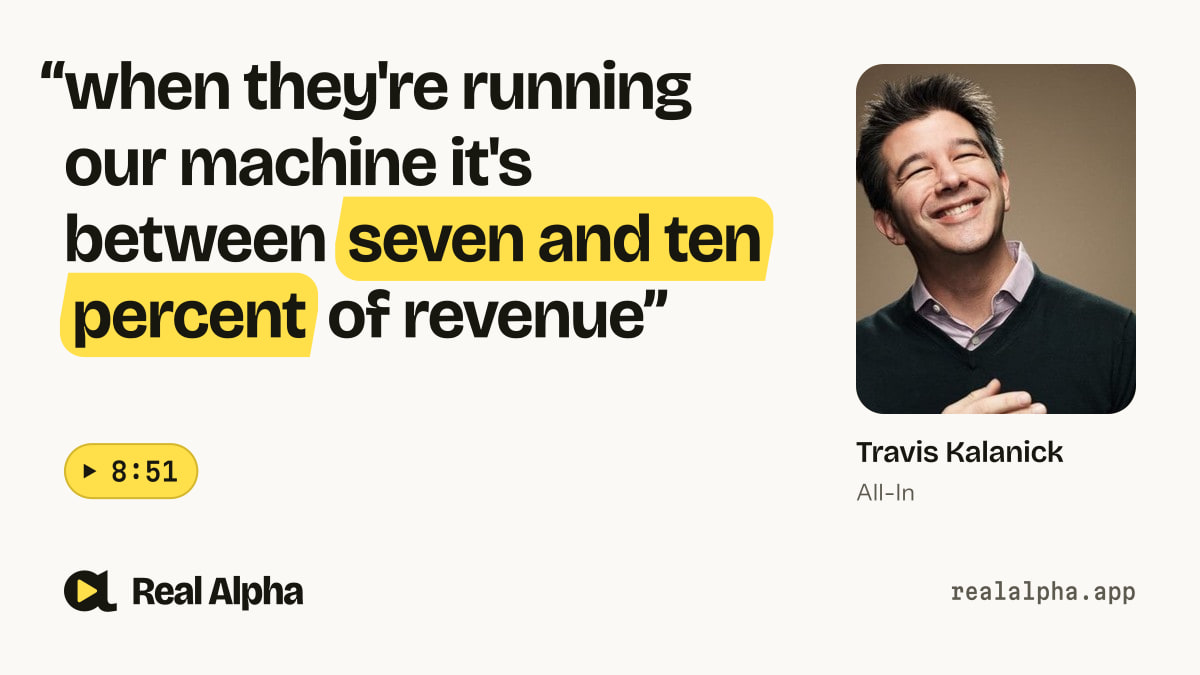
“when they're running our machine it's between seven and ten percent of revenue”
 Travis Kalanickat 8:51 · All-In
Takeaways Pro pick
- The machine assembles up to 300 bowls an hour.
- Labor falls from about 30% of revenue to 7–10%.
- Automated kitchens could expand delivery without replacing restaurants.
One of Pro's picks, open to you here. Try Pro free for 7 days
One of Pro's picks. The rest of the summary and the 3 takeaways are in Real Alpha Pro; the video, the quote and the transcript stay free.
Read it with Pro, 7 days freeAbout this segment
Travis Kalanick explains how automated kitchens assemble meals and reduce labor costs. The approach depends on automating the full workflow, not just installing a machine.

CEO, Atoms
Built Uber and now leads Atoms, applying industrial AI and specialized robotics to automate food, mining and transport.

Chamath Palihapitiya, Host · Founder & CEO, Social Capital
Led Facebook's growth team; his firm backed Slack and AI chipmaker Groq.

Jason Calacanis, Host · Founder & CEO, LAUNCH
Early Uber angel; sold Weblogs Inc. to AOL; hosts This Week in Startups.

David Friedberg, Host · CEO, Ohalo
Founded The Climate Corporation, sold to Monsanto for about $1.1B in 2013.
From “Grok 4 Wows, The Bitter Lesson, Third Party, AI Browsers, SCOTUS backs POTUS on RIFs”, Jul 11, 2025. Watch the full episode
Thanks. We'll look at and fix what's off.
Transcript
Transcribed by machine (Whisper) from the episode’s audio, so a word may be off here and there.
- 6:41
it's a 60 square foot machine like uh imagine running like a sweet green like brand or a chipotle like brand i'm just making it so it comes to life for people who who you know are like hey what is this thing imagine you just order online exactly the kind of bowl you want and actually this machine could run like many brands at the same time and then does you build the bowl you want whatever ingredients uh it's sort of if you look at that bottom you see those little white bricks at the bottom that's what carries the bowl underneath dispensers it fills up the machine puts a it sauces the the bulb and it puts a lid on it it takes the bowl puts it in a bag uh puts utensils in the bag seals the bag and the bag goes down a conveyor belt where then another machine what we would call an agv takes the bowl to the front of house the bowl
- 7:35
gets put into a locker the courier via door dash who breeds courier will wave their app in front of a camera and it will open up the locker that has the food that they're supposed to pick up so it just it takes out a lot of what we would call the the cost of assembly um which is more reduces mistakes right it's hard to make a mistake yeah we know exactly how many grams of every ingredient or put in that's exactly what you're supposed to get and so you get a higher quality product it takes a lot of the cost out you imagine ultimately that's going to be they're going to be couriers with that as well that you know i like to say autonomous burritos like is a waymo going to carry a burrito or is tesla going to have a a machine that carries food or you know is there another another company that ends up doing you know sort of the the things that the the autonomous
- 8:29
delivery of things and the point is is well where we are right now is we've got customers and so those customers are starting to deploy this quarter and it's pretty interesting i mean you can see that in our delivery kitchens the cost of labor is about 30 of revenue that's what the successful guy let's say 30 35 of revenue in a in a brick and mortar in a brick and mortar restaurants it's even higher okay when they're running our machine it's between seven and ten percent of revenue right amazing then you take out the cost of the delivery you know and now it's becoming everybody can have a private chef which was your original vision for uber it was people don't know the original tagline but it was your your private everybody has a private driver everyone's private driver was the original for uber basically the infrastructure is already there
- 9:21
And I said this on, you know, one of your recent, I think it was at the all in summit, Jason, but like, um, in the mobility cars, you know, I'm transport, uh, space, the roads were already there. The cars were already built. People weren't using their cars 98% of the day. So the infrastructure is already there to get people around, to do this as a service and do it very efficiently and conveniently with food.
- 9:51
The infrastructure is not there. Like, yes, restaurants have excess capacity. That's what Uber Eats utilizes. But to go and say, like, let's make 30% of all meals in a city sort of prepared and delivered by a service, the infrastructure is not there. So you have to build it. So our company, the mission is infrastructure for better food. so that's real estate that's software and robotics for the production and delivery of food in a super efficient way all right uh keith what are your thoughts any questions well he's not here but isn't this what david freeberg tried to do a few years ago yeah this came up on the last all in yeah there's the last one i was at yeah yeah it's up it's so the problem was i told freeberg people don't want to eat quinoa you gotta put a little steak in there maybe a piece
- 10:43
salmon but he was kind of really i think eventually he relented and let people have a little bit of protein uh but yeah so it's such a great vision wait he he died as a vegan martyr i think the business died as a vegan martyr well there's a lot of people have died on that hill but the bottom line is if you're going to get into automation you have to it has to be end-to-end automation what i mean by that is like there are pizza there are pizza companies that have come and gone automated pizza companies where it's like we have a pizza machine and everybody's like yeah this is amazing and you have a guy you have a million dollar pizza machine and then on the left you have a guy feeding ingredients into the pizza machine and on the right you have a guy taking the pizza out and then putting it in a box and doing all this so instead of one guy making
- 11:31
pizzas i have a million dollar machine and two guys making pizza and so when you look at these like a robotic food production machines or food assembly machines. You have to look at the full stack and say, does it work with the ecosystem that exists in a restaurant? And does it go full stack from, you know, like, like, we have this thing where that machine we saw earlier. The staff preps the food, they put the food in the machine, and then they leave.
- 12:05
They're gone. This restaurant runs itself for many hours without anybody there. But this could be McDonald's, Burger King, and Taco Bell. Nobody would know. That right there, that machine is an assembly machine, right? The food is prepped by humans and then assembled by this machine. for a chipotle or a sweet green this is like a a majority of their labor right you go up to a chipotle there's like 10 guys at lunch and you're still in line that machine right there does 300 bowls an hour right and so you go okay that's the this is what's called um like the assembly line it's just that front line where you basically assemble things i think sometimes i will call the make line what will happen over time is you'll have perpendicular lines going into it where you're producing food right so you'll have a production or make line going into an assembly
- 13:02
line here and then you go oh wow so you have something that dispenses burgers on buns that's the dispenser that's the assembly right but it's like factorial on steroids basically yeah and then And it's like, how do you cook that burger? That's what I call, that's what we call state change. So state change is the cooking of the food. Assembly is the like, how do I put it together and plate it? Doesn't this collapse?
- 13:30
Like, for example, if you have a yield of 300 per hour, you said, out of that one machine. Yes. Very quickly, you can impute the value of having a smaller footprint store with five of these things in a faceless warehouse with drone delivery or cars, you don't need the physical infrastructure. So then don't you create a wasteland of real estate? Or how do you repurpose all the real estate? Well, the way to think about it is like 90%. Well, it's probably a little lower than that right now. Let's say 85% of all meals in the US are at home. They just are. And a vast majority of those meals are cooked at home. So, you know, like Uber Eats and DoorDash, they represent like 1.8% or 2% of all meals right now. It's very tiny, right? So what you're doing is you're using real estate and infrastructure to prepare and deliver meals to people at their
- 14:28
homes. And so it's not... Restaurants still exist. We're still going to want to go to restaurants. We're still going to want to go outside. We learned that during COVID. We knew it before. We definitely know it after. And so I don't, it's not really like a decimating real estate situation. It's taking a thing we used to do for ourselves and creating a service that does it higher quality.