The alpha, twice a week
That was 3 min.
Get the best new moments in your inbox every Wednesday and Saturday. It's free.
Check your inbox
We sent a link to your address. Click it to finish signing up. Not there in a minute? Look in spam.
or
All-In · 3 min · Jul 23, 2025
Forced EHR adoption halved clinician productivity
 Shyam Sankar
 says top-down AI adoption misses the worker agency that drives useful applications.
In this episode
Full analysis- 22:59AI lets new workers run factories after 30 days of training5 min
- 57:01AI assistants can cut industrial training from years to monthsPro pick 3 min
- 1:17:59The SBA is opening AI financing to small businessesPro pick 5 min
- 40:57Robots can unlock power by finding lost plant capacity3 min
- 53:12Forced EHR adoption halved clinician productivity3 min
- 31:22Energy costs and proprietary data shape Hadrian's factory model3 min
- 1:31:09SBA equity structures could give taxpayers upside3 min
- 1:08:41Open models preserve choice as AI labs concentrate3 min
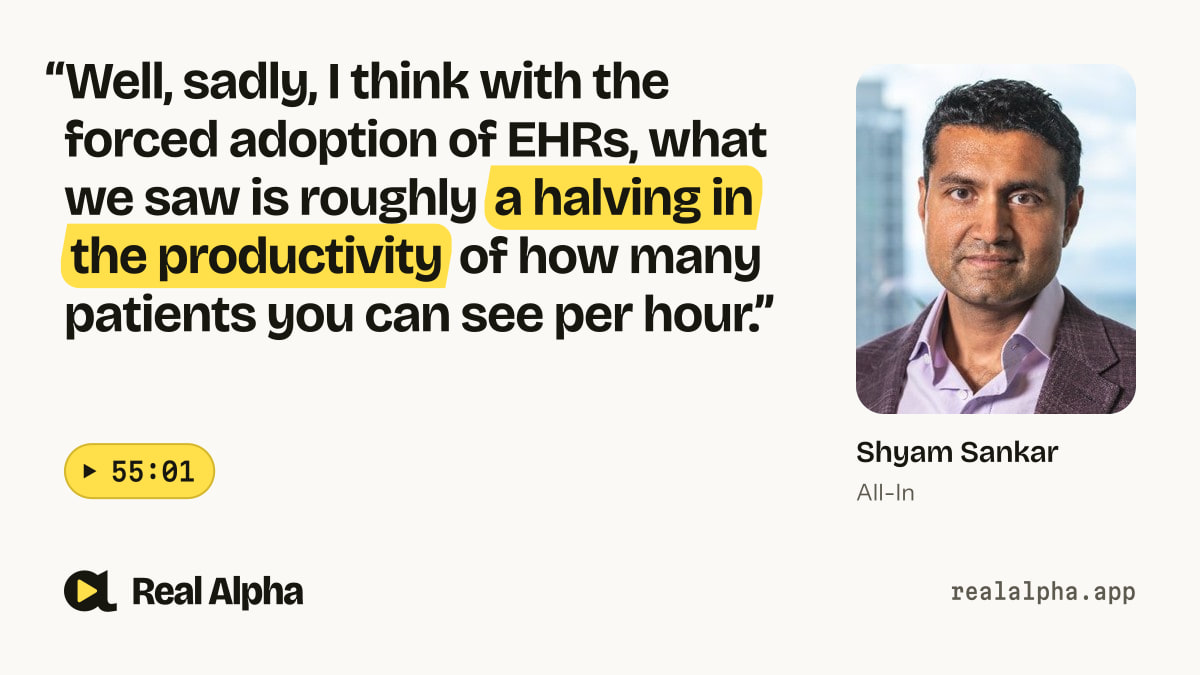
“Well, sadly, I think with the forced adoption of EHRs, what we saw is roughly a halving in the productivity of how many patients you can see per hour.”
 Shyam Sankarat 55:01 · All-In
Takeaways
- Give frontline workers room to surface applications themselves.
- EHR adoption roughly halved patients seen per hour, Sankar says.
- Specialized models can improve outcomes beyond general models.
About this segment
Shyam Sankar says top-down AI adoption misses the worker agency that drives useful applications. He also says forced EHR adoption roughly halved patient throughput, underscoring the stakes of workflow design.

Chief technology officer & executive vice president, Palantir
Runs Palantir's technology as CTO, having joined as employee 13 and pioneered the forward-deployed engineering model.

Chamath Palihapitiya, Host · Founder & CEO, Social Capital
Led Facebook's growth team; his firm backed Slack and AI chipmaker Groq.

Jason Calacanis, Host · Founder & CEO, LAUNCH
Early Uber angel; sold Weblogs Inc. to AOL; hosts This Week in Startups.

David Sacks, Host · Co-founder & partner, Craft Ventures
PayPal's first COO, founded Yammer; White House AI & crypto czar 2025–26.

David Friedberg, Host · CEO, Ohalo
Founded The Climate Corporation, sold to Monsanto for about $1.1B in 2013.
From “Winning the AI Race Part 1: Michael Kratsios, Kelly Loeffler, Shyam Sankar, Chris Power”, Jul 23, 2025. Watch the full episode
Thanks. We'll look at and fix what's off.
Transcript
Transcribed by machine (Whisper) from the episode’s audio, so a word may be off here and there.
- 53:20
What is it about a particular industry or use case that makes it an early adopter versus mid versus late that you're seeing? Because now that you're touching all these different industries, you probably have a good point of view on this. Yeah, my take is actually a different dimension of slicing that, which is where does the institution liberate their worker to drive the adoption versus where are they trying to force fit some sort of solution top down?
- 53:44
You know, AI is a method of unleashing the agency of the worker, the creativity of the individual, and they're the ones coming up with these use cases. I mean, Chris was talking about it from Hadrian, where you'd be surprised at how people with deep mechanical intuition, traditionally considered blue-collar workers, are the ones who are able to pick up the skills, build the applications, innovate on their own processes, and have that spread through the organization.
- 54:08
And are you seeing that you have to build vertical tools or generalized tools for some horizontal kind of set of users somewhere in the organization? Well, I think that the opportunity with AI is really that you can unleash what's different about your business than all the others. So there's a degree to which you can have generalized solutions. But there's a lot of alpha to be captured by understanding what's unique about how we do things.
- 54:32
How do we lever up human taste? Everyone is afraid of AI replacing the human. That's not what I'm seeing. I'm seeing it make the most, the person with the greatest taste more valuable and an ability to spread that to the breadth of the organization. Let's talk about something beyond taste, which is also like knowledge and skill. And tell us about AI inside of healthcare. I think that a lot of people probably think that we have an incredibly cutting edge system of tools and software that helps doctors and nurses actually provision great care.
- 55:06
What's the actual reality that you guys are seeing? Well, sadly, I think with the forced adoption of EHRs, what we saw is roughly a halving in the productivity of how many patients you can see per hour. A halving. A halving, yes. So we became half as productive. And we really need to, you know, the opportunity is to work backwards from what is the care that needs to be delivered? How do we build the tools around that?
- 55:28
How do we help the nurses, the care staff spend more time with the patients and less time with the computer? And do you guys see a world where, in order to facilitate that end market versus a different end market, you have an ensemble of many, many, many different techniques and approaches in AI, or do you think it all sort of gets form-fit into this one trillion parameter, huge, ginormous thing that kind of tries to do everything?
- 55:53
I think the cardinality of agents and models is very high. I think there will always be alpha to be achieved, you know, improved differentiation. improved outcomes by specializing to the use case. Now, it's great to start with the general models, but you will specialize over time. Do you feel pressure to do that now, or do you think