The alpha, twice a week
That was 3 min.
Get the best new moments in your inbox every Wednesday and Saturday. It's free.
Check your inbox
We sent a link to your address. Click it to finish signing up. Not there in a minute? Look in spam.
or
TBPN · 3 min · May 8, 2026
Founder mode starts by fixing one corner of the company
 Brian Chesky
 explains how he coached small teams by working directly with them and reviewing their work.
The episode’s best minutes
Full analysis- 3:26Founder mode starts by fixing one corner of the companyPro pick 3 min
- 7:04Travel needs a richer interface than a text chatbot2 min
- 18:00Consumer AI needs product thinkers, not just AI researchersPro pick 3 min
- 4 more moments in the full episode
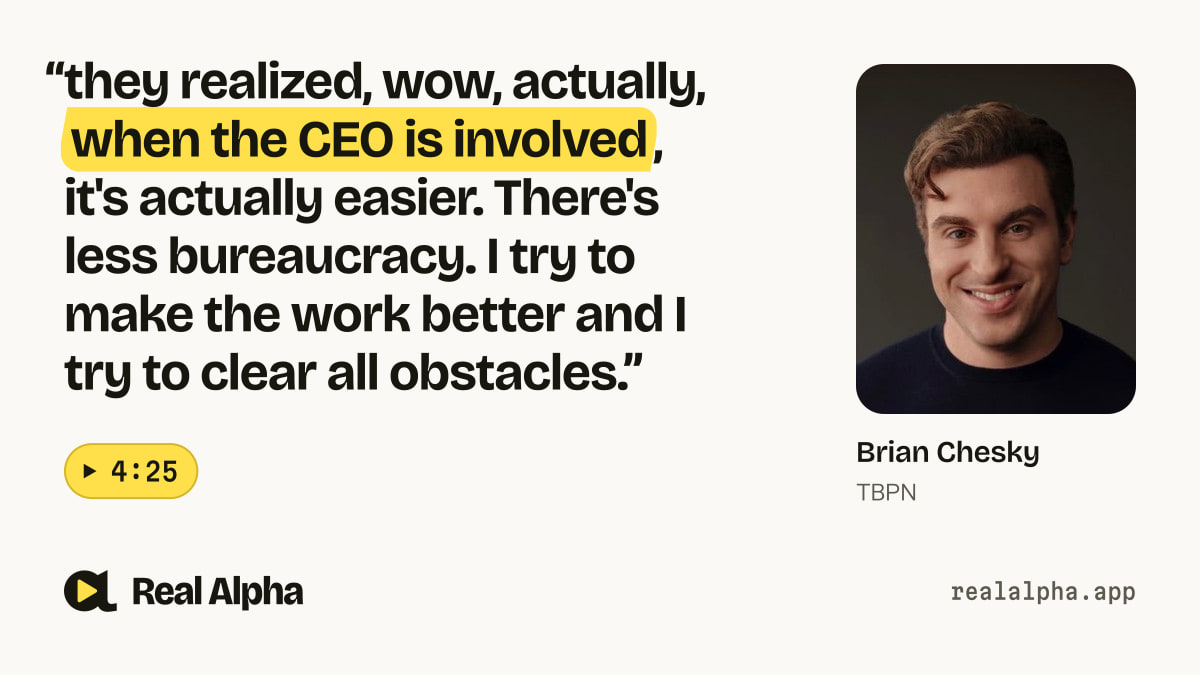
“they realized, wow, actually, when the CEO is involved, it's actually easier. There's less bureaucracy. I try to make the work better and I try to clear all obstacles.”
 Brian Cheskyat 4:25 · TBPN
Takeaways Pro pick
- Improve one team or service area before scaling the approach.
- Regular reviews help teach pace and quality standards.
- CEO involvement can reduce bureaucracy and clear obstacles.
One of Pro's picks, open to you here. Try Pro free for 7 days
One of Pro's picks. The rest of the summary and the 3 takeaways are in Real Alpha Pro; the video, the quote and the transcript stay free.
Read it with Pro, 7 days freeAbout this segment
Brian Chesky explains how he coached small teams by working directly with them and reviewing their work. The approach built intensity and shared habits without overhauling the whole company.

Brian Chesky is CEO of Airbnb.
Built Airbnb from its first hosted stays into a global community with over five million hosts.

John Coogan, Host · Co-host, TBPN
Co-founded Soylent and Lucy; OpenAI bought his show TBPN in April 2026.

Jordi Hays, Host · Co-host, TBPN
Founded Branded Native; co-founded fintech Capital, which Rho bought.
From “Airbnb CEO on Why AI Will Create a New Era of Consumer Products”, May 8, 2026. Watch the full episode
Thanks. We'll look at and fix what's off.
Transcript
From the transcript TBPN publishes with the episode.
- 3:29
Yeah. So it's a great thing. I mean, really, what I'm talking about has played out over, like, really five years. Yeah. And the term founder mode, what it really meant that Paul Graham wrote was about me like skipping layovers of management and going into the details with teams. And instead of trying I mean, here's my advice. If you're a CEO or a leader of a company that's big Mhmm. Don't try to change the whole company. Try to change a corner of the company. It's kinda like don't renovate the whole house. Pick like one room and make it perfect and then go room to room. Sure.
- 3:55
So I really told teams like, hey, like, I actually I actually didn't replace the team. I took the team that was already working. I like handpicked some people on the team, but I really just taught them the pace. And I would review work very regularly. So I'd sometimes review the work weekly or even daily Mhmm. To just teach them a level of intensity, a level of perfection. And it was unfamiliar and uncomfortable. And I will tell you that not everyone liked it and some people didn't stick around the company because they didn't like that way of working, but those who stuck around and the vast majority did, they realized, wow, actually, when the CEO is involved, it's actually easier. There's less bureaucracy. I try to make the work better and I try to clear all obstacles.
- 4:36
And so I basically did that group by group. And the great thing is, like, I was in massive number of details reviewing everything for years. But eventually, it's like muscle memory. It's like, I don't know, an instructor or a coach. You have to teach them, but once they learn that and they have the muscle memory like a golf swing, you can step back and now it's muscle memory. So now I don't have to be in all these details, all these teams. But I would just say a couple things to people listening. Like, leadership is presence, not absence. I think a generation of management's consulting or management school, management teaching taught us that CEOs should trust their people and get out of the way. And I don't think trust and get out of the way are the same thing.
- 5:16
Again, I think leadership is presence. And if you if you you should actually be partnering with your people. You should be on the field with them. If you're a if you're a cavalry general, you should be on a horse. You should be on the battlefield. You're not like you're not overseas somewhere else just Yeah. Writing out blueprints. You got to be on the field with them and you got to be leading from example. I think leadership from the front not from the back. And so these are just some of the things we do. And I think AI is going to create like the equivalent of an AI founder mode, which is now you have to be even more hands on.
- 5:44
And I don't think in the era of AI there should be any pure people managers because you're so close to the details, to the data that everyone has the opportunity to be hands on. And it's hard to imagine only managing people and not agents. I think this hands on approach is for everyone inside of a company.