The alpha, twice a week
That was 4 min.
Get the best new moments in your inbox every Wednesday and Saturday. It's free.
Check your inbox
We sent a link to your address. Click it to finish signing up. Not there in a minute? Look in spam.
or
Decoder · 4 min · Oct 29, 2026
Frontier models can matter most in competitive work
 Joey Brookhart
 argues that some fields need the strongest available models, especially when work is adversarial or high stakes.
The episode’s best minutes
Full analysis- 8:33Inference efficiency is funding frontier model trainingPro pick 4 min
- 12:22Frontier models can matter most in competitive work4 min
- One more moment in the full episode
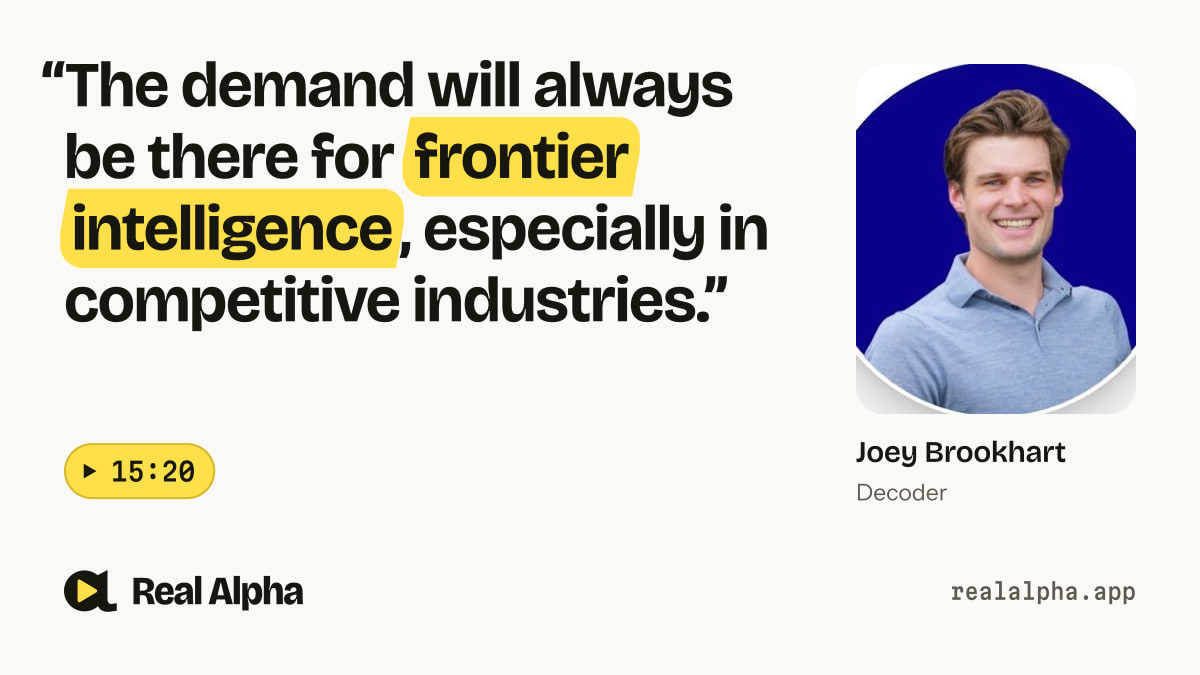
“The demand will always be there for frontier intelligence, especially in competitive industries.”
 Joey Brookhartat 15:20 · Decoder
Takeaways
- Cybersecurity can require frontier models to defend against frontier models.
- Labor replacement may justify spending on the strongest models.
- Anthropic is testing products for legal, finance, and cyber work.
About this segment
Joey Brookhart argues that some fields need the strongest available models, especially when work is adversarial or high stakes. He says frontier labs are also building vertical products while cheaper models handle simpler tasks.

Joey Brookhart is an analyst at SemiAnalysis and co-lead of its Tokenomics Model.
Co-leads SemiAnalysis’s Tokenomics Model, linking AI hardware inputs to software outputs and modeling AI-serving economics.

Nilay Patel, Host · Editor-in-chief, The Verge
Helped start The Verge in 2011 and has hosted Decoder since 2020.
From “Inside Anthropic’s trillion-dollar AI gamble”, Oct 29, 2026. Watch the full episode
Answers “Will AI make cyberattacks worse?” See all 70 answers
Thanks. We'll look at and fix what's off.
Transcript
Transcribed by machine (Whisper) from the episode’s audio, so a word may be off here and there.
- 12:35
There's a point of model capability that would allow you to go into more verticals than just coding, right? We might be at it now, right? The idea of capability overhang exists. The idea that the models we have today could go and take over bio research. They're taking over mathematics today. Like there's a point at which the smartest business decision is to stop training and to just sell your profitable model into more and more companies.
- 13:00
And Anthropik as a public company will face that pressure. Do you think they're organized or structured to fend it off? Yeah, I think they're structured well. I think with some like the voting stock in areas like that, they definitely are. We've seen this in tech before and even like publicly when Zuckerberg has made these decisions before to invest heavily. I just want to point out, it didn't always pay off.
- 13:21
Yeah, it did not always pay off. Although you and I technically are in the metaverse right now. Yeah. By some definition. Right. But I think that's something and there's an interesting, you know, number in the S1 that 80 percent of revenue in the last six or last three months comes from models released in the last six months. So then you say, OK, 20 percent of the models are like Opus, you know, 4.5 in earlier versions.
- 13:45
I think one thing going forward is you always need to be if you're a frontier model company, you always need to be at the frontier. Wait, can I ask a really dumb question about that? Yeah. Why? Why? Like this is, I think, the heart of my sort of curiosity about the industry right now is if you enabled some bleeding edge technology that could revolutionize the entire world, at some point, the most profitable thing to do is to just go play it out in all the different verticals, right?
- 14:13
it is not to go make the next one. And it's actually run an efficient model in legal services and medicine and wherever else that there hasn't been diffusion of AI yet. And so this idea that you always have to be at the frontier, that Anthropic always has to be competing with Google and OpenAI and whoever else. I get it right from their self-conception. But from a business point of view, an AI-enabled business is going to throw off more money and spend more money with me, the AI provider. And that isn't necessarily related to being at the frontier.
- 14:44
Yeah. I think there's a few portions of that. You know, four new verticals, and this is like very cyber specific. If an adversary is using a frontier model, you need to be defending with a frontier model. You know, things like, you know, when we talk to like some enterprises, you know, it's not like email summary where I can run that on open source or Sonnet. Like there are just certain verticals we're having, you know, I mean, if you were in In a legal case, as a defendant, would you want your lawyer using a non-frontier model if the prosecution was hitting?
- 15:13
Oh, I got bad news for you about what's going on in the legal market right now. Yeah. So, you know, there are certain areas, yes, that are more, you know, the competitive dynamics do dictate that. And I think from a go-forward perspective, we've seen this with like open source too catching up. The demand will be there. I think Dylan says this a lot. The demand will always be there for frontier intelligence, especially in competitive industries.
- 15:36
And there are certain tasks, I think, as you go towards more labor replacement versus labor augmentation, where that also is the case. At the same time, they are getting more vertical. If you go look at job postings or what they're hiring for, putting out more of these SKUs in areas. And there's a lot of beta testing going on, like Claude for Financial Services, Claude for Legal. Their cyber program, they're giving away 250 or sorry, 25K of credits per month for people in their cyber program.
- 16:03
So that'll be a huge skew for them in 27. Those verticalized areas and then ones that are specifically where you need to be, you know, it's more adversarial, I should say, or competitive are kind of the main reasons why. But I think we can both agree there's areas like email summary and, you know, work that definitely doesn't need to happen.