The alpha, twice a week
That was 3 min.
Get the best new moments in your inbox every Wednesday and Saturday. It's free.
Check your inbox
We sent a link to your address. Click it to finish signing up. Not there in a minute? Look in spam.
or
Grit · 3 min · Oct 13, 2025
Gamma built its values by observing how the team worked
 Grant Lee
 describes recording the behaviors teammates praised before turning them into company values.
The episode’s best minutes
Full analysis- 41:58Gamma found product-market fit after rebuilding creation with AI4 min
- 35:05Gamma built its values by observing how the team workedPro pick 3 min
- 58:04Taking too much funding can create pressure to spend it5 min
- 5 more moments in the full episode
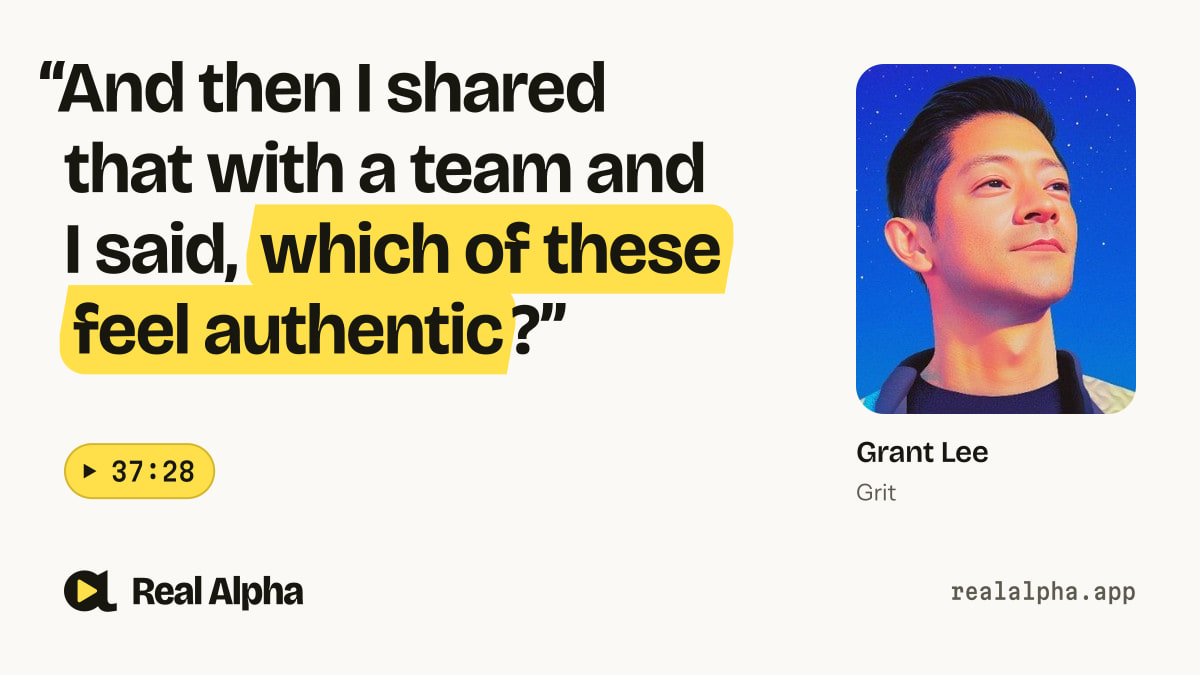
“And then I shared that with a team and I said, which of these feel authentic?”
 Grant Leeat 37:28 · Grit
Takeaways Pro pick
- Observe real behaviors before writing company values.
- Ask the team which values feel authentic.
- Revisit the culture deck as the company grows.
One of Pro's picks, open to you here. Try Pro free for 7 days
One of Pro's picks. The rest of the summary and the 3 takeaways are in Real Alpha Pro; the video, the quote and the transcript stay free.
Read it with Pro, 7 days freeAbout this segment
Grant Lee describes recording the behaviors teammates praised before turning them into company values. The team then refined a living culture deck together, rather than starting with abstract principles.

Grant Lee is cofounder and CEO of Gamma.
Built Gamma, an AI presentation and website tool serving 50 million customers; formerly COO of ClearBrain.

Joubin Mirzadegan, Host · Partner, Kleiner Perkins
Took Palo Alto Networks' cloud business from $2M to $50M+ ARR in a year.
From “From Idea To Impact: How Gamma Is Redefining Presentations | Grant Lee”, Oct 13, 2025. Watch the full episode
Thanks. We'll look at and fix what's off.
Transcript
Transcribed by machine (Whisper) from the episode’s audio, so a word may be off here and there.
- 35:08
Yeah. A lot of my questions, I'm incubating a company here at KP and we're going through a lot of these core questions. And one of the things that I think I got wrong was I had multiple pages of values that were core to me, okay, that I thought were very important in whatever I did next. If I ever wanted to operate again, whatever that would look like, what would that mean? Yeah. Okay. And very quickly, what I realized was like me, two co-founders, founding engineer, you sit in a room together for seven days a week.
- 35:45
Yep. And I realized like, oh, like, I don't actually think any of those things matter. And the reason for that is because it is just how you behave that defines what it is. 100%. And to your point of like defining what it is before you move on to the next thing, defining what it is is like, how do you all behave together? Like what is that core behavioral cohesiveness that then is like, okay, we want people that are whatever, high slope and low ego, for example, because that's how we feel like we are.
- 36:18
And so it's so hard to like pre-define any of these things because so much of the company that you build is the people that you hire. And so much of the values that you try and imbue are through those people, like through how you actually act every day. And then you can decide what those things are. And this is what we did. I mean, so we didn't come in with predefined values. What we did was, you know, the first seven of us and eventually 12, you know, we're in Slack a lot.
- 36:50
People, there's like a shout out channel. And so like anytime like someone does something amazing, you know, they can give someone else a shout out on the team. And then what I would do is I'd start just writing down what people were praising other people for. Like, what are the things I'm like, oh, this is, you did an awesome job. This is exactly what you did. And I observed people's behaviors in general. Like, what is something that, you know, Jess as an engineer, like, what did she do that was special that I'd be like, oh, if I could have another Jess, this is, this would be great. Right. I'd write that down. And then I had this sort of notebook of all the things that people did, all the behaviors that people did. And I started crafting our culture deck and I turned.
- 37:30
all those behaviors and a set of values. And then I shared that with a team and I said, which of these feel authentic? And we continue to iterate on that together. And that formed the first version of the culture deck. The culture deck is a living deck. Every time we have a new batch of new hires, I go through it. We ask questions about like, what are things we appreciate about, you know, how we operate and I edit it. And so like once a year, at least, if not more often, we're going in and we're revising it, we're adding to it. And that's the way we try to like stay true to a living thing that to your point is actually the people we hire. Hopefully the foundation is solid so that you're not like constantly rewriting the whole thing. Right.
- 38:10
But that first set is really observing the people around the room and trying to articulate what are the values they bring to the table. I think it's really well said. And you waited to do that deck