The alpha, twice a week
That was 4 min.
Get the best new moments in your inbox every Wednesday and Saturday. It's free.
Check your inbox
We sent a link to your address. Click it to finish signing up. Not there in a minute? Look in spam.
or
Grit · 4 min · Oct 13, 2025
Gamma found product-market fit after rebuilding creation with AI
 Grant Lee
After signups plateaued, Gamma rebuilt its creation flow around AI and saw daily signups soar through word of mouth.
The episode’s best minutes
Full analysis- 41:58Gamma found product-market fit after rebuilding creation with AI4 min
- 35:05Gamma built its values by observing how the team workedPro pick 3 min
- 58:04Taking too much funding can create pressure to spend it5 min
- 5 more moments in the full episode
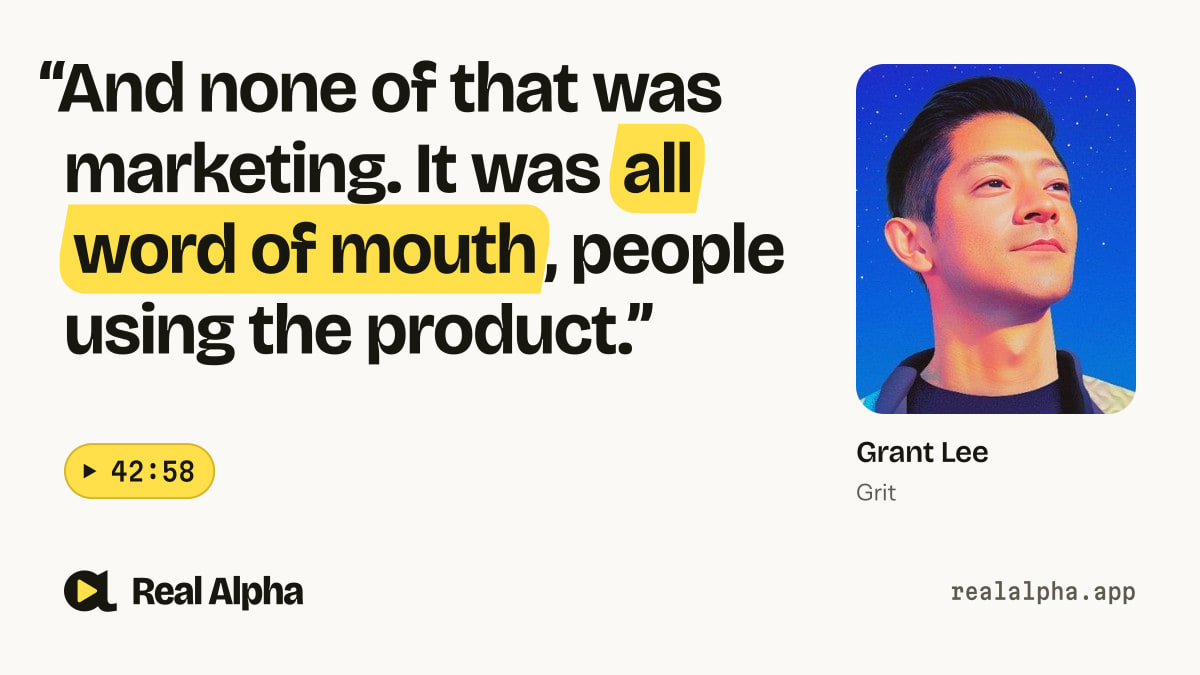
“And none of that was marketing. It was all word of mouth, people using the product.”
 Grant Leeat 42:58 · Grit
Takeaways
- A popular launch is not proof of product-market fit without word of mouth.
- AI reshaped Gamma’s creation flow after two years of building foundations.
- The team kept its launch date despite uncertainty over access to its money.
About this segment
After signups plateaued, Gamma rebuilt its creation flow around AI and saw daily signups soar through word of mouth. The launch landed during the SVB crisis, forcing the team to choose whether to stay the course.

Grant Lee is cofounder and CEO of Gamma.
Built Gamma, an AI presentation and website tool serving 50 million customers; formerly COO of ClearBrain.

Joubin Mirzadegan, Host · Partner, Kleiner Perkins
Took Palo Alto Networks' cloud business from $2M to $50M+ ARR in a year.
From “From Idea To Impact: How Gamma Is Redefining Presentations | Grant Lee”, Oct 13, 2025. Watch the full episode
Answers “Is AI paying off for companies?” See all 116 answers
Thanks. We'll look at and fix what's off.
Transcript
Transcribed by machine (Whisper) from the episode’s audio, so a word may be off here and there.
- 42:01
And then the new signups start plateauing or they start going down. And it's like, okay, you're still getting new signups, but you have not earned word of mouth. People are not telling other people. You do not have organic virality. So you can keep on getting new startups, So you're never going to have sort of exponential growth, right? And so at that point, we knew, okay, there's some interesting building blocks here that we've done, but is this standalone?
- 42:26
We are not going to succeed as a business if this is... continues to be a good case. There is no amount of incremental improvements we're going to do to turn us into a company that has product market fit. That's the moment where we went, let's go back to the drawing board, three-month sprint of engineering AI into the entire creation flow, relaunching our AI launch in March of 2023. And that's where things, that was the inflection point. All of a sudden, it took us like eight months to get to 60,000 signups. And then the day we launched, we got like 5,000 signups, then like 10,000 signups a day, then like 20,000 signups a day, then like 50,000 signups a day. And none of that was marketing. It was all word of mouth, people using the product. And that's the moment you know, okay, we have something here that can
- 43:09
just continue to grow organically without us even touching anything else. That's insane. When people go through the idea maze for a long time, there's a natural sense of skepticism that emerges because of course, like you've been trying to find product market fit for a while. Yeah. When you saw the first day of signups, were you like, man, too good to be true? Oh, totally. Yeah. I mean, the first month you're just like, oh, come on.
- 43:33
What is this? This is like, no way. And then you keep checking the dashboards, of course, every like five seconds. You're like, yeah, okay, well, maybe we're onto something. This is like, okay, yeah, this is, but yeah, you're so paranoid. You're so paranoid. Did the team stick with you? Did everybody on the team stick with you all the way through? Yeah. All the way through. That's amazing. Yeah. I mean, it really feels like, you know, within the first couple of years, we, so going back to that, even just that specific moment of time, right? Like two weeks before our AI launch, and this was, you know, this was sort of a bet the company moment. Like we, this had to succeed.
- 44:07
SVB collapse happened. All of our money, most of our money was in Silicon Valley banks. It was like, I had to call a team meeting and this is going back to like the fun part of being at the stage was we're in the two bedroom, converted two bedroom apartment. So I had to call everybody into one of the bedrooms and we're like, okay, well, you know, everyone's reading the news, SVB, you know, our money is totally at risk. And we had to decide, you know, are we going to stay heads down. We had the launch date already set like three months in advance. We're going to stick to this launch date or we're going to be like, oh, let's try to figure things out. We'll push this out a little bit. And basically we had the moment was like, okay, we're sticking to the launch date. I don't know how we're going to make payroll, but I will find a way. I don't know if
- 44:51
we're going to talk to our investors. We're going to figure something out and we're not changing the launch date. I think those are the moments where everyone can see like we are. all in this together, the level of resilience and trust you build in moments like that, you can't really manufacture. It just happens. And through that, I was just like, I'd never seen a team work harder. We got through the launch and it was just like massive feeling of this is super rewarding. We are doing something that is special. We're doing something together. And it was literally all hands on deck to make it happen. It's insane. I'm very happy for you. It's just