The alpha, twice a week
That was 3 min.
Get the best new moments in your inbox every Wednesday and Saturday. It's free.
Check your inbox
We sent a link to your address. Click it to finish signing up. Not there in a minute? Look in spam.
or
Bloomberg Intelligence · 3 min · Oct 29, 2026
Gen Z dating activity is picking up as apps add in-person events
Nicole D'Souza says 34% of surveyed Gen Z respondents were single and not dating, while 35% were single and dating.
In this episode
Full analysis- 1:31Google faces AI monetization and market-share problems4 min
- 11:16AI is pushing tech firms to consolidate around systems and supplyPro pick 3 min
- 15:42Caterpillar's AI boom brings long orders and later capacity risk3 min
- 7:35Alphabet's stock sentiment can swing with new model releases4 min
- 5:01Microsoft's lower capex partly reflects delayed projects2 min
- 19:36Gen Z dating activity is picking up as apps add in-person events3 min
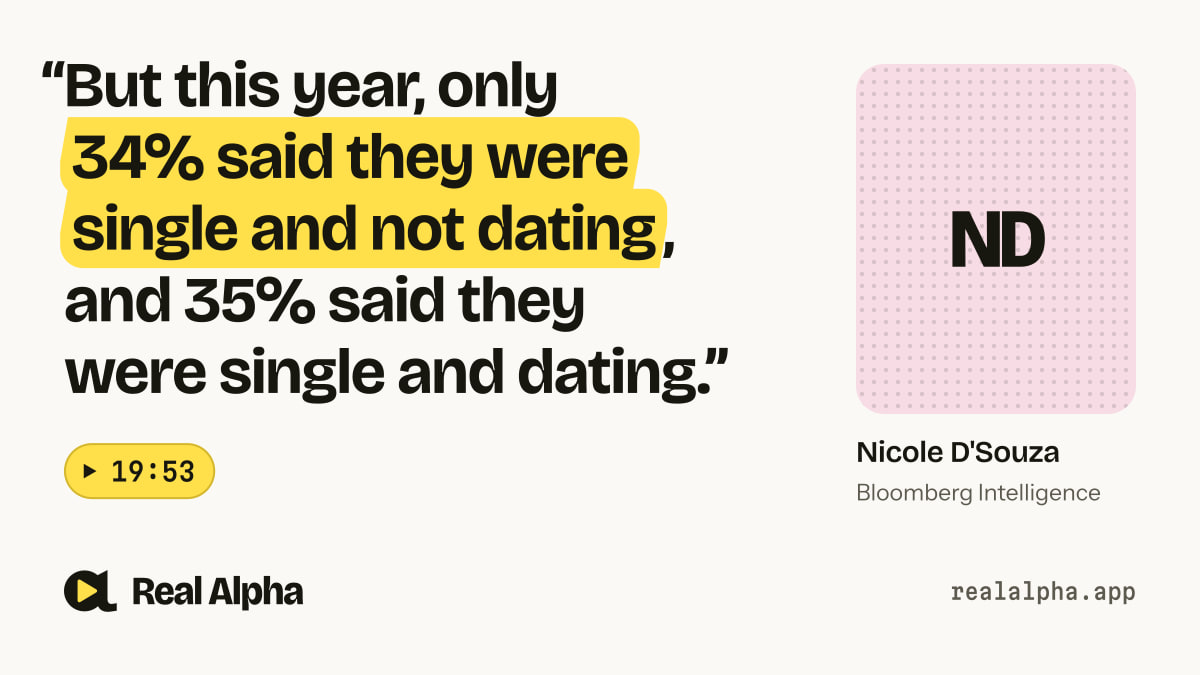
“But this year, only 34% said they were single and not dating, and 35% said they were single and dating.”
Takeaways
- 34% said they were single and not dating; 35% were single and dating.
- In-person events target Gen Z users who don't want to swipe.
- Hinge's relationship focus helps it charge a premium and grow users.
About this segment
Nicole D'Souza says 34% of surveyed Gen Z respondents were single and not dating, while 35% were single and dating. In-person events respond to users who prefer meeting offline, while Hinge benefits from its relationship focus.
Internet & Software Equity Analyst, Bloomberg Intelligence
Analyzes internet and software companies, including dating-app trends in Bloomberg Intelligence’s Gen Z survey.
- PS
Paul Sweeney, Host · Bloomberg Intelligence
- SF
Scarlet Fu, Host · Bloomberg Intelligence
From “Google Erases a Record $500 Billion as AI Eats Into Sales | Bloomberg Intelligence”, Oct 29, 2026. Watch the full episode
Thanks. We'll look at and fix what's off.
Transcript
From the transcript Bloomberg Intelligence publishes with the episode.
- 19:39
The dating survey that we did this year, the biggest difference that we've seen is that Gen Z is actually starting to date. Last year when we conducted the survey, 44 Gen Z respondents said that they were single but not dating. And that raised some concerns about the future of addressable markets for dating app platforms. But this year, only 34% said they were single and not dating, and 35% said they were single and dating. So it looks like these patterns are starting to change. Gen Z is getting out of the house. They're going on dates. So definitely a more optimistic survey this year.
- 20:13
Okay, so many follow-up questions. Gen Z also likes to go to the mall now and they're indulging in some, I guess, old school behavior. They kind of like analog things right now. So why have they started to become more open to dating apps whereas before they were kind of avoiding it?
- 20:31
So I think dating apps have released a lot of features that really appeal to Gen Z. So one of them is in real life events. So they set up events in real life where Gen Z can come, mingle, meet people, and kind of look for a future partner. And so these events were specifically created because Gen Z was not swiping. They were not interested in staying on platforms and talking to people online. They didn't like AI in their dating apps. They wanted to meet in real life.
- 20:58
I didn't know where to go. I'm sorry, we're showing our age in every way. I'm just going to ask you, you and your cohorts, what are you doing these days?
- 21:08
So right now, I would say the most popular dating app in terms of growing users is Hinge. Hinge. So Hinge has been growing users. It is seen as more of a serious relationship app. So for people who are looking maybe to settle down or engage in a long-term relationship.
- 21:26
What's the gimmick for Hinge versus the others? Hinge, I mean, I think it used to be that it was your Facebook friends, so you had kind of friends of friends in common. Now I think it's more just for people who are looking for relationships. Okay. Versus Tinder, which has always kind of historically been viewed as like a short-term connections type of app. But they're starting to kind of change that brand.
- 21:47
So.... Is this an advertising-based monetary model? Is that the economic model. For these dating apps? It's subscription. It's subscription? Yes. Okay.
- 21:56
So are these things, are they good businesses? So it's interesting. I mean, if you look at Hinge, I mean, because I think people are willing to pay for an app that will introduce you to your lifelong partner, Hinge can charge a premium and it still grows users. Whereas Tinder has struggled because people are less willing to pay for an app that's a shorter-term connection.
- 22:17
But if you meet your long-term partner, then you don't need Hinge anymore, and then you'll cancel, and then Hinge loses a customer.
- 22:24
It's interesting because, yeah, this is a conversation we have a lot with investors, which is what is the motivation for dating apps to function well as in meeting your partner and then also keeping you on the app. Correct. I think how we think about it is that the addressable market is always growing, right? People enter relationships, but they do break up. And then younger users are getting to a point where they're interested in dating and meeting a partner. So the addressable market will continue to grow, even if people meet on the app and eventually delete it.