The alpha, twice a week
That was 3 min.
Get the best new moments in your inbox every Wednesday and Saturday. It's free.
Check your inbox
We sent a link to your address. Click it to finish signing up. Not there in a minute? Look in spam.
or
Knuckle Up with Nakul · 3 min · Sep 9, 2026
Glean's edge depends on learning how enterprise work gets done
 Arvind Jain
 says connectors and permissions are only the baseline: Glean studies experts, tasks and workflows to capture how work happens.
In this episode
Full analysis- 27:54AI gives Jain strategic visibility he could not get before5 min
- 24:02AI will raise customer expectations, not shrink company teamsPro pick 4 min
- 41:51Fast innovation makes product moats feel temporaryPro pick 4 min
- 33:11Leaders at Glean must build their own priority agents4 min
- 38:16Glean tests AI fluency and uses AI to screen hiring packets2 min
- 12:33Core SaaS systems will remain, while point apps get rebuilt2 min
- 15:04Glean says its context layer cuts token use by 30 to 50 percent4 min
- 3:54Glean's edge depends on learning how enterprise work gets done3 min
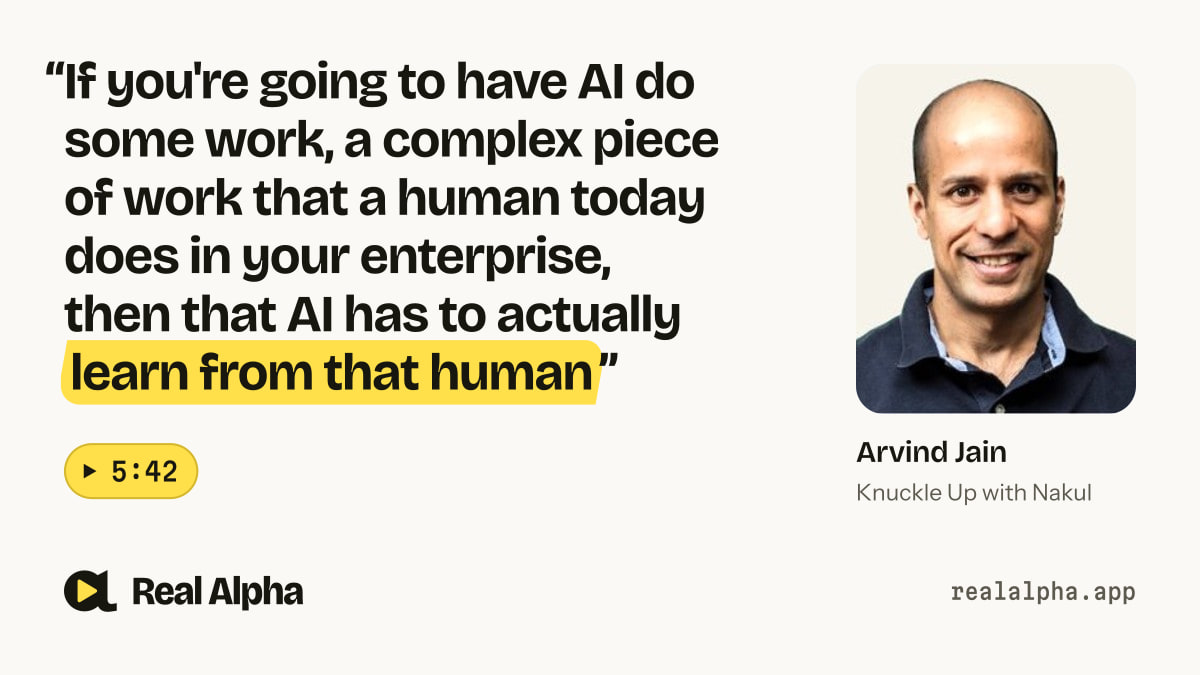
“If you're going to have AI do some work, a complex piece of work that a human today does in your enterprise, then that AI has to actually learn from that human”
 Arvind Jainat 5:42 · Knuckle Up with Nakul
Takeaways
- MCP connections alone may not capture how a business works.
- Glean maps tasks and observes experts' actual steps.
- Automation needs tacit judgment as well as documented procedures.
About this segment
Arvind Jain says connectors and permissions are only the baseline: Glean studies experts, tasks and workflows to capture how work happens. That context helps agents handle enterprise-specific work.

Arvind Jain is founder and CEO of Glean.
Founded Glean, the AI work assistant, after co-founding and leading R&D at Rubrik and a decade at Google.

Nakul Mandan, Host · Host, Knuckle Up with Nakul
General partner at Audacious Ventures; his show goes deep with founder CEOs on how they build.
From “$7B AI founder: "AI is not capable of replacing you right now" | Arvind Jain (CEO, Glean)”, Sep 9, 2026. Watch the full episode
Thanks. We'll look at and fix what's off.
Transcript
Transcribed by machine (Whisper) from the episode’s audio, so a word may be off here and there.
- 3:59
But then maybe I will also share a little bit more about where we spend our R&D resources. So the company now is about 1,500 employees. That makes us one of the largest pure-play enterprise AI companies in the world. But we are actually not spending a lot of that time trying to train and build models. Glead is a multi-model product. We actually partner with the best model companies, you know, whether that's OpenAI or Enthropic or Google.
- 4:26
we actually also incorporate open source models built on NVIDIA you know technology or like you know the open source model out there you know it's really great to be in that position where we can actually leverage that innovation that you know the labs are bringing and then we get to actually build things that they're not focused on yet so that together you know with their technology plus our technology we can bring the best experience to our users so that's that's part of our core strategy so it's not just then connectors and permissions is you're saying it's much more than just building connectors with crm workday every every other system and permissioning yeah it goes well beyond that that's the basics that's the nuts and bolts like you connect with all the enterprise systems even that is actually by the way quite hard so and you should understand
- 5:13
that today the industry has taken the direction of not wanting to build those integrations we build it. But, you know, if you look at the strategy that the labs have taken, they are actually choosing this MCP-based architecture where they don't build integrations anymore. They're expecting that each individual enterprise application will put up an MCP server, which allows an AI model to interact with those systems, you know, a little bit. But that's actually quite shallow. And it doesn't actually, in that approach, you don't get to actually learn how your business works. Ultimately, like, you know, our viewpoint is this. If If you're going to have AI do some work, a complex piece of work that a human today does in your enterprise, then that AI has to actually learn from that human how they've been doing this work.
- 6:01
You know, some of it is written down in, you know, SOPs and documentation, but some of it is in their mind and they exercise, you know, that judgment every day. So you have to be able to actually bring that automation in your business. You have to actually go much deeper, much deeper than connecting with the systems and understanding what data and what knowledge is where. You have to actually understand how work actually happens.
- 6:23
And that requires you to actually even understand what work is, like what are the tasks, what are the key jobs to be done in this business. You have to observe like who are the people who actually do that work, who are experts on it. You have to observe their activity to see these are the 10 steps, you know, that this person took to complete this particular task. And these are all the observations that we built.
- 6:39
This is the context graph. And so Glean has been investing in that for many, many years. And that right now we still see as an area which is, you know, completely open. Like we're not seeing other people actually building that yet. So let me steel man the other side of the argument just for debate, right?