The alpha, twice a week
That was 3 min.
Get the best new moments in your inbox every Wednesday and Saturday. It's free.
Check your inbox
We sent a link to your address. Click it to finish signing up. Not there in a minute? Look in spam.
or
Big Technology Podcast · 3 min · Feb 18, 2026
Google expects useful quantum applications within five years
 James Manyika
 cites falling error rates and a molecule-spin calculation validated with lab data as signs of progress.
In this episode
Full analysis- 27:55AI tutoring works best when it teaches the steps6 min
- 10:39NotebookLM grew from a research tool into an audio product7 min
- 1:11DeepMind gives researchers room to explore, then doubles down7 min
- 37:27Google expects useful quantum applications within five years3 min
- 42:27Google's flood forecasts now cover 150 countries2 min
- 19:14Google still gets product ideas from outside Labs4 min
- 24:06Google moves research breakthroughs into real-world use3 min
- 44:32Google plans its first AI training runs in space by 20272 min
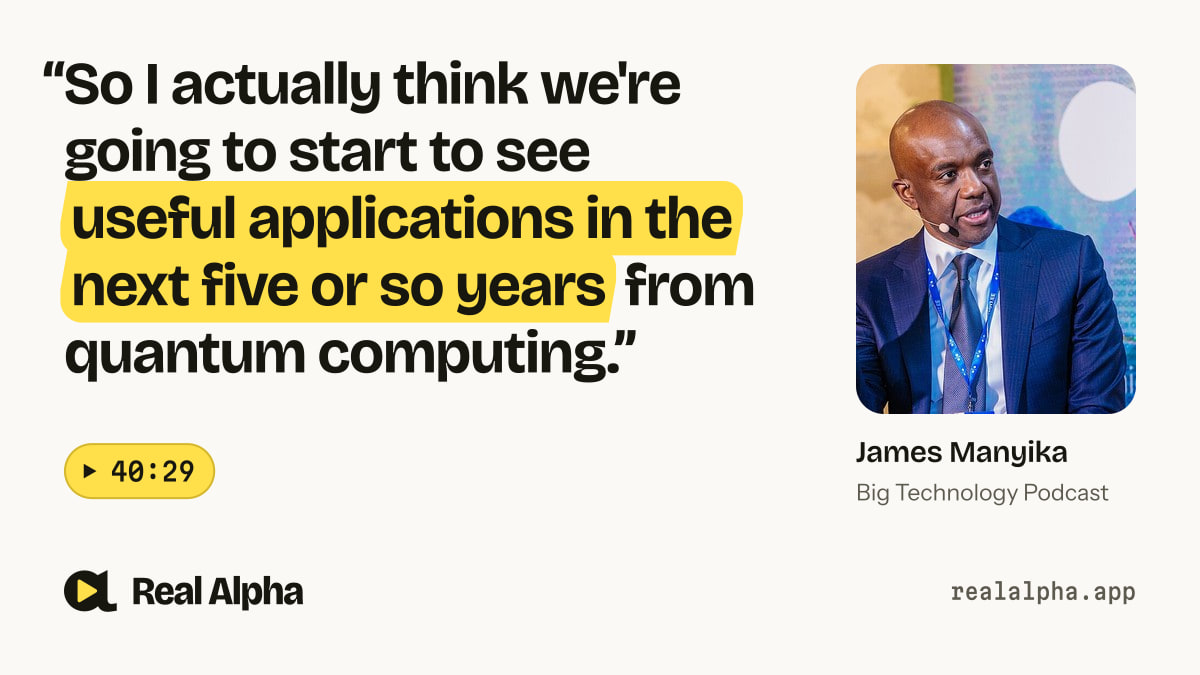
“So I actually think we're going to start to see useful applications in the next five or so years from quantum computing.”
 James Manyikaat 40:29 · Big Technology Podcast
Takeaways
- Willow showed error rates falling as the system scales.
- Quantum Echoes computed molecular spin dynamics, checked against NMR data.
- James expects useful applications in roughly five years.
About this segment
James Manyika cites falling error rates and a molecule-spin calculation validated with lab data as signs of progress. He expects useful quantum applications in about five years.

Senior Vice President for Research, Technology, and Society, Google
Leads Google and Alphabet’s efforts to responsibly shape ambitious innovations for the benefit of people and society.

Alex Kantrowitz, Host · Founder, Big Technology
Former BuzzFeed News senior tech reporter and author of Always Day One.
From “How Google DeepMind Operates & Experiments — With Lila Ibrahim and James Manyika”, Feb 18, 2026. Watch the full episode
Thanks. We'll look at and fix what's off.
Transcript
Transcribed by machine (Whisper) from the episode’s audio, so a word may be off here and there.
- 37:33
It's definitely too much to cover in a short amount of time, but I don't want to leave here without touching on them. So first to you, James, state of quantum seems like it's moving faster than a lot of people anticipate or believe. We have an incredible quantum AI team that's doing extraordinary kind of path-breaking work. And I think the headline on this is that I think quantum computing is actually making more progress than people realize.
- 37:57
Because keep in mind that the whole idea of what everybody's aiming for in quantum is how do we build a fully error-corrected quantum computer? And there's been lots of different approaches to this. I think the dominant approach that most people are taking is the superconducting qubits approach. That's what our team is doing. There are other teams in the world that are doing that. It's a very complex way of doing at it.
- 38:20
People think it's the best shot at it. But there are other mechanisms. There's neutral atoms approaches. There's a whole range of approaches. I think what the progress that's happened is as follows. The underlying chips are making incredible progress. Our Willow chip, for example, hit a big milestone. It was a big enough deal about a year and a half ago where it was able to do in a benchmark computation called RCS, which would take a classic frontier supercomputer 10 subtillion years to do.
- 38:54
And that's like, you know, one of like 25 zeros. It's a big number. It was able to do that in under five minutes. So the progress on, and also in correct errors, in a fundamentally breakthrough way. One of the things that's always been an issue with error correction, which is the other big barrier in quantum computing, is how can you reduce the error rate as you scale up and add qubits? So the real breakthrough, despite the fun, spectacular number that I told you about, The real breakthrough, which is what got us the breakthrough of the year award prize, was that for the first time, we're able to show that you can do what's called below threshold error correction, which is as you scale up the system, the error rates are actually going down, which is exactly what you'd want as opposed to that they're actually going up.
- 39:41
So that was a big deal. The other big deal was actually late last year because all these benchmarks, including the one I just told you. These are computations that are fun and great for benchmarking, but these are computations that are actually not useful for anything. But last year, we were able to show probably the first useful computation. These are quantum echoes results. It was a big enough deal made the cover of nature, which is great.
- 40:06
Our teams were excited about that. What that showed was an actual useful computation for figuring out the spin dynamics of molecules, which could not have been done any other way. and were able to validate the results with colleagues at Berkeley who actually validated the results in a lab with NMR data. So that was the first example of a useful computation. You put all that together, you realize that the progress that people had kind of decades away is actually happening much faster.
- 40:35
So I actually think we're going to start to see useful applications in the next five or so years from quantum computing. And that's pretty exciting. Definitely. We're going to spend much more time, I think, on this show thinking about that.