The alpha, twice a week
That was 4 min.
Get the best new moments in your inbox every Wednesday and Saturday. It's free.
Check your inbox
We sent a link to your address. Click it to finish signing up. Not there in a minute? Look in spam.
or
Decoder · 4 min · May 26, 2026
Google unified its AI teams to make decisions faster
 Sundar Pichai
 explains how ChatGPT prompted him to combine research teams, centralize infrastructure, and reorganize Search.
The episode’s best minutes
Full analysis- 8:31Google unified its AI teams to make decisions faster4 min
- 26:07AI anxiety reflects social change, not just product quality7 min
- 33:40Publishers are adapting as search traffic and user behavior shift5 min
- 4 more moments in the full episode
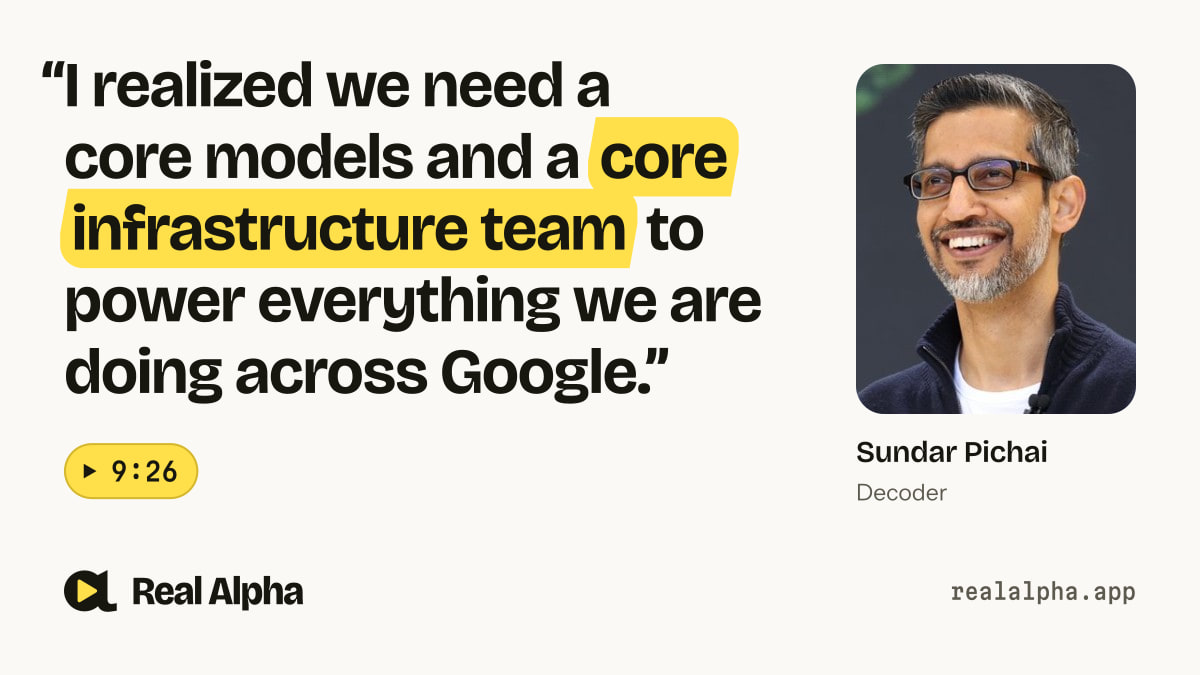
“I realized we need a core models and a core infrastructure team to power everything we are doing across Google.”
 Sundar Pichaiat 9:26 · Decoder
Takeaways
- Google DeepMind brought Brain and DeepMind together.
- A centralized AI infrastructure team supports work across Google.
- Weekly AI product reviews helped speed and guide decisions.
About this segment
Sundar Pichai explains how ChatGPT prompted him to combine research teams, centralize infrastructure, and reorganize Search. The changes were meant to help Google move faster and apply AI consistently.

Sundar Pichai is CEO of Google and Alphabet.
Helped build Google Toolbar and Chrome, then led Google from 2015 and Alphabet from 2019.

Nilay Patel, Host · Editor-in-chief, The Verge
Helped start The Verge in 2011 and has hosted Decoder since 2020.
From “How Sundar Pichai is rethinking Google for the AI era | Decoder”, May 26, 2026. Watch the full episode
Thanks. We'll look at and fix what's off.
Transcript
Transcribed by machine (Whisper) from the episode’s audio, so a word may be off here and there.
- 8:44
Could OpenAI show up and take your market share and search away? Between that and now, you have changed Google, right? You have restructured it. There are new people in leadership roles. Connect those dots for me. How did you think about, OK, I need to actually change how the company works with the competitive moment you were in that got you here? That's a great question. Look, I think for me, I always internalize that moment.
- 9:07
It was tough to convey it outside, but I was, you know, we had set the company, you know, I pivoted the company to be AI first. We had all the ingredients. So in some ways, I felt like the Overton window had changed. People were adopting these technologies faster than we had expected. And so to me, it was a way to go and actually express ourselves through our products. But I realized we had to organize ourselves for it.
- 9:37
And going back to my earlier point, I realized we need a core models and a core infrastructure team to power everything we are doing across Google. So a lot of my initial energy was to go set that up. One AI team, we had world-class research teams in brain and deep mind, bringing that together as Google DeepMind, which was harder than it sounds because it's like saying, go put Stanford and MIT together and create a department out of it or a university out of it.
- 10:10
So I think doing that well. And then at that time, I also set up with Amin Vedat, who's our SVP of AI infrastructure now, a centralized infrastructure team, which has paid great dividends. And then another evolution was realizing we need a chief AI architect to kind of architect this technology across Google. and Cori taking on that role as well. So those were important changes. We obviously made sure Search needed to move faster.
- 10:43
So Search was split across many leaders, so pulling it under Elizabeth Reed with Nick Fox being responsible for the overall area, Josh Woodward coming to... I help with our labs product and working on Gemini later, driving innovation, as well as, you know, obviously I have extraordinary leaders in the company, other leaders like Philip Schindler, who runs all our operations and so on. So it is stepping back and end-to-end thinking about the structure and make sure we are set up well for this moment where we need to move faster as a company, which meant we needed to make faster decisions.
- 11:23
I set up these new product reviews once a week. These were AI product reviews, making sure we are intentful about how we apply this technology, where we apply them, and wanted to review everything firsthand. That anything to do with AI, which we were shipping to users, went through that channel. And I spent time directly with whoever was working on it. Yeah. The other decoder question I ask everybody is about decisions. You're describing a lot of