The alpha, twice a week
That was 5 min.
Get the best new moments in your inbox every Wednesday and Saturday. It's free.
Check your inbox
We sent a link to your address. Click it to finish signing up. Not there in a minute? Look in spam.
or
Decoder · 5 min · May 26, 2026
Publishers are adapting as search traffic and user behavior shift
 Sundar Pichai
Asked about publishers preparing for zero search traffic, Sundar Pichai points to changing habits and a wider mix of information sources.
The episode’s best minutes
Full analysis- 8:31Google unified its AI teams to make decisions faster4 min
- 26:07AI anxiety reflects social change, not just product quality7 min
- 33:40Publishers are adapting as search traffic and user behavior shift5 min
- 4 more moments in the full episode
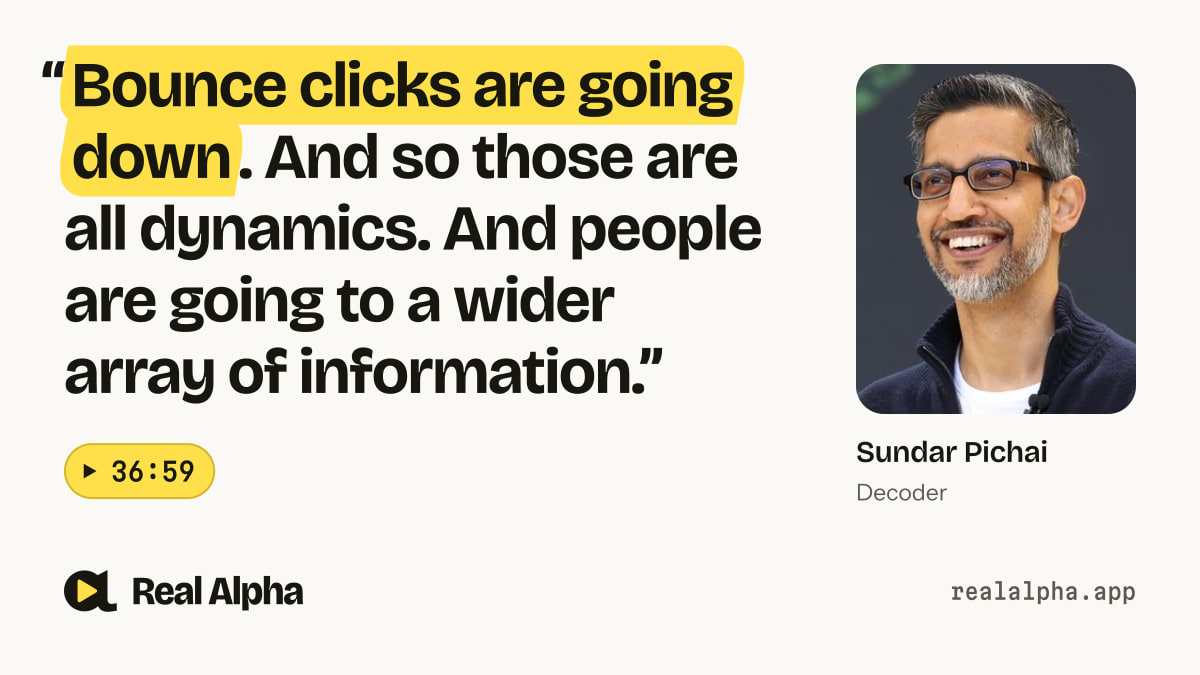
“Bounce clicks are going down. And so those are all dynamics. And people are going to a wider array of information.”
 Sundar Pichaiat 36:59 · Decoder
Takeaways
- Pichai says publishers are adapting to shifts in how people find content.
- Google says it is adding links and surfacing subscribed sources.
- He says bounce clicks are declining as low-quality clicks are filtered out.
About this segment
Asked about publishers preparing for zero search traffic, Sundar Pichai points to changing habits and a wider mix of information sources. He says Google aims to connect people with web content, while acknowledging that low-quality clicks are declining.

Sundar Pichai is CEO of Google and Alphabet.
Helped build Google Toolbar and Chrome, then led Google from 2015 and Alphabet from 2019.

Nilay Patel, Host · Editor-in-chief, The Verge
Helped start The Verge in 2011 and has hosted Decoder since 2020.
From “How Sundar Pichai is rethinking Google for the AI era | Decoder”, May 26, 2026. Watch the full episode
Answers “Will AI replace Google search?” See all 5 answers
Thanks. We'll look at and fix what's off.
Transcript
Transcribed by machine (Whisper) from the episode’s audio, so a word may be off here and there.
- 33:52
uh to operate and to be fruitful to make new work in uh you and i have discussed the concept i call google zero for many years idea that you will stop sending traffic to the web uh you've disagreed with me that this is real very much so uh this last week hasn't happened in the last many years well i'm just gonna do a quote it's this time it's not me and i i didn't i didn't feed this to Roger Lynch, the CEO of Condé Nast, he did an interview with TBPN last week, and he said, I'm just going to read a quote, every year our search traffic was down more than we had forecast.
- 34:20
So last year I told our teams, assume there is no search. You have to have your businesses planned as if search is zero. That is Google zero. Condé Nast is saying, we're assuming that search will go to zero. How would you respond to that, right? The idea of one of the biggest, most iconic publishers in the world is saying, I can't depend on this anymore. look first of all the information ecosystem is so much broader beyond google by by far we see it in the data you see it uh everywhere so if any publisher over the last 10 years i would look at verge and i would say where you were when you first took over how much it's evolved since then the types of content you make where all you put that content out how all you users are coming to you. I think it's exceptionally dynamic, and so it makes sense to me every publisher is adapting to
- 35:12
this new world. We are, you know, adapting to the evolving world, how users are consuming technology. We had to do when the world shifted from web to mobile. We are shifting it from a world of mobile to People having ongoing conversations, chatting with these products, talking to them, consuming it in voice and many different form factors. People are expressing preferences for various types of content.
- 35:40
They're looking for user-generated content. They're looking for podcasts. They're looking for that. through it all we are very committed to uh both meeting user expectations and also getting them to connecting them to what's out on the web and just even in the last year even since we've launched these features we've gone back we've added more links another area where behavior is changing many publishers rightfully so are thinking what subscription models sure but i'm just saying Kande Nast is saying, we're going to assume our search traffic is zero given the trends that we see. Should they assume that? This is, you know, I always view people understand their businesses better. I mean, I'm not in a position to tell, you know, such an iconic publisher what they should think about their business or plan. You know, if they are building content, which is
- 36:37
high quality and people like it, I expect us to be to reflect that in our products. That much I can commit to them, right? So that's what my, you know, so, but I think more than any other company, through this evolution, we are working very hard to make sure people can get connected and we are planning to do it in search, in Gemini, and that still underpins a lot of what we do. But there is evolution. Like, as the technology improves, low-quality clicks get filtered out.
- 37:08
That's a natural evolution we see. We see it in our metrics. Bounce clicks are going down. And so those are all dynamics. And people are going to a wider array of information. And there are more people producing information than ever before. So that pie is growing faster than... So all these dynamics are happening. It's a complex ecosystem. But our commitment to, you know, making sure we reflect the vastness and diversity of the content.
- 37:44
And we do think people want to connect ultimately to these sources. But we are trying to meet them in those moments. And people come with very different intent and very different moments. One of the small features we have done, but very important, I think, is if you've subscribed to something, reflect that as a preferred source for you as a user. but that's a new change which we didn't have before, we are adapting to the fact that publishers are increasingly turning to subscribe offerings too.
- 38:15
Publishers, YouTube creators, should they be able to opt out of training