The alpha, twice a week
That was 8 min.
Get the best new moments in your inbox every Wednesday and Saturday. It's free.
Check your inbox
We sent a link to your address. Click it to finish signing up. Not there in a minute? Look in spam.
or
Big Technology Podcast · 8 min · Oct 24, 2026
Google’s compute choices pit cloud revenue against frontier research
 Alex Kantrowitz
 and Roy weigh selling scarce compute through Google Cloud against using it to train frontier models.
The episode’s best minutes
Full analysis- 8:42Google’s compute choices pit cloud revenue against frontier research8 min
- 25:34Meta’s AI revenue math exposes the scale of its spendingPro pick 6 min
- 38:45The PHP flaw gives attackers unauthenticated access to web serversPro pick 6 min
- 5 more moments in the full episode
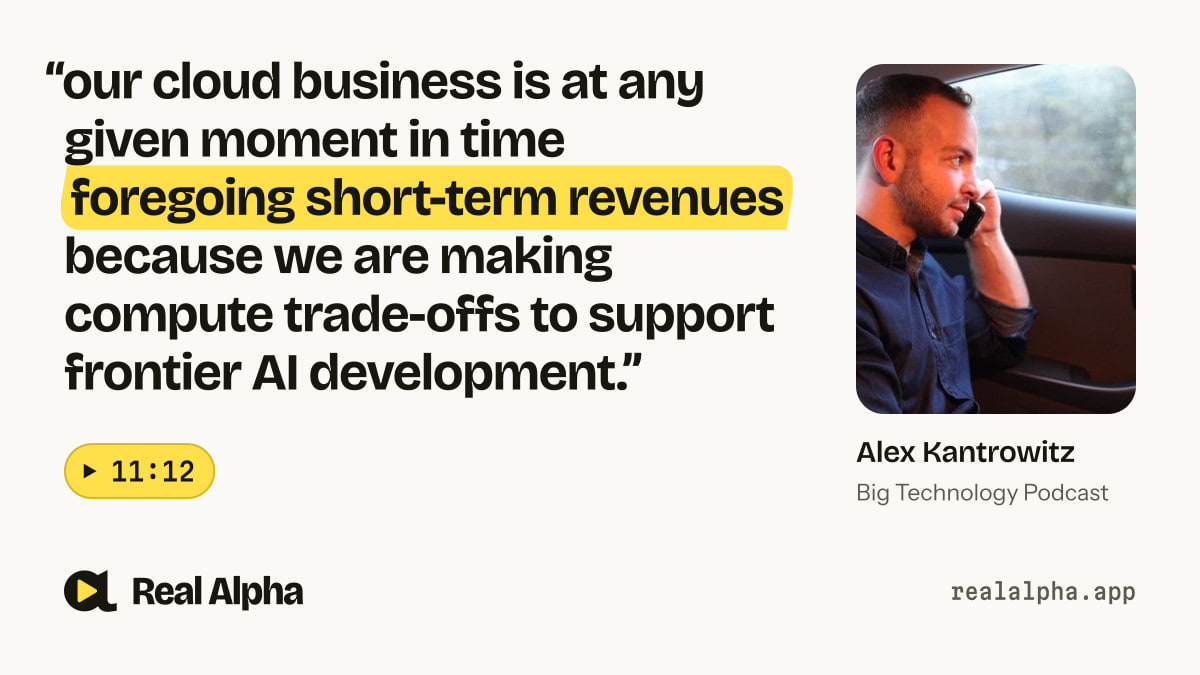
“our cloud business is at any given moment in time foregoing short-term revenues because we are making compute trade-offs to support frontier AI development.”
 Alex Kantrowitzat 11:12 · Big Technology Podcast
Takeaways
- Google Cloud is giving up near-term revenue to support AI research.
- Google Cloud’s 82% growth gives it a chance to catch Azure.
- Pichai argues some compute limits can spur research efficiency.
About this segment
Alex Kantrowitz and Roy weigh selling scarce compute through Google Cloud against using it to train frontier models. The trade-off could shape Google’s cloud growth and AI position.

Alex Kantrowitz, Host
Founder, Big Technology
Former BuzzFeed News senior tech reporter and author of Always Day One.
From “Google’s Potential, AI Money Spigot Shutting?, PHP Bug & Cybersecurity’s “Black October””, Oct 24, 2026. Watch the full episode
Answers “Is there still a GPU shortage?” See all 95 answers
Thanks. We'll look at and fix what's off.
Transcript
Transcribed by machine (Whisper) from the episode’s audio, so a word may be off here and there.
- 8:53
really is this company with so much going on, and yet many dilemmas, right? Another dilemma is where to allocate the compute. And you mentioned Google Cloud. And I think there is a well-documented and obvious clear conflict of interest between AI research and cloud compute and cloud services within Google. Let's say you have a bucket of compute. You could give all that compute to cloud services. And because of the demand for AI compute, chips, et cetera, you could make massive profits. We'll talk about this in a minute, but Google Cloud Platform grew 82% this past quarter. And that's with a lot of the compute capacity going to AI research, right? So if you were to put even more capacity to cloud, I wouldn't be stunned if they overtook Azure and maybe even AWS at some point in cloud computing. But basically, I spoke with Sundar
- 9:55
about this. And what he said was, everybody is short compute. He said, today, when you look at everything. Everyone is short, not just us, other companies. And everyone wishes you had two times what you planned for because these decisions that you have today in 2026 were made in 2024. And this is probably the toughest part of his job is allocating the compute between cloud profits and research, which is a cost, but can put it in place to be able to lead the AI game. And of course, as much as we might clamor for the product, it's always like, well, where's Google's latest model. And they finally have one with Argon that's performing quite well on the benchmarks.
- 10:35
I love this because actually that decision, where do I allocate the compute, is the ultimate expression of team product versus team model. Are you going to push it to the research side and the actual frontier training side? Or are you going to push it to Google Cloud, which is going to be the much more application and product heavy side of things? Again, it's not pure product, but it's still in the much more kind of like general utilization.
- 11:02
of that compute. So I like it, Sundar, and he's going to show us which team he's on based on where that compute gets allocated. And it sounded like from the interview that it's still going to be leaning towards the research side. Is that a fair understanding? I think basically what he was trying to say was research is going to eat. Here's the quote, our cloud business is at any given moment in time foregoing short-term revenues because we are making compute trade-offs to support frontier AI development. So very clearly, cloud is sacrificing money. And then he said something else, which I thought was interesting, and I don't think the world has picked up on. So what he talked about was that some constraints are good. Even our AI researchers have some constraints, which are also good. That's what inspires creativity. That's what
- 11:51
helps you come up with a more efficient algorithmic breakthrough. If you were to run that logic by, let's say, the, you know, the AI researchers at Anthropic or OpenAI, I think they'd have a heart attack. So I think it is very interesting to hear his perspective that like, yeah, I'm going to give you the amount of compute I think is necessary to advance the frontier and we're committed to the frontier, but some constraints might be good for you. I mean, that was interesting.
- 12:21
That is a very different philosophical shift that no one's picked up on yet. No, it's great to call that out because I actually think that is very relevant. Again, to go back and forth, though, if he's saying on one side the entire industry is short compute and my biggest challenge is allocating that compute. But I do like this idea because, again, there's a lot of kind of talk around how it was actually a lack of access to abundant compute that actually pushed Chinese innovation on more on the algorithmic side.
- 12:48
We've seen innovations with decision models in JEV recently and actually doing more with less. Certainly that kind of constraint forces innovation versus you have infinite access to compute and that's going to be how you approach all these problems. I think that is interesting that he's saying that. Again, what does that actually mean for his – what do you think those meetings look like? Do you think they have like a meeting where all the most powerful people at Google sit and then wait to be told which pile of compute they're going to get access to?
- 13:29
It's like one chart goes up and it's like, all right, sorry, cloud. Research gets this many. I do think there's a version of that. I mean, I'm not privy to the details of the meetings. We're just hypothesizing. This is fanfic, Google fanfic. But I mean, it would not be stunning for me to, you know, think that there are people with projects within the company who are like, I'm going to need this much compute or I'm leaving.
- 13:57
And that those are the decisions that he's faced with. I'm sure that happens. I mean, Noam Shazeer, for instance, who's been in and out of Google and found a character AI in the middle. He left. He went to OpenAI. Why do you think that happened? I mean, I could just imagine the conversation. And they spent a lot of money bringing him back. yeah so yeah i just invest in some well i guess they couldn't have just invested in some more gpus right hence the short compute but but they're making tpus the problem is that the the decisions that takes two years in terms of build out probably even longer honestly um but yeah and then on the cloud side it's probably just like um you know i could seek the cloud i could see Thomas Corian making the argument. Listen, we are in a rare position where after lagging as the
- 14:46
number three cloud computing company, cloud computing service, we can make a legitimate push for, you know, at least number two and potentially number one. And I mentioned this before a Google Cloud Platform 88 almost an 82% growth rate this past quarter year over year. Their revenue last quarter was 24 billion, 24.8 billion. Azure's revenue last quarter was 29.4 billion. AWS's revenue was 42.2 billion.
- 15:18
AWS, 37% growth. Azure, 42% growth. Google Cloud, 82%. Sorry, yeah. Azure, 42% and Cloud, about 82%. They have a meaningful shot here at at least passing Azure. I don't think people are recognizing this. If these numbers continue at pace for maybe another year or two, they're a solid number too. And if you're running the cloud business, man, it's like you make that pitch and it's a company that's been struggling to build a cloud business for a long time or really clawing at it. This is the moment to capitalize. But of course, it comes with the expense of research. What is your decision as a hypothetical tsundar? Flood the cloud, man. Flood the cloud.
- 16:03
Cloud's got to eat. No, I don't know. I don't know. I wouldn't want to be in that job because it's so hard. How about you? I think it, again, I love it. It comes back to,