The alpha, twice a week
That was 6 min.
Get the best new moments in your inbox every Wednesday and Saturday. It's free.
Check your inbox
We sent a link to your address. Click it to finish signing up. Not there in a minute? Look in spam.
or
Big Technology Podcast · 6 min · Oct 24, 2026
Meta’s AI revenue math exposes the scale of its spending
 Alex Kantrowitz
 and Roy compare Meta’s infrastructure spending with plausible revenue from its AI assistant, then discuss investor fatigue around OpenAI’s funding.
The episode’s best minutes
Full analysis- 8:42Google’s compute choices pit cloud revenue against frontier research8 min
- 25:34Meta’s AI revenue math exposes the scale of its spendingPro pick 6 min
- 38:45The PHP flaw gives attackers unauthenticated access to web serversPro pick 6 min
- 5 more moments in the full episode
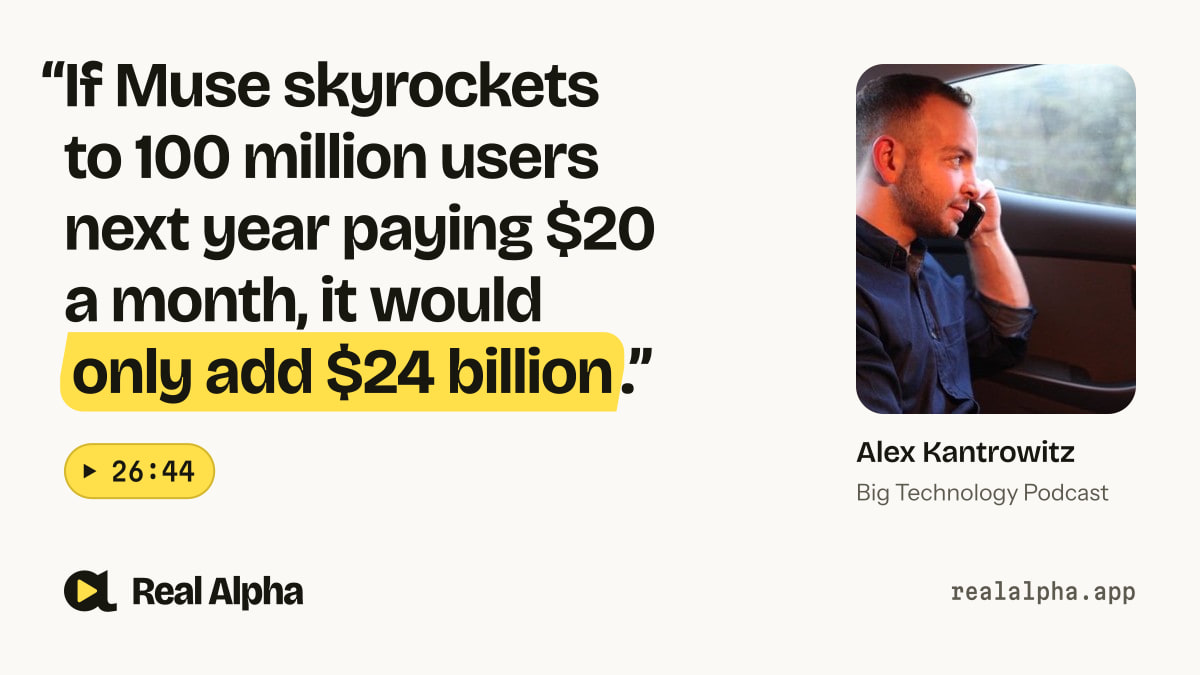
“If Muse skyrockets to 100 million users next year paying $20 a month, it would only add $24 billion.”
 Alex Kantrowitzat 26:44 · Big Technology Podcast
Takeaways Pro pick
- 100 million paid users would add $24 billion in annual revenue.
- Meta’s projected AI infrastructure spending is $825 billion.
- Investors may be tiring of repeated mega-rounds.
One of Pro's picks, open to you here. Try Pro free for 7 days
One of Pro's picks. The rest of the summary and the 3 takeaways are in Real Alpha Pro; the video, the quote and the transcript stay free.
Read it with Pro, 7 days freeAbout this segment
Alex Kantrowitz and Roy compare Meta’s infrastructure spending with plausible revenue from its AI assistant, then discuss investor fatigue around OpenAI’s funding. The gap makes the financing challenge concrete.

Alex Kantrowitz, Host
Founder, Big Technology
Former BuzzFeed News senior tech reporter and author of Always Day One.
From “Google’s Potential, AI Money Spigot Shutting?, PHP Bug & Cybersecurity’s “Black October””, Oct 24, 2026. Watch the full episode
Answers “Is AI a bubble?” See all 99 answers
Thanks. We'll look at and fix what's off.
Transcript
Transcribed by machine (Whisper) from the episode’s audio, so a word may be off here and there.
- 25:45
Like, to me, is the reason capital is becoming more constrained because people don't buy the compute story or that they've seen that it's actually very difficult to build these data centers and that it's not going to happen as quickly as possible? And going back to Sundar's point as well, do you think the market as a whole has said actually this idea that the entire world will be short of compute is actually validated?
- 26:13
or do you think people are just like, actually, I'm not going to give you money to fund data centers because they're hard to build? I believe it's neither of these things. Okay. So I have two other reasons. One is the investors are starting to do the math on what it's going to take to make these products profitable. This is a little item from a Wall Street Journal story that I read, which actually did the math on what Muse would need to generate to pay back some of these investments that Facebook is making. Remember, Facebook raised its guidance from $700 billion that it's going to spend on AI infrastructure to $825 billion. This is the amount of money they anticipate Muse building in one of the good scenarios. If Muse skyrockets to 100 million users next year paying $20 a month, it would only add $24 billion.
- 27:02
to Meta's annual revenue, about 12% of next year's anticipated capital spending. Associated advertising fees could add more to the pop, but probably not a ton. Meta made about $67 of revenue per daily active user, mostly from ads. In the year to end of the third quarter, for 100 million users, that would add another $6.7 billion. Again, this is a company that's spending $825 billion on the AI build-out.
- 27:35
So basically, in order to make this work, the company needs to get Muse to a billion users. And even then, we have questions. I think trying to come up with what is the scaled business model of personal agents like Muse, and normally I'm very skeptical when people try to avoid that question. for a company like meta i still think it's still a bit early again trying to apply the would you pay twenty dollars a month are you trying to trying to extrapolate out the existing uh ad revenue per daily active user i still think like we don't know what the business model around personal agents is going to be or it will there be a sustainable one but i mean agreed like if the market starts asking those questions, it's a huge problem for a lot of companies, especially startups, because I think like to date, especially on personal agents, the assumption is whoever just
- 28:31
starts getting people draining tokens and using it nonstop and getting completely habitual to it, the money will come. So if people start asking that, that is a problem. So that's one for me is people are actually doing the math here and they're like, how does this work? And the other side of it is, I think they're fatigued. The system itself has put so much money into these companies, and it's still experimental. And the belief was there, but eventually that hits a wall. That's from the Financial Times. OpenAI has cut its valuation target for its latest funding round after facing resistance to a 1.4 trillion price tag from some investors. It's going to be 1.25 trillion. Now, deeper in the story, this was the rationale.
- 29:16
Multiple people with knowledge of the Morgan Stanley-led process said demand from clients was weaker than in the past. There has been zero clamoring, said one of the people. All the prior times OpenAI have been on, there's been a frenzy. This time it's a bit of a thud. Some investors were also suffering from fatigue or indigestion after having invested heavily in prior rounds. OpenAI raised $40 billion in March 2025, $122 billion in March this year, And Anthropic has raised close to $100 billion this year.
- 29:48
And that might be the most simple and obvious explanation here. It's fatigue. And I am happy if this is the case. You know what, everybody? I hope you all have a little bit of indigestion. Let's all just take a moment. Even the fact that there was zero clamoring, that in the past there was much clamoring, is a reminder that everyone has been way too kind of intense about it. Because again, the fact that we're calling it a thud when the jump in valuation is going to be almost 50% higher than its last funding round is crazy.
- 30:23
Like the extrapolation, the expectations is still, I mean, just maniacal. So the idea that like that is a thud, I think it's healthy for the markets overall. So if everyone can take a breath, pause to start moving forward again, I am happy. So do you think that this means OpenAI briefly? Do you think this means OpenAI is no longer on track to a successful IPO? Or is it just sort of, I mean, usually these things, once these things stop going up, they start going down in a real way.
- 30:57
I think it all depends on Anthropic and what happens. I mean, it is kind of crazy. to think about like you're sitting at you're invested in open ai heavily heavily all that matters is how the market receives anthropic any kind of like let's like try to evaluate the financials on a comparable basis none of that's going to matter if anthropic gets hit there's no way open ai is going out ronjan before we move over to alex damos i just gotta ask you one more