The alpha, twice a week
That was 7 min.
Get the best new moments in your inbox every Wednesday and Saturday. It's free.
Check your inbox
We sent a link to your address. Click it to finish signing up. Not there in a minute? Look in spam.
or
Founders · 7 min · Nov 4, 2026
Government can attract young talent with skills-based hiring
 Scott Kupor
 describes the federal workforce's age imbalance and pitches short, demanding government stints as career-building.
The episode’s best minutes
Full analysis- 30:27Government needs permission to take measured risks7 min
- 38:25Government can attract young talent with skills-based hiring7 min
- 48:48Digitizing retirement records is transforming a paper process6 min
- 5 more moments in the full episode
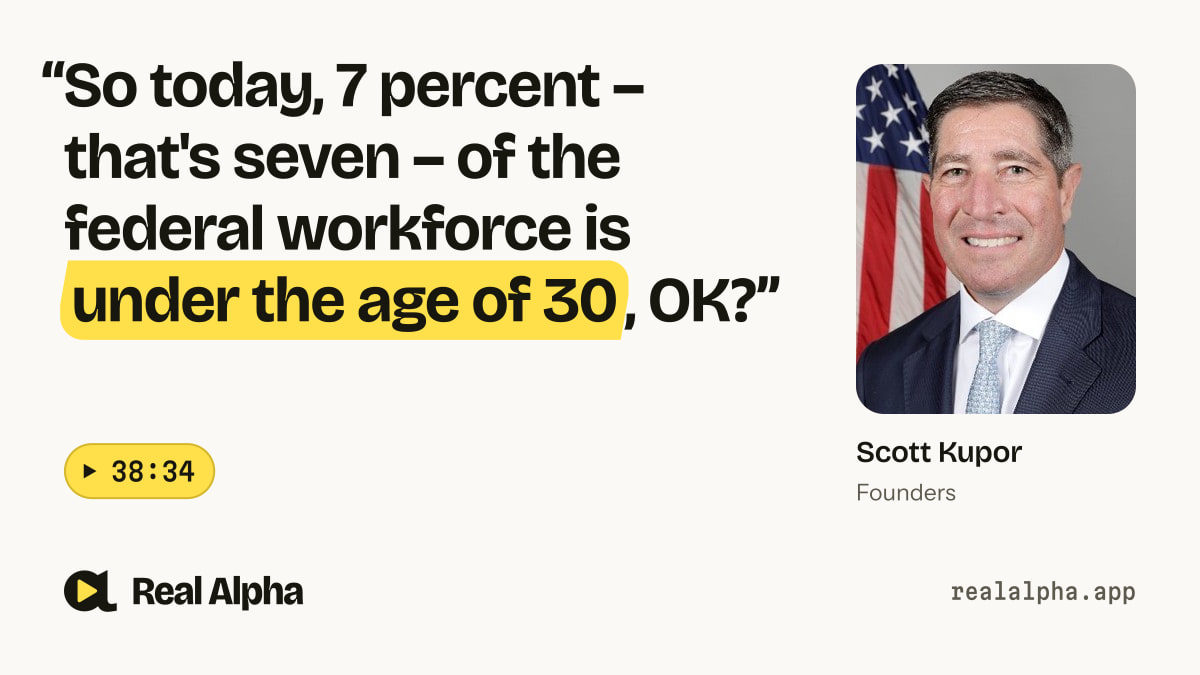
“So today, 7 percent – that's seven – of the federal workforce is under the age of 30, OK?”
 Scott Kuporat 38:34 · Founders
Takeaways
- Only 7% of federal workers are under 30.
- Tech Force offers technical staff a two-year government stint.
- Skills assessments can replace degree and experience proxies.
About this segment
Scott Kupor describes the federal workforce's age imbalance and pitches short, demanding government stints as career-building. He argues hiring should assess skills, not rely on degrees or tenure.

Scott Kupor is a director of the U.S. Office of Personnel Management.
Built Andreessen Horowitz from its 2009 inception into a major venture firm before leading the federal government's HR agency.

David Senra, Host · Host, Founders
Has read an entrepreneur's biography every week for Founders since 2016.
From “He Helped Build a16z & Is Now Rebuilding the Government | Scott Kupor”, Nov 4, 2026. Watch the full episode
Thanks. We'll look at and fix what's off.
Transcript
Transcribed by machine (Whisper) from the episode’s audio, so a word may be off here and there.
- 38:31
Now, there is a talent problem, which you and I talked about a little bit, which is we suck at getting early career people into government. Explain the demographics of who's working in the government right now because this is a wild study. So today, 7 percent – that's seven – of the federal workforce is under the age of 30, OK? So just so your listeners have a comparison, if you look at the total U.S. workforce, 23 percent of the total U.S. workforce is under the age of 30, OK?
- 38:54
OK, so by a factor of three to one or more, the federal government is way under indexed on early career people. OK, if you go to the other side, 44 percent of our population is over the age of 50. And the government, sorry, 44 percent in government is over the age of 50. That compares with about 33 percent in the total U.S. workforce. So we are three to one under indexed and then we are 11 percentage points over indexed in the over 50 category in federal government.
- 39:19
So, you know, we've talked about this, but look, I'm a small government guy. I won't presuppose your ideological views, but like- Son of a Cuban immigrant. Okay, so you're more small government than the big government. Okay, so that explains a lot. Like if we did nothing else, half of our workforce will retire over the next five or 10 years, and we are stuck with nobody to actually do the work, right?
- 39:39
So like we need something more than zero people to actually work in the federal government. So thing number one that motivated me is like, can we solve that problem? And I think you solve that problem in two ways. One is we actually have to go tell a story about why it's interesting to go to government. So we've been talking about this. But one of the things I'm doing after I go here is we're starting on a college tour, which we have never done at OPM.
- 39:59
We've never gone. gone out to colleges or where the actually young people are and said, let's go find you. Let's tell you what's compelling. Let's actually create programs around this. And so we're going to do that. And, you know, you may not have seen this, but I do these stupid social media things on, you know, Instagram and WhatsApp and stuff like that, because, like, I've hired younger people who actually understand.
- 40:20
How do we get a message to people who are looking at this stuff? And your message is what? We need young, technically talented people to just do a two-year stint. Yeah, exactly. Because I think somebody was saying, like, when you first came in, oh, you're like, you're kind of screwing things up because our pitch here is like, you have a job for life. Yeah. And you're like, yeah, but young people don't think that way.
- 40:40
Yeah. So I had a manager who, like, told me that. They're like, you guys suck because our whole pitch to people has come here and you have lifetime employment. And I told her this. I'm like, look, that is the worst pitch I've ever heard. Like, there's not a single person under the age of three today who is thinking about lifetime employment. And if they are, by the way, you know, I hate to say this, but like, that's not the kind of person we want, because that's not the kind of like self-motivated driven person that we want in the government.
- 41:01
So my pitch to people is, look, come here, do something, you know, not just as good for your country. That's fine. But like, do something that's actually good for yourself, which is come spend two or three years to work on like some of the most complex, hardest problems there are out there, right? If you're interested in space, like go work at NASA. What like Jared Isom and NASA is doing is fucking awesome. And like, you should be part of that. Or if you want energy stuff, go to the Department of Energy. There's all kinds of cool, like supercomputer stuff and all kinds of things, work on these hard problems. And then after that, quite frankly, if you want to go to the private sector, that's amazing. Like, let's help you go to the private sector. So this Tech Force program I mentioned, in addition to these two-year stints, we partners with 40 private
- 41:39
companies, right? So all the names you would know, right? You know, Alphabet and Meta and Beta Brits and all these guys. And what they're doing during the two years is they're going to do training and career development for these folks in this program. And at the end of the two years, we're going to do like a massive job fair. And if we've done our job right in the government, We have trained these folks so well that I want, you know, every private company to be fawning over these people.
- 42:00
It's a little bit like, you know, you and I were mentioning, right, in Israel and the IDF, right, they have this cyber core where it's the best, the brightest kids coming out of high school who go to the cyber core. And when they come out, every, like, venture capital firm is falling all over themselves to fund these guys. Every, like, cyber company wants to hire them. Like, that's the kind of thing, like, we want for the federal government.
- 42:17
And if people love being in government, great. God bless them. They can stay in government. But, like, we don't need to ask people to make, like, 30, 40-year commitments. I think your appealing to interests is way smarter than saying, hey, here's the government, you're a citizen, come try to do something. good for the government. That will get some percentage of people, but it's like, you're going to get a lot more if it's like, no, this is actually good for you and your country at the same time. That's align the incentives. And look what could happen. This is where your starting point is when you come in. This is what we can do. This is what you'll learn during this. And this is what happens after that. That's exactly right. And then while you're here, which comes to the second point is, look, I have to create a high performance culture for people like that to
- 42:51
succeed, right? So if I can convince young, aggressive, like career-minded people to come to government, they can't come to the environment that I walked into, which is you have to sit in a job for a year before I consider you a promotion, or I can't hire you at a GS-14 level because you have an experience. I'll tell you the story, which is somebody was reminding me of today. So if you follow the Doge stuff, right, there's a guy named Big Balls. Have you ever heard of Big Balls? I've heard of Big Balls. I don't know anything else but his name. It's very hard to say it on air. But anyways, as I mentioned to somebody I talked to this morning, he actually has a name. His name is Ed. So apologies to his mom that basically Big Balls has become his name.
- 43:28
He joined the government. He joined Doge. He joined Elon's team. I think he was 19 years old. He went to Northwestern. I think he dropped out as a sophomore, okay? And he's one of, like, the most brilliant software developers around, basically. And he's like, look, I got motivated by Elon, and I want to do this stuff. And he's still there, by the way. He works for Joe Gebbia now as part of this national design studio, which is, like, redesigning all of the, like, web sites for the government.
- 43:48
Anyway, so when I saw this article come out a few months after he joined, this was in the height of the Doge stuff when, of course, everyone was, you know, thinking the world had come to an end. And there was a quote from a government employee that said, we would never hire, he didn't say big balls, he said Ed. He said, we would never hire Ed in government because he didn't have a college degree and he didn't have five years of work experience. And when I saw that, like, literally, like, I wanted to pull my fucking hair out because I was like, this is exactly the problem, right? This guy's awesome. We should hire him because he actually has the skills to help us.
- 44:18
And literally every job description in government, almost all of them have, like, a college degree requirement. Well, in my mind, that is a proxy for skill that may be indicative of something, but may not. The fact that Ed didn't have a college degree had no bearing on his software engineering skill set, but it would have been used to basically kept him out of a job because he would not have qualified, or we would have hired him at this low level where we would have paid him $40,000 a year, which he never would do. Of course, he would go to Silicon Valley and get paid 10 times that. So part of this is if we're going to get great people, we have to be able to actually have them walk into a culture that actually believes in performance, that believes in accountability, that allows them to progress the organization, that pays them at the level
- 44:59
that's appropriate. then look, we're never going to like pay what Silicon Valley does. And that's fine. And that's okay. But we ought to at least level people appropriately so that like Ed should not come in at this GS5, which is like the most entry level for government. He should come in at a GS14 or 15, which is the highest levels because his merit shows that he's capable of performing at that level. But the system as it existed would not have allowed that to happen. So this is what we've been doing for a policy perspective is to fix all that stuff and say like merit matters, take a test, take an assessment,