The alpha, twice a week
That was 7 min.
Get the best new moments in your inbox every Wednesday and Saturday. It's free.
Check your inbox
We sent a link to your address. Click it to finish signing up. Not there in a minute? Look in spam.
or
Founders · 7 min · Nov 4, 2026
Government needs permission to take measured risks
 Scott Kupor
 explains why government avoids risk and how that blocks innovation, then outlines performance-rating and promotion reforms.
The episode’s best minutes
Full analysis- 30:27Government needs permission to take measured risks7 min
- 38:25Government can attract young talent with skills-based hiring7 min
- 48:48Digitizing retirement records is transforming a paper process6 min
- 5 more moments in the full episode
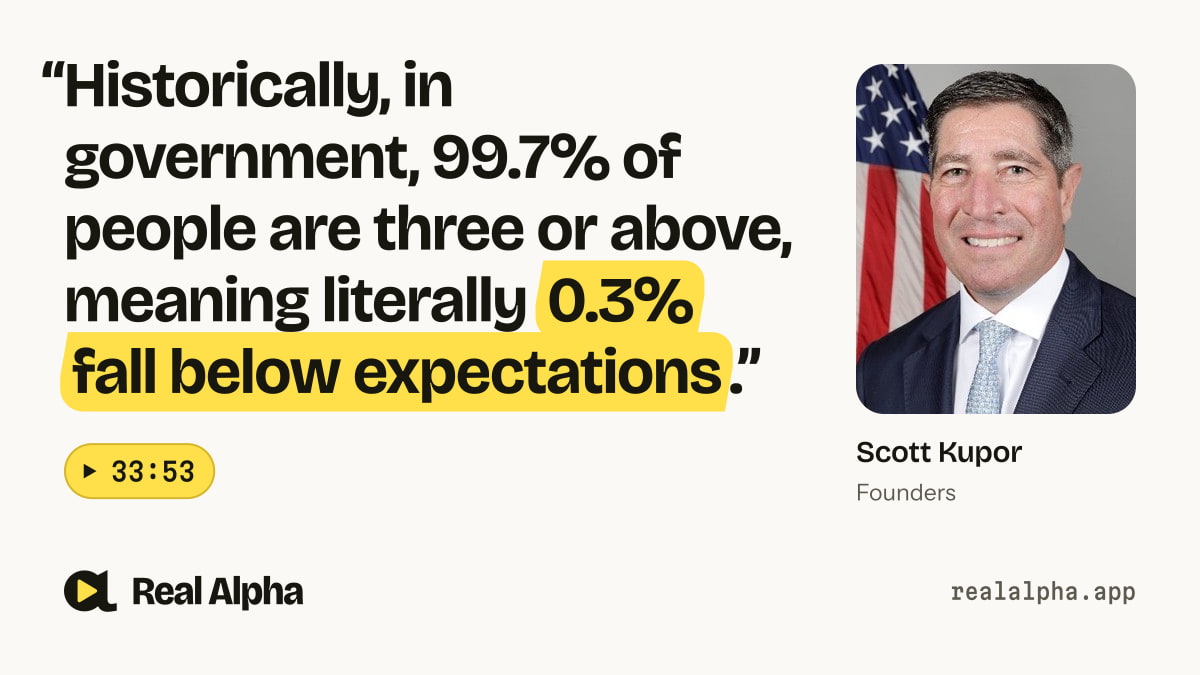
“Historically, in government, 99.7% of people are three or above, meaning literally 0.3% fall below expectations.”
 Scott Kuporat 33:53 · Founders
Takeaways
- Fear of scrutiny can make doing nothing the safest option.
- Kupor says 99.7% of federal employees meet or exceed expectations.
- He wants ratings, pay and promotions to reflect merit.
About this segment
Scott Kupor explains why government avoids risk and how that blocks innovation, then outlines performance-rating and promotion reforms. The changes aim to reward strong work and make room for accountability.

Scott Kupor is a director of the U.S. Office of Personnel Management.
Built Andreessen Horowitz from its 2009 inception into a major venture firm before leading the federal government's HR agency.

David Senra, Host · Host, Founders
Has read an entrepreneur's biography every week for Founders since 2016.
From “He Helped Build a16z & Is Now Rebuilding the Government | Scott Kupor”, Nov 4, 2026. Watch the full episode
Thanks. We'll look at and fix what's off.
Transcript
Transcribed by machine (Whisper) from the episode’s audio, so a word may be off here and there.
- 30:33
particularly on the latter side, is like the incentive structure is completely screwed up from my perspective. Before you move on, let's describe this. Why is the incentive structure completely screwed up from your perspective? So a couple of things. Number one is it is an incredibly like legal regulatory compliance related culture, basically. And so everything that happens basically in government is for fear of doing something wrong. We do the same thing we've been doing the same, you know, all along. So the idea of innovation, any kind of innovation is very much difficult to do because the better thing to do is keep doing what you're doing. Don't take risks. You know, when I first came in, one of my, you know, reports said, look, our job is to keep you out of the news, basically. And I was like, well, okay, well, tell me more
- 31:17
about that. And they said, well, we don't want you to get hauled in front of Congress for doing something that they don't want you to do. We don't want you to get a report from the GAO, which is basically like this compliance organization. We don't want the inspector general, you know, doing stuff. I was like, okay. Okay. So then let me just sit in the room and do nothing. That's easy. Yeah. Like it's pretty easy how to solve that. Right. Which is okay. Like we will just do nothing. Right. It's exactly right. And that's what I said. I was like, that's not your job. Like your job is to help us figure out like, what can we do that's good? And yes, if we have a good reason for doing something and we screw it up, like I'm fine getting hauled in front of some congressional committee and explaining that to them. Obviously if we're, if we're, our process
- 31:50
was crappy. That sucks. We got to fix that. But what it means is basically it does not allow for any innovation, right? So look, I come from, as you know, we come from this crazy world in venture capital where we take like obscene amounts of risk, which is fine because you've got like upside that potentially is uncapped, right? If you find Coinbase in 2012, as Chris Dixon and Mark did, you know, if it works, right, it can, you know, generate 300, 500 times your money, right? And like, that's a good thing to happen. And that can cover a lot of mistakes. We don't have that in government. But instead, what they've had is basically the answer is like, take zero risk.
- 32:20
But that also means therefore like no consideration of upside potential for anything. And so part of the incentive structure that I think we have to put in place and we're trying to put in place is I've been using this term permissioned risk. which is deliberately different from the permissionless risk that I think exists in Silicon Valley, which is we've got to have this conversation, and we've got to be willing to let people take some risk, and that risk needs to be appropriately sized for the organization.
- 32:40
So if you're in Department of War and the risk is people die, okay. Like, maybe we ought to have a really, like, low tolerance for that. But, look, what I do and what most people in government do is not life or death, right? So, yes, like, we want to get people their Social Security checks. We want to get people their IRS refunds. Like, if it happens, you know, plus or minus a day or two from when we expect it, like, you know, most cases nobody's going to die. But if we could actually like automate a system and figure out like how do you make it dead simple for people to get their social security checks or their retirement checks or anything like that, that has massive upside potential. But the incentive system has never allowed that. So that's part of number one, like that's part of the reason why
- 33:15
the system screwed up is like there is zero, zero opportunity for innovation. As a result, therefore you have slow and plotting and not great customer service from a lot of these organizations. Well, not only that, if there's zero possibility for any kind of innovation, like what kind of talent are you going to attract? Yeah. So here's the other side of this, right? Which is then you have a performance management system that's also screwed up. So I'll give you a story. I think you and I may have talked this a long time ago when we first met.
- 33:39
Everybody gets ranked generally one through five at the end of the year in terms of their employee rating. Some organizations have a four point rating, but say one through five, one is the worst. Like you definitely like should not be here. Five is like, you're not going to cover off the ball. And three means, Hey, like, you know what? Like you're good. You're doing what we asked you to do, that's all fine. And every organization, quite frankly, needs a lot of people like that. Historically, in government, 99.7% of people are three or above, meaning literally 0.3% fall below expectations. Now, in a population of 2 million people, it's not even mathematically possible. It's not. So you have one problem, which is we don't do anything on low-end accountability in the government. I'll tell you about how we're going to change this in a minute. So that's a
- 34:21
serious problem to your point, which is, look, how do I attract and retain great people when I'm sitting here, you know, busting my ass and you're like dialing it in and everyone knows you suck, but like nobody actually wants to do anything about it. Like that's a terrible place for high performing people to be. So like, yes, exactly. And then on the other end, so four and five, right, those are the top ratings mean not just you're doing your stuff, but like you're extraordinary or you're outstanding, you're doing great stuff. In the senior, just give you an example, in like the most senior side of the government, which is like 7,000 people that are like senior executives, something like 90% of people get ranked a four or a five, meaning like literally everybody's awesome.
- 34:56
In an organization of 7,000 people. Yeah, it's not, again, it's just not possible. What it means is like we've gained the system. And as a result, again, if I'm a high performer, like, you know, I want to be a high performer and there ought to be smaller numbers of people who are high performers. And by the way, I ought to just portionally get money for that. So when you have a system where 90% of the people get ranked at the top of the class, that means the bonuses make no sense, right? I give you a thousand bucks and it has no incentive value, it has no retentive value. Instead, like we should have a system where, which was what we're doing is we've put a rule in place, which is no more than 40% of the population can be at that top ranking.
- 35:30
and 60 plus percent of the compensation pool needs to go to those 40 percent of the people. Now, personally, I'd like to do even more extreme than that, but like we've got to crawl before we walk and run on this stuff. But like if you want to attract great people, you have to hold people accountable on the bottom end and you have to allow for differentiation. And the third thing you have, by the way, just you got me on my soapbox, is almost every promotion opportunity in government is gated by tenure. So you have to be in the job for a certain period of time, typically at least a one-year minimum before I can even consider you for promotion. Now, again, like if I'm going to hire some person who's awesome in software development and they knock the cover off the ball and within six months, like they demonstrate that they're better than I
- 36:10
thought. They're especially stuck in purgatory for six months. Yeah. And then by the way, if you promote them, they have to wait another 12 months, right? So we're eliminating stuff like that. So these are all policy changes we're making, which is we're going to eliminate, it's called time integrate is the name for it. But like what we want is a merit-based culture where you come in and we level you appropriately for what you can do.
- 36:29
So one of the programs we have is called TechForce, just so you're aware, which is basically we're trying to build this elite core. You and I talked about this. This is a elite core of like we're trying to bring in 1,000 software engineers, AI experts, data scientists to serve two-year terms of government. We're hiring them at what's called the GS-14 level, which is pretty high. That's like the second highest individual contributor level in government.
- 36:49
And we're hiring that way because we are actually giving them assessments that technically analyze their skill set, right? So they come in and they have to do like an actual test by a third party that is a code development test. Never before has the government done this, right? Instead, I would give you a questionnaire and you would self-rate your skills, right? You would say, I'm a real good software.
- 37:08
It's one through five. Turns out I'm a five. You're a five, right? You know this language. You know that language. And again, like it's just – it's crazy and there's a whole historical reason for it, which is like there was this lawsuit about disparate impact on these exams. But the point is like if we have a merit-based culture, we will bring people in at the right level. We will promote them at the right pace.
- 37:26
And then I believe they will want to stay because they will feel like they're actually able to do what they want to do. Right now, until the changes we've made, like, historically, we've had a system where, like, it's very hard for you to break out of the pack, basically. And that's just not amenable to having a high-performance culture.