The alpha, twice a week
That was 5 min.
Get the best new moments in your inbox every Wednesday and Saturday. It's free.
Check your inbox
We sent a link to your address. Click it to finish signing up. Not there in a minute? Look in spam.
or
The Information's TITV · 5 min · Nov 16, 2026
GPU prices vary up to threefold, largely with provider reliability
Xianghang Yang says reserved GPU prices can differ by 2–3x, with reliability accounting for much of the spread.
In this episode
Full analysis- 5:54Founder successors often lack the founder’s strengths4 min
- 10:20Reusing Starship’s upper stage could sharply cut launch costs6 min
- 17:51Claude’s Office connector has about one-tenth Copilot’s users7 min
- 25:07A strong Anthropic IPO could reopen the market for 900 unicorns6 min
- 35:19GPU prices vary up to threefold, largely with provider reliability5 min
- 41:57Companies customize open models for quality, cost and control2 min
- 32:06Anthropic’s IPO could give OpenAI a useful market test3 min
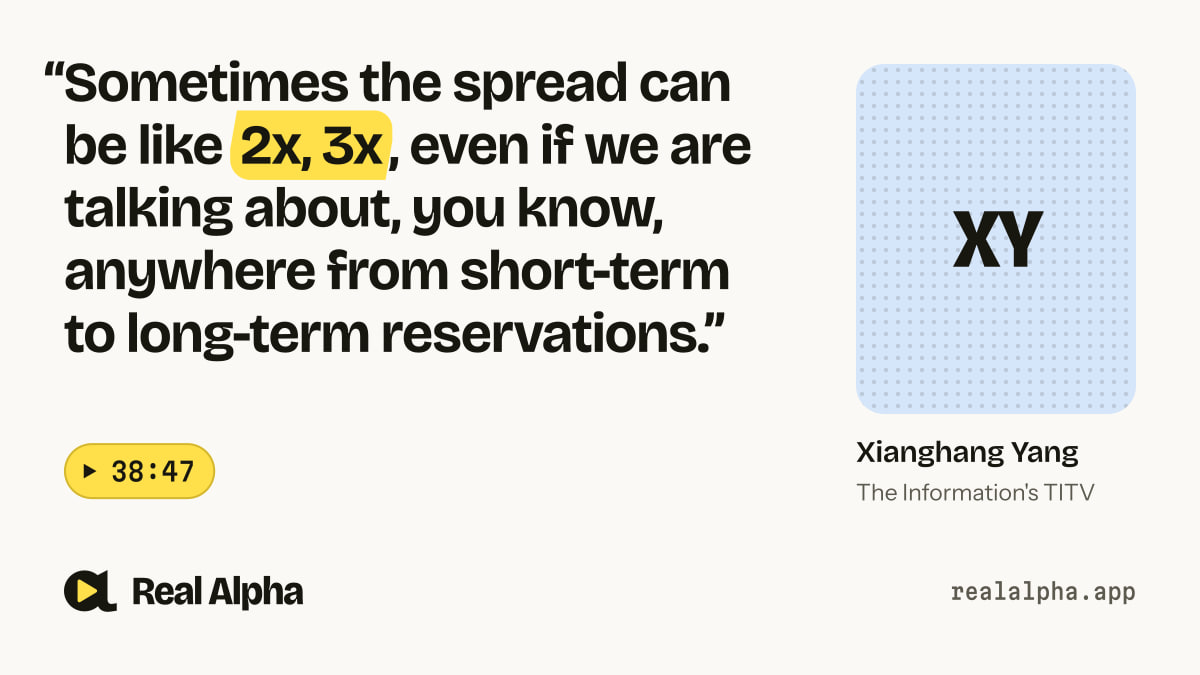
“Sometimes the spread can be like 2x, 3x, even if we are talking about, you know, anywhere from short-term to long-term reservations.”
Takeaways
- Reserved GPU pricing can vary by 2–3x across providers.
- Provider reliability is the biggest contributor to price gaps.
- SkyPilot abstracts reliability issues across GPU fleets.
About this segment
Xianghang Yang says reserved GPU prices can differ by 2–3x, with reliability accounting for much of the spread. SkyPilot aims to mask provider issues so companies can use a wider GPU fleet.

Akash Pasricha, Host · Host, TITV
Led The Information's Pro subscription and co-wrote its flagship newsletter, The Briefing.
From “Jensen Huang’s Allies Push for His Return, Claude Trails Copilot in Office”, Nov 16, 2026. Watch the full episode
Thanks. We'll look at and fix what's off.
Transcript
Transcribed by machine (Whisper) from the episode’s audio, so a word may be off here and there.
- 35:24
sky pilot website um it says that instead of forcing developers to pick one cloud you're aiming to create a sky of compute can you unpack what that really means yes absolutely so this is based on a project we started at berkeley um around 2011 and the main idea and the main problems you are trying to solve is that the resources cloud resources in particular the GPUs are more and more scarce and in response to the scarcity developers respond by getting the GPUs wherever they are now they are confronting with a very fragmented ecosystem in which they have GPUs on various clouds super scalars as well as a new clouds so the question is that how are going to use these resources in a coherent way make it easy to deploy and scale the largest workloads including the training and inference and this is what where skypilot is coming in
- 36:31
it making it much easier for the developers to run their workloads basically on any cloud so jan is is this like a a marketplace for compute of sorts where you're the developers on one side and and the cloud providers on the other side is that how it works yes i think it's it's pretty much from the technological perspective this is exactly what it Dibos. So what happens right now, actually, even beyond being a real market, is that many companies, including the large companies and even super scalars, because they do not have enough GPUs, even on their cloud, they are going to go and get other GPUs on other clouds.
- 37:22
So now you have these organizations and their developers having access to multiple clouds and having resources on those clouds. And now their problem is how to use the resources. And this is an easy way to scale their workloads because they don't want to use all their time to figure out how to port their workloads from one cloud to another. Right. This is exactly what SkyPilot provides. But this sky of compute, is it a marketplace where the cloud providers are essentially auctioning off compute against each other?
- 38:02
Not now, but this is exactly what it could enable in the future. Okay, interesting. Jong-un, talk to me about why it is that pricing across these cloud providers varies so significantly. is this just the efficiency of their operations on the ground, the power costs, the construction of their facilities, or what is it that goes into the different pricing here? Yeah, you know, there's many, like, industry analysis firms, you know, tracking the pricing across providers, right?
- 38:34
Some, like, semi-analysis actually published CustomRacks every year, right, ranking providers new clouds into many tiers. So I think if you look at the reserved blackwells or reserved hoppers in the last couple of months, there's a dramatic spread across providers, right? Sometimes the spread can be like 2x, 3x, even if we are talking about, you know, anywhere from short-term to long-term reservations.
- 39:01
I think the biggest contributor to the spread is because some providers are really like much more reliable. You know, they get their everything, get their house in order, right? So you see much, much fewer reliability issues. And if you go to some other up and coming providers, they can be extremely unreliable. And so what Skypilot comes into play is, you know, we are building a platform for, like Deon said, for companies to manage their AI computes, right, regardless of what providers they bring.
- 39:34
So we actually build a lot of value-added services on top to mask away some of the reliability issues so that AI companies can utilize their entire GPU fleet, regardless of where it comes from, and they can build and train and serve their own intelligence in-house.