Free with a sign-in.
The best 16 min of 46
Jensen Huang’s Allies Push for His Return, Claude Trails Copilot in Office
Blake Scholl argues Jensen Huang deserves due process, while SkyPilot’s founders say cross-cloud compute and in-house AI stacks can give companies more control.
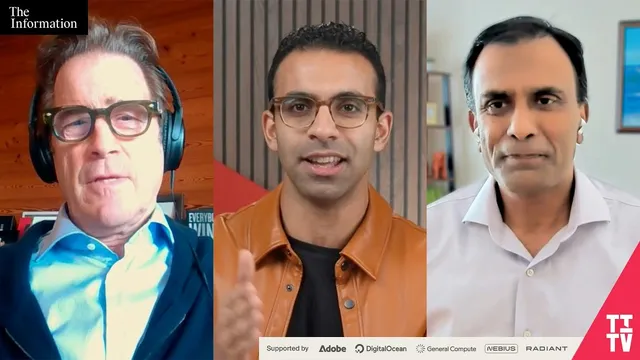
 The Information's TITV · Akash Pasricha with Blake Scholl, Aaron Holmes, Dallas Dolen, Ion Stoica and Xianghang Yang
The best minutes
- 5:54Founder successors often lack the founder’s strengths4 min
- 10:20Reusing Starship’s upper stage could sharply cut launch costs6 min
- 17:51Claude’s Office connector has about one-tenth Copilot’s users7 min
Also worth watching
- 25:07A strong Anthropic IPO could reopen the market for 900 unicorns6 min
- 35:19GPU prices vary up to threefold, largely with provider reliability5 min
- 41:57Companies customize open models for quality, cost and control2 min
- 32:06Anthropic’s IPO could give OpenAI a useful market test3 min
Skip the opening show rundown, the petition's due-process discussion, the NeoCloud survival discussion and the closing Jensen board questions.
Full analysis · 6 min read
Real Alpha · Nov 20
Claude’s Office connectors have about a tenth of Copilot’s weekly users
- Claude’s Office connectors had about one-tenth Copilot’s weekly users, Aaron Holmes reported.
- The gap is meaningful, but it cannot separate product quality from Microsoft’s distribution, pricing and security pitch.
- Teams should measure task success, reliability-adjusted cost and control before changing defaults.
Free with an account
Read the rest of the analysis
6 sections, the 4 other voices it tests Scholl against, and what it means for you. Every episode we cut gets one.
Check your inbox
We sent a link to your address. Click it to finish signing up. Not there in a minute? Look in spam.
or
Signed up before? The same buttons sign you in. The episode, its moments and the transcript stay free.
Claude trails Copilot by roughly an order of magnitude
Aaron Holmes reported that Claude’s Office connectors had about an order of magnitude fewer weekly average users than Copilot. They were also growing more slowly, six months after Anthropic introduced the connector.
That is a useful competitive signal, but a narrow one. It counts weekly connector users, not all Claude use, paid Office seats, task outcomes or renewals.
For example, a Copilot user may still reach Anthropic models through some features. Holmes said Copilot uses Claude models for some features, so a Copilot session does not automatically mean Anthropic lost the task.
The ratio therefore measures adoption on Microsoft’s home turf, not which model customers prefer overall. It also cannot show whether people switched from Claude or never adopted the connector.
“They're about an order of magnitude smaller in terms of weekly average users.”
Our read
The gap shows where adoption stands inside Office, not why customers chose it. A distribution advantage can look like a model advantage unless teams separate those factors.
Microsoft sells a bundled defense, not just model quality
Holmes said Microsoft plans to make price, security and quality central to its defense. Its pitch is not just better answers, but integration with the Office and Azure environment customers already use.
For instance, Holmes was told Ignite would emphasize lower token use and keeping data within an Azure boundary. Those concerns affect budgets and governance, but the episode offers no comparative savings or security audit.
Holmes said Microsoft has some confidence that its collected Copilot satisfaction data is getting better. He thinks that may be starting to show in Copilot sales Microsoft has disclosed.
The product’s usage lead therefore cannot establish that its model is better. Convenience, bundled access and security assurances can each help explain why customers use it.
Satya Nadella made a related point on The Pragmatic Engineer in November 2026. He said companies should preserve private evaluations and switch models without losing their learning loop.

Our read
Microsoft’s edge here is a package of access, governance and improving product quality. The episode does not isolate which part drives usage, so buyers should test each separately.
Scholl says founder succession defeats simple deputy promotion
Blake Scholl’s succession theory is plausible, but his evidence is illustrative rather than systematic. He said founders build around distinctive strengths and weaknesses, while their subordinates are chosen to complement them.
He cited Apple, describing the Mac, iPod and iPhone as products of the Steve Jobs era. He said Apple remained financially successful afterward, while he thinks Jobs might have moved it beyond the iPhone.
Scholl also said history shows that replacing a visionary founder with an operator or CFO can preserve a business while losing its trajectory. He offered anecdotes such as Apple, not measured comparisons of leadership or product output.
One hypothesis he offered is that founders replace each other better than nonfounders replace founders. He called succession an unsolved problem, rather than presenting a tested solution.
“the people they surround themselves with have to complement them”
Our read
The Apple comparison makes Scholl’s concern concrete, not conclusive. His examples suggest a question about succession design, but do not establish a general rule.
Scholl favors reinstatement as investigations proceed
Scholl said he hopes Jensen Huang is reinstated and that investigations then play out. He said the government and Nvidia’s board should do their roles, with facts carrying the day.
His preference is clear, not neutral. Scholl signed the petition and supports Huang’s return, while saying he has no inside information about the board’s process.
Ion Stoica, Databricks cofounder, offered a narrower view near the end of TITV in November 2026. He said Huang had done a fantastic job, but he did not know the details and trusted Nvidia’s board to lead a strong process.
Paul Kedrosky said on Prof G Markets in November 2026 that Huang’s conduct makes a return difficult to defend. His separate point about higher capital costs for AI companies concerns financing, not evidence about Nvidia’s inquiry.
Ed Ludlow said on Bloomberg Businessweek in November 2026 that Nvidia went public before dual-class shares were common, leaving Huang without voting control. Founder status and formal control are distinct, but neither settles the board’s decision.
 Paul Kedrosky · Prof G Markets · Nov 19AI financing is tightening for marginal compute providers
 Ed Ludlow · Bloomberg Businessweek · Nov 14Nvidia's 1999 IPO left Huang without founder-style voting control
Our read
Scholl favors reinstatement while investigations proceed. His preference is clear, but this episode does not establish what the investigations will find or what the board should decide.
GPU prices make reliability part of the cost
SkyPilot’s founders offer a useful comparison because AI infrastructure costs are not captured by list price alone. Xianghang Yang said reserved Blackwell or Hopper prices could differ by two to three times across providers.
Yang identified reliability as the largest contributor to that spread. A cheaper reservation has less value if capacity fails or workloads need recovery, making usable cost more informative than the quote.
Take the setup described here. SkyPilot coordinates GPUs across clouds and aims to mask some provider reliability problems, so companies can use more of their available fleet.
Ion Stoica said SkyPilot is not currently a compute marketplace, though it could enable one later. The episode describes a way to manage fragmented supply, not proof that shortages or provider risks disappear.
Our read
The relevant comparison is dependable compute delivered per dollar, not the lowest quoted rate. SkyPilot’s founders describe a way to manage provider variation, not evidence that it eliminates it.
In-house models trade control against operating burden
Yang’s case for in-house models is quality plus economics, not cost alone. He said companies can customize open models for their domains and get better quality at lower cost, while keeping more control.
But the episode gives no benchmark, customer count or measured savings for that view. Buyers still need to compare task quality, inference cost, integration effort and security on real workflows.
Stefano Corazza, Canva’s AI research head, made a related efficiency point on The TWIML AI Podcast in November 2026. He said owning the full stack enables deeper inference optimization, supporting the mechanism but not SkyPilot’s results.
That makes control a hypothesis to test, not an automatic benefit of self-hosting. Bringing applications, models, platform and compute in-house also increases operational responsibility.
A private scorecard can connect evaluation to actual costs. Compare the gains with the convenience and bundled economics of an integrated assistant before expanding the stack.
Our read
Custom models may improve quality and cost, but the episode offers no measured result to budget against. Teams should verify those gains on their own tasks before adding operational complexity.
What it means for you
- Set an adoption baseline. Track weekly active users for each assistant inside the same workflows. Keep connector use separate from total model use and paid seats.
- Separate use from quality. Test assistants on the same Office tasks, then score completion, rework and time saved. This helps distinguish distribution from better task performance.
- Price reliable compute. Compare cost per usable GPU hour across providers, including downtime and recovery. Yang said reserved prices could vary two to three times.
- Run a private model eval. Measure task quality, cost and security for customized models against your current workflow. Keep the evaluation useful when models change.
What to watch
- Whether Copilot’s weekly-user lead and growth advantage persist.
- Whether Microsoft’s Ignite cost and security pitch comes with measurable evidence.
- What the first six months after Anthropic’s IPO reveal about the metrics public investors reward.
Send this to product and IT leaders choosing the default AI workflow for Office.
Watch the minute where Holmes gives the weekly-user gap.
Written by Real Alpha from the episode's transcript and the other moments it links, then checked against the transcript. Quotes are the speaker's exact words.
Minute by minute
- 3:09Scholl argues for due process
Scholl says Jensen Huang should not be pushed out of Nvidia in a media firestorm, and argues that the board and government should investigate while facts emerge. He says founder succession remains unsolved: successful subordinates may complement a founder without being suited to replace one. He points to Steve Jobs, Elon Musk and Huang as distinctive leaders who drive reinvention.
- 9:26Upper-stage reuse could cut launch costs
Scholl calls Starship’s return an early proof point, not evidence that rapid reusability is solved. He explains that a booster reaches roughly Mach 3, while the upper stage accelerates to around Mach 25, making its return and heat protection much harder. He says full, rapid reuse could further reduce the cost of access to space, and that SpaceX will need to iterate with real hardware.
- 17:22Copilot retains an Office usage lead
Holmes reports that six months after launch, Claude’s Office connectors have about an order of magnitude fewer weekly users than Copilot and are growing more slowly. He says Microsoft’s bundling, convenience and improving product quality may help, and notes that Copilot still uses Anthropic models for some features. At Ignite, Microsoft plans to stress cost, Azure data security and AI agents.
- 25:36Anthropic’s IPO could encourage listings
Dolen estimates that about 900 private unicorns, valued at $5 trillion to $6 trillion, are looking to go public; he says that backlog represents about four years of traditional IPO volume. He argues that a strong Anthropic listing could signal opportunity for other companies. He also notes that about 70% of companies that went public in the last three years trade below their IPO price.
- 28:26Investors may press startups for cash flow
Dolen says investors in startups and newly listed companies will likely focus on positive cash flow and paying customers, not necessarily GAAP earnings. He says a successful Anthropic IPO could motivate private companies such as Stripe, Databricks and Anduril to consider listing. He expects OpenAI and other firms to learn from Anthropic’s post-IPO trading and investor response.
- 35:19AI workloads span cloud providers
Stoica describes SkyPilot as a way to run workloads across multiple clouds when companies cannot find enough GPUs from one provider. He says the platform is not currently a compute marketplace, though it could enable one. Yang says GPU reservation prices can vary by 2x to 3x, with provider reliability among the reasons; SkyPilot aims to help manage those differences.
- 39:55GPU demand supports neoclouds
Stoica says GPU demand remains high, with large cloud providers having sold capacity into 2027, and argues that the market may need more neoclouds. He says new providers could build more focused infrastructure using newer GPUs, but does not claim to know whether they will survive once larger providers expand capacity.
- 42:04Companies want customized, in-house AI
Yang says companies can customize open-weight models for better domain-specific quality at lower cost, and argues that quality matters alongside price. He says security concerns are also pushing companies to bring applications, models, platforms and compute in-house for greater control.
- 44:08Stoica trusts Nvidia’s board to decide
Asked whether Nvidia should bring Huang back, Stoica says he has no view on the decision and does not know the details. He says Huang did a fantastic job as CEO and that the board should run a strong process.
Published Nov 16, 2026.
Transcript · 35 min read
The Information's TITV, hosted by Akash Pasricha, with Blake Scholl, Aaron Holmes, Dallas Dolen, Ion Stoica and Xianghang Yang.
Transcribed by machine (Whisper) from the episode’s audio, so a word may be off here and there.
welcome everyone to the information's ti tv my name is akash vasreecha it is monday november 16th we have got a big week ahead of us with anthropics ipo slated for this thursday and i want to flag some special coverage the information is planning for the day on thursday starting at 11 30 a.m pacific 2 30 p.m eastern we are hosting a live video summit for the information subscribers we're going to talk through the markets reactions in real time as the stock starts to trade we'll talk about what it means for the ipo market how anthropics tech currently stacks up if you are a subscriber. You can register for the live video summit at theinformation.com slash events. If you're not a subscriber, I highly recommend you become one. You can check out our website for more details. Today on the show, we are covering the petition circulating through Silicon Valley, advocating for Jensen Huang to return as the CEO of NVIDIA. We're going to bring on the CEO of Boom Supersonic, who is one of the signatories. We're also going to talk through the big starship landing this weekend for SpaceX.
We then have some exclusive reporting for you on how Microsoft's Claude integrations are starting to plateau in terms of usage. We'll then give you a preview of what to expect for the Anthropic IPO and the IPO market with our partner, PwC. And we're going to close out the show with the co-founder of Databricks, who has a new startup that was featured last week on our list of the 50 most promising startups here at The Information. It's going to be a great show to start off the week, so let's get right on into it. Two big stories making headlines over the weekend were a growing petition to bring Jensen Huang back as CEO of NVIDIA that a number of Silicon Valley heavyweights have signed on to, and separately, SpaceX hitting a major milestone, catching the upper stage of its Starship rocket.
To talk about both of these, I want to bring on Boom Supersonic CEO Blake Scholl. Blake, welcome to the show. It's great to have you here. Great to be here. Thanks for having me. Okay, so let's start with the petition. You have signed it. Walk us through why you decided to do that. I think founders are incredibly unique. People like Jensen are incredibly unique. They've got a unique place in history. And I think it's important we not have a comeback of cancel culture. And I think what we, you know, no one condones an affair. That's really simple. But the rest of this, I think we just don't know what really happened. And if there was a violation of law that needs to be investigated by government, there needs to be a process of objectively finding out what actually happened. And what we shouldn't do is convict somebody in the headlines and boot them out of the company that they founded in a media firestorm. Okay. So, I mean, let's just maybe break it down into maybe bit by bit here. The violation of the company policy. I mean, And if he was having this relationship, the company code says, you know, avoid conflicts of interest, part of which are personal relationships.
Read the whole transcript
So where do you stand on that? I think this is coming down to a basic thing, which is due process and not ejecting somebody from a company they founded due to a media firestorm. It's that simple. Okay. Okay. And so what about the board investigation? I mean, if the board does find evidence that he was the target of a foreign surveillance effort and that Alice Wong was connected to that, I mean, if the board found that, then what would that change about your perspective, if anything? I mean, I'm not on the board of NVIDIA. Like, so I'm coming at this really from an outside perspective, which...
simple uh you convict people in the court of law not in a court of public opinion uh and you don't inject uh hugely valuable founders on a whim in a media firestorm and like that's it and so we should let the government do their role we should let the board do their role and we should let the facts carry the day but what we have to remember is that uh none of this is to be taken lightly and we don't want to bring back cancel culture where all it takes is like a rush of headlines and then someone's out and then we don't think about it. Right. Do you think that it will happen? I mean, do you think the board will bring them back or what's your sense of what the process here could unfold to be?
I have no inside data. You know, my hope is that, yeah, we're able to reinstate Jensen and then we let, you know, we let investigations play out. The government has a role in investigating this. The board has a role in investigating this. And I think everyone deserves some transparency and some facts. and Jensen deserves due process. Right. Let me ask you this.
“the people around the founder complement the founder. None of them is like the founder.”
to another story which uh maybe uh will make some more sense here why the plane in the background why you're an expert on this next topic that we were hoping to talk to you about starship uh landed the upper stage of their rocket for the first time over the weekend um you obviously are in the business of aerospace, I guess, if I can call it that. So I'm sure you were watching this very closely. Can you just help me understand here, I mean, what are the variabilities here?
And I realize we're talking about rocket science, so just bear with me here. I mean, what are the variabilities here, if you're SpaceX, that make it hard to know, if I'm launching a rocket, you know, I'm not really certain what the outcome is going to be if I'm going to be able to land this thing or not? Because I'm just imagining all the calculations that we can do, and then I'm
“You can't predict what it's going to take to do something that no one's done before.”
I've always wanted to ask this. The rockets that splash down in the ocean, can they reuse some of these parts, if at all? The ones that land in the ocean? Yeah, I don't think they're trying to, right? The point is to be able to go launch a full orbital rocket, booster, and upper stage, bring it back to the launch pad that it came from, refuel it, and then go again in a short period of time with a small amount of cost. You need to make rockets reusable like airplanes are reusable. That's the whole thing. Going and plucking them out of the ocean is like kind of a distraction along the way.
Yeah, and I just wondered if, you know, along the way, the ones that do the splashdown flights, you know, the ones that don't go according. I just wondered if you could reuse any of the parts, if at all. I mean, theoretically you could, but I don't think that is the focus of the development effort. The focus of the development effort is to make the whole thing fully and rapidly reusable. And uh... And so I think the way you do that as quickly as possible is to go all in on that and plucking stuff out of an ocean and trying to refurbish it might save you a little bit of cost, but it's a distraction from the real goal.
Right. Yeah. Okay. Well, like you said, rocket science 101. So I appreciate you coming on. And next time you come on, we do have to ask you about the planes that you're building at Boom because you're working on some cool stuff. I want to thank you, Blake, for coming on. That is Blake Scholl, the founder and CEO of Boom Supersonic here on TITB. Anthropic is trying to convince Microsoft customers to connect Claude to Office 365 and use it as their main AI assistant in the software. But so far, Microsoft is showing some success convincing customers to stick with its own co-pilot tool instead of Claude.
That is according to new exclusive reporting from my colleague Aaron Holmes. I want to bring on Aaron to share more about what he found. Aaron, welcome back to the show. It's great to have you here. Remind us of the context here.
“the cloud connectors for Office are still, you know, pretty marginal compared to Copilot. They're about an order of magnitude smaller in terms of weekly average users.”
our Microsoft reporter here at The Information.
Our next segment is with our partner, PwC. All eyes are on Anthropic this week as it looks to list shares on Thursday on the NASDAQ. The question now isn't just how it will perform, but really what it means for the IPO market at large. For a conversation on all that, I want to bring on Dallas Dolen. tech media and telco industry leader at pwc dallas welcome to the show it's great to have you back it's always great to see you kosh okay uh anthropic it's coming up this thursday as far as we know nobody knows what's going to happen with the shares what i'm more focused on is what
“There are currently estimated to be about 900, maybe a little bit more unicorn, you know, private companies looking to go public”
what about some of these other um late stage company the the companies who we've all been waiting to go public the stripes the databricks the andurals um you know i i'm it's the story here has really been they can raise the money in the private markets and i wonder if you think this is at all an inflection point for those companies at all you know when you get used to being private for a really really long time um it may very well be that that's the position that you're in the couple that you mentioned there um have have been you know stalwarts if you will as it relates to unicorn but also you know staying private and the the the inklings or you know some of the testimonials that are coming out and saying hey you know maybe this is something we don't want to do i do think a really positive and successful ipo you know from an anthropic and then looking backwards obviously to you know what what spacex did could be the motivation for some of these
other companies that are sitting there um to go public and you know the top the top 10 or so they're on that list you named a few of them you know ripple ramp cognition a few of the others that are on there you know that's a lot of companies who i think could be really motivated i think the markets would be highly receptive to companies like that going so you know it's sort of like uh if your friend jumped off a bridge would you go do it too i mean i could see that being you know analogous to you know this situation with ipos and and executives and shareholders and employees importantly looking at this and saying aha here's an opportunity you know can we build some forward momentum and is this something we want to go do right okay and then looking ahead
“we're going to have a really clear indicator of what the analysts and the markets are responding to in terms of direction of flow on the data”
We are bringing on another pair of founders whose company Skypilot made our recent edition of The Information's 50 Most Promising Startups.
The company coordinates AI inference across the major cloud providers. It was founded by Jan Stojka and Jiangang Yang. Jan is also the co-founder of Databricks. I want to bring them on both for a conversation. Welcome to you both. it's great to have you here thank you for having us okay so jan i want to start with you on the
“Sometimes the spread can be like 2x, 3x, even if we are talking about, you know, anywhere from short-term to long-term reservations.”
Right. So Jan, I want to ask you a question about some of these cloud providers, specifically the NeoCloud providers that have been very much center of attention the last couple months. Given that you work with all these different cloud providers in the ecosystem, what do you make of the scrutiny around the NeoCloud's business models? Do you think that it is warranted or do you think it's unfair? I think fundamentally what we are seeing, and you read that everywhere, there is a huge scarcity of GPUs. And many of the clouds, including the large ones, they already sold their GPUs probably 2027, for 2027.
So fundamentally, there is a big demand. I think there could be questions about how the new clouds are going to build their infrastructure. They need to raise a lot of money to do so. but I think that again it's like when you look forward, it's not like you need less NeoClouds, you need probably more and each NeoClouds to be bigger. But I guess the question is, do you think these NeoClouds can survive after these hyperscalers or as you call them, superscalers, after they complete their data center build outs, will this need for bridge capacity go away? i think um it's very hard and i am not expert there but whenever you are going to build something new you are going to have an advantage right because you are going to learn everything what was done before and you are not going to have some kind of the technical depth and and then it's going to allow you to build a much more focused infrastructure which in general is going to be cheaper um also as you are going to get also newer uh gpus new york then they are going to be also in general cheaper at least in terms of flops per dollars so that should be able to
“By taking a really good open wave model and customize it in their particular domain they can get much better quality at a lower cost”
if I didn't ask you about the Jensen situation, given that you're the chair of the Databricks board and you have tremendous board experience yourself. Do you have a view on whether or not they should bring Jensen back? Unfortunately, I don't have a view on that. Okay. Any thoughts
thoughts on how the board might be able to handle all of this pressure with the petition and everything like that? Yeah, I think, look, I mean, it's a difficult situation, I think, obviously for NVIDIA and for the entire AI ecosystem. And obviously, I don't know the details, Jensen did a fantastic job as the CEO of NVIDIA. That's kind of a truism, everyone knows that. But of course, you know, there are, you know, you just trust the board and is going to do the right things and they are going to lead a strong process and we'll see what is going to be at the end of it. Great. Okay. Well, I want to thank you both for coming on. That is Jan Stojka and Xianghang Yang from SkyPilot here on TI TV.
that does it for today's show a reminder we are on this stream monday through friday at 10 a.m pacific 1 p.m eastern if you can't make it then episodes are available on the information.com on our youtube channel or wherever you get your podcasts make sure to follow us on social media on x on instagram on tiktok and on linkedin i am already excited for our next show tomorrow have a great rest of your monday bye-bye for now