The alpha, twice a week
That was 3 min.
Get the best new moments in your inbox every Wednesday and Saturday. It's free.
Check your inbox
We sent a link to your address. Click it to finish signing up. Not there in a minute? Look in spam.
or
Bloomberg Surveillance · 3 min · Nov 6, 2026
Health costs are squeezing wage gains as payroll growth resets
 Claudia Sahm
 says rising health-insurance costs compete with cash wages as inflation rises.
In this episode
Full analysis- 34:11AI fundamentals and market narratives are moving apartPro pick 7 min
- 42:21Asian investors are buying the dip as funds face lossesPro pick 6 min
- 49:59Short-dated corporate debt can beat money-market yields5 min
- 28:19One-off price pressures could bring inflation to 2.5% in 20275 min
- 19:13Bond yields may have overshot after a global selloff3 min
- 0:43Health costs are squeezing wage gains as payroll growth resets3 min
- 14:04Cyclical hiring is now leading the jobs mix2 min
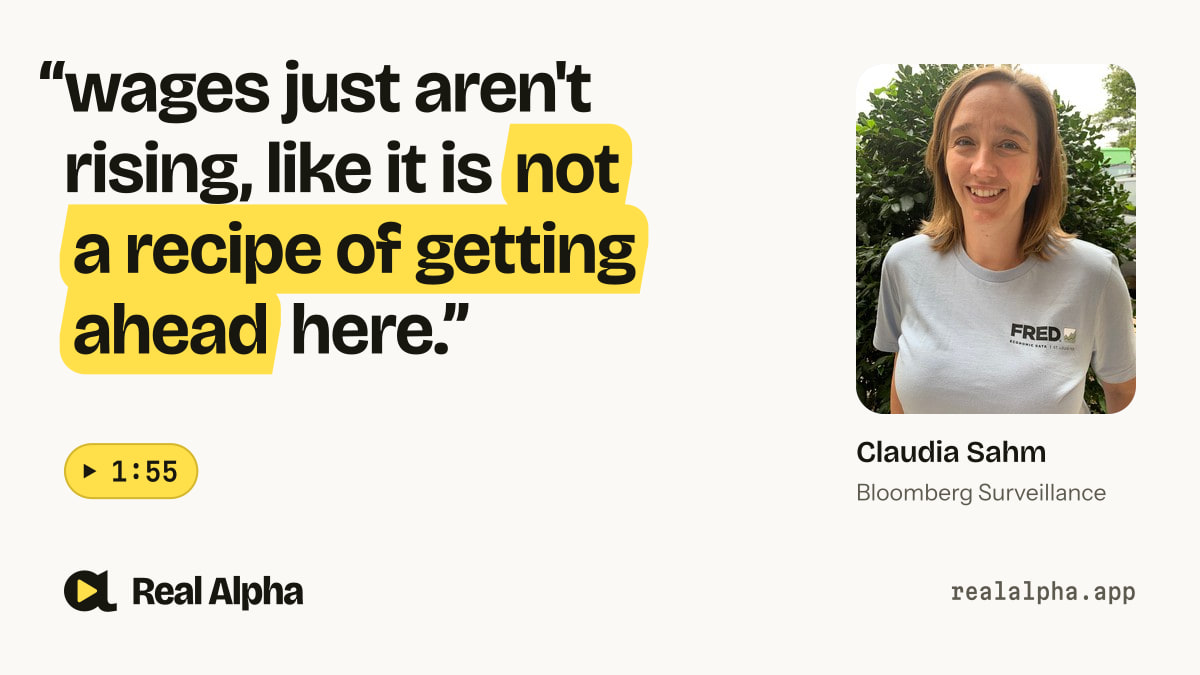
“wages just aren't rising, like it is not a recipe of getting ahead here.”
 Claudia Sahmat 1:55 · Bloomberg Surveillance
Takeaways
- Health-insurance costs are rising considerably for employers.
- Real wage gains are weak as inflation has picked back up.
- Immigration shifts and an aging workforce lower the payroll-growth baseline.
About this segment
Claudia Sahm says rising health-insurance costs compete with cash wages as inflation rises. She sees payroll growth around 70,000 as a result of weaker labor-force growth, immigration shifts and an aging workforce.

Chief Economist, New Century Advisors
Developed the Sahm Rule recession indicator and advised the Federal Reserve, White House, and Congress on economic policy.
- TK
Tom Keene, Host
- PS
Paul Sweeney, Host
From “October Jobs and Tech Selloff | Bloomberg Surveillance”, Nov 6, 2026. Watch the full episode
Thanks. We'll look at and fix what's off.
Transcript
From the transcript Bloomberg Surveillance publishes with the episode.
- 0:46
my favorite is the ECI Wages and Benefits Index. We ballooned out of COVID to 5% year over year. We've come back But we haven't come back enough, but inflation's high. Are we getting ahead every month in our wages and benefits?
- 1:09
Not in an inflation-adjusted sense, particularly this year once. And that's really about inflation having picked back up again after the conflict in the Middle East began. And we've seen on the wages side some slowing, particularly in what goes home to people's paychecks. I thought what was really notable out of the Employment Cost Index last week was that, unlike today's data, average hourly earnings, The ECI also brings in the cost employers pay for benefits, including health insurance.
- 1:41
And those are rising pretty considerably, the health insurance costs. So that's one where, you know, if employers have got to put those costs into the.
- 1:49
Benefits, they're not going to pass on in the wages. And you just don't see the, you know, the wage improvements.
- 1:54
So I think given the backdrop of inflation has picked back up and wages just aren't rising, like it is not a recipe of getting ahead here.
- 2:02
I would suggest, Paul, on this jobs moment, that health care costs, housing insurance costs, line up the list of costs is just a huge story.
- 2:13
Huge story. And I think we kind of saw that in the midterms here. Affordability is the broader number. So, Claudia, is a 70,000 change in on-farm payrolls, is that kind of the new normal? Because there was a time we were all used to something 100,000, 200,000. Is sub 100,000 the new world here? So yes, I think so at least for now.
- 2:36
And it's true since the beginning of the year, payrolls have averaged a little under 70,000. Now we've had some times where we've got some upside surprise on that and saw some in the hundreds of thousands and some good months, but that didn't hold.
- 2:48
And we've seen some pretty weak months. Last month was just a little under. 30,000, but it has been really pretty stable around that average. of about 70,000, which is a big improvement over last year. Like we ended the year with some really like scary payroll numbers. But if you go back a few years from that, 100,000, 200,000, these are the averages. And the thread that ties this kind of average moving around so much is we have had really big shifts in labor force growth in the US. And a lot of that ties back big shifts in immigration policy. And we've also seen, you know, an aging of the workforce. We've got, you know, so demographics are kind of pulling that average down. So, yeah, we might get a good month today, but it's going to take a lot to pull that average up to some to numbers like the 200,000 we've been used to
- 3:35
for some time.