The alpha, twice a week
That was 3 min.
Get the best new moments in your inbox every Wednesday and Saturday. It's free.
Check your inbox
We sent a link to your address. Click it to finish signing up. Not there in a minute? Look in spam.
or
Bloomberg Businessweek · 3 min · Oct 23, 2026
Hiding applications and using zero trust can limit cyberattacks
 Jay Chaudhry
 describes how hiding applications and limiting movement across connected systems can reduce exposure to cyberattacks.
The episode’s best minutes
Full analysis- 1:39Chip financing grew from one deal to a trillion-dollar market5 min
- 18:12The wealthy can avoid income tax without selling stock6 min
- 11:20Hiding applications and using zero trust can limit cyberattacks3 min
- 2 more moments in the full episode
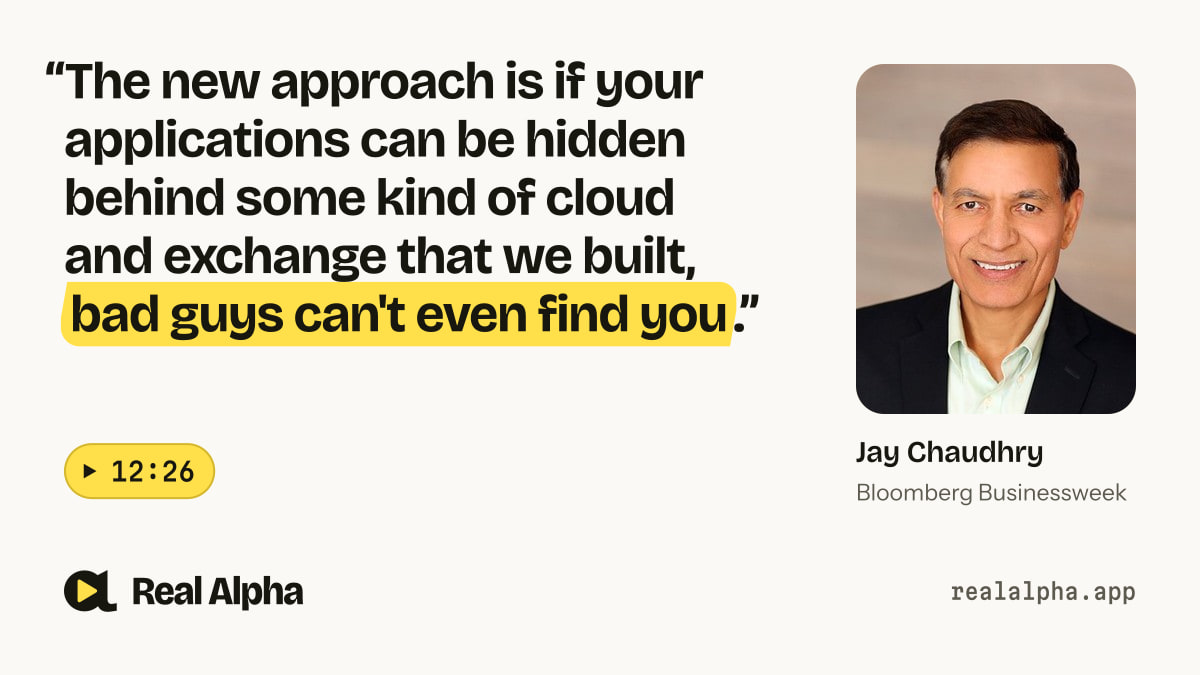
“The new approach is if your applications can be hidden behind some kind of cloud and exchange that we built, bad guys can't even find you.”
 Jay Chaudhryat 12:26 · Bloomberg Businessweek
Takeaways
- The PHP flaw affects a widely used share of websites.
- Hiding applications can make them harder for attackers to find.
- Zero trust can limit how far an intruder moves inside a network.
About this segment
Jay Chaudhry describes how hiding applications and limiting movement across connected systems can reduce exposure to cyberattacks. His examples show why patching alone may not be enough.

CEO & Founder, Zscaler
Built Zscaler’s Zero Trust Exchange and founded earlier security companies SecureIT, CipherTrust, and AirDefense.
From “Bloomberg Businessweek Daily: Blackstone Chips Bet (Podcast)”, Oct 23, 2026. Watch the full episode
Thanks. We'll look at and fix what's off.
Transcript
From the transcript Bloomberg Businessweek publishes with the episode.
- 11:31
Well, one of the things I want to ask you, Jay, from your perspective, and this is your world, when you say larger and larger, is it that AI in terms of these vulnerabilities that they will reach more and more like with, are you talking depth in terms of the impact, the troubles that it can ultimately create, which kind of freaks me out. Right.
- 11:53
So, so both actually getting broad, take PHP. It's widely used over 70% of websites. So it's very wide, but the then second part is depth. How serious is the vulnerability? That gets measured on a scale of 1 to 10. This is sitting at a 9.4. I think those things will happen. The question is, how do we protect ourselves? Everyone is focused on patching and patching and patching. No one has done patching ever. So while patching is important, I think you need to look at things differently.
- 12:26
I'll give you an example. If your house gets attacked every day, Are you keep on building a moat bigger and bigger and bigger moat?
- 12:34
No, it doesn't work. You need to figure out what's the new approach. The new approach is if your applications can be hidden behind some kind of cloud and exchange that we built, bad guys can't even find you. If they can't find you, they can't attack you. So that's a different way of doing it. That's number one. Number two, when all these offices are connected to each other, The bad guys get into one office.
- 12:59
That's the contagion part, right? Keep going. Yes, yes. That's the contagion part.
- 13:05
It's like if a bad guy lands in New York City from outside and this bad guy or, say, a terrorist gets on U.S. highways, there's no light. They can go anywhere. That's the part that spreads it out. For that, you need to bring zero trust. If we do these two approaches... In addition to patching, we've been in good shape. I'm an optimist. I think human ingenuity is wonderful. We think we can protect our customers, and we are doing it.
- 13:34
By the way, we ran 450 research assessments for our customers, and they're getting in. A better and better shape. But also, in the last 24 hours, our research team found 1,200 unique attacks that are launched on the PHP servers. And those things will happen. We need to get proactive with newer approaches, not old firewall-based security.