The alpha, twice a week
That was 6 min.
Get the best new moments in your inbox every Wednesday and Saturday. It's free.
Check your inbox
We sent a link to your address. Click it to finish signing up. Not there in a minute? Look in spam.
or
Bloomberg Businessweek · 6 min · Oct 23, 2026
The wealthy can avoid income tax without selling stock
 Ray Madoff
 argues that wealthy people can avoid taxable income by holding appreciated stock, borrowing against it and benefiting from buybacks.
The episode’s best minutes
Full analysis- 1:39Chip financing grew from one deal to a trillion-dollar market5 min
- 18:12The wealthy can avoid income tax without selling stock6 min
- 11:20Hiding applications and using zero trust can limit cyberattacks3 min
- 2 more moments in the full episode
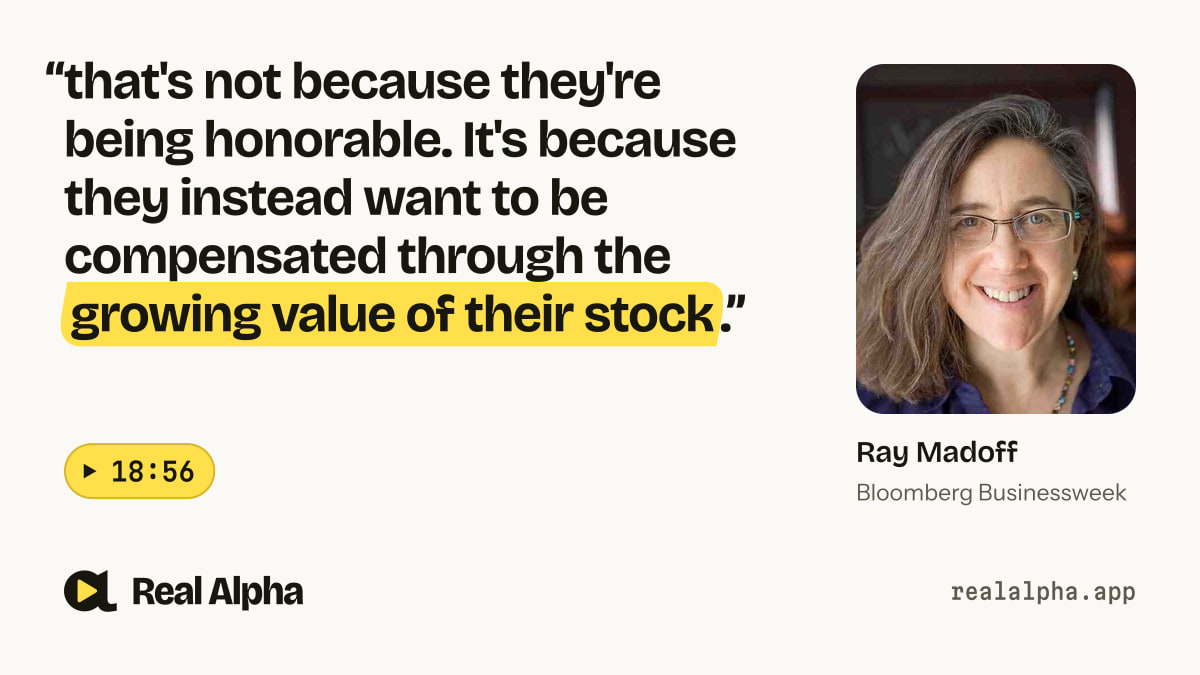
“that's not because they're being honorable. It's because they instead want to be compensated through the growing value of their stock.”
 Ray Madoffat 18:56 · Bloomberg Businessweek
Takeaways
- Many billionaires receive wealth through stock growth, not salary.
- Buybacks can raise share value without triggering taxes like dividends.
- Borrowing against stock can fund a lifestyle without selling shares.
About this segment
Ray Madoff argues that wealthy people can avoid taxable income by holding appreciated stock, borrowing against it and benefiting from buybacks. That helps explain why income-tax statistics can obscure how wealth is taxed.

Professor of law, Boston College
Authored The Second Estate, arguing the tax code entrenches wealth and creates an American aristocracy.
From “Bloomberg Businessweek Daily: Blackstone Chips Bet (Podcast)”, Oct 23, 2026. Watch the full episode
Thanks. We'll look at and fix what's off.
Transcript
From the transcript Bloomberg Businessweek publishes with the episode.
- 18:23
And so I think that what's going on in this country is lots of people are sensing that our tax system is unfair. But what they don't know is how it's unfair. They hear things like the top 1% pay 40% of the taxes. So then why would there be a problem? And the issue is exactly this point you make, which is that people who have a job, who earn salaries, they pay income taxes and the highest earners pay the highest income taxes. However, the wealthy are able to avoid taxes because they are able to avoid taxable income. And that's because they don't rely on salaries. All of our famous rich people take salaries of like a dollar. And that's not because they're being honorable. It's because they instead want to be compensated through the growing value of their stock.
- 19:17
And so for people who have investments and inheritances, they have an entirely different tax system. And that tax system is utterly porous and really optional so that people who rely on investments and wealth They are able— and inheritances are able to avoid taxes altogether. And in this way, they are like the second estate of pre-revolutionary France, who were the aristocracy that were legally written out of the tax system.
- 19:44
And that's what we've done here. And the reason that statistic is so confusing— Legally written them out of the tax system. So go ahead. Yes. And the reason that statistic is so, that's always being brought up by the Wall Street Journal and others trying to say, it's reason, so misleading is because the 1% they're referring to, it's not. Jeff Bezos. No, it's the doctors, it's the lawyers. It's not Elon Musk.
- 20:07
Exactly. They're not in that bulk of people who are paying the taxes. And they're just as likely to be in the 40% of Americans who are non-payers of income tax as they are in the top 1% that are paid 40% of the income tax. It wasn't always like this. No.
- 20:21
And this is actually a relatively new phenomenon. You've talked about how even during the Reagan administration, the 1980s, this was a completely different scenario. What happened? Absolutely.
- 20:32
And so what's interesting is that our tax system was written specifically to address the world of inequality. And it was designed to impose its greatest burdens on the richest Americans by having a high income tax, originally a tax limited only to the richest Americans, but then made progressive so that the income tax you had a higher rate, the more you earned. And on top of that, an additional estate tax, which was designed to make sure that the wealthiest Americans contributed the most because they had the most capacity. And two things happened. One thing that happened is that we shifted the ways that.
- 21:11
Companies shared profits. Prior to 1982, the main way they shared profits was through dividends. And dividends used to be taxed the same as salaries and wages. And so you owned a lot of stock, you got a lot of dividends, you paid a lot of taxes. Now, that's not the case with our billionaires of today. Their companies don't share profits through dividends. They have growing ownership value, growing value of their stock.
- 21:41
And one big way they do it is by buying back their own stock. And prior to 1982, this was seen as price manipulation. Because when a company buys back its own. Stock- Supply and demand, right?
- 21:52
Exactly. The value of the shares goes up. It's such a big part. It's so fun. I don't know that I had realized or made that connection because we used to talk about dividend reinvestment plans, drips. That was a big investment strategy and it kind of has gone away. And it's just interesting. We're always like, why aren't those tech companies paying dividends? Well, so as we think about kind of where we are, I think there's another component to kind of layer on this is that individuals who are super wealthy are able to leverage that wealth politically. And whether that's to keep the tax code still favorable to them. Talk to us a little bit about that part of this.
- 22:36
So first of all, they're able to leverage their wealth politically. first of all, for. Their personal use, right? Because people say, well, they have to sell that wealth and pay capital gains, but they don't. No, they just call the bank. Exactly. Call the bank, call a friend, call anybody who wants to lend them money and know that it's going to be very well secured and there's people lining up to do it. So they can get endless loans and they do to support their lifestyles.
- 23:01
Sorry, I just want to jump in here. That's why I don't necessarily buy the argument from some of these folks in California who are opposed to Prop 40 that they'll have to sell shares of their company in order to pay that. Exactly. Well, couldn't they just call a bank? Mark Zuckerberg, if he has to pay 5% tax, it'd be about $ 12 billion based on his net worth. Wouldn't a bank loan him $ 12 billion?
- 23:22
I think with $ 150 billion or more of stock to secure it, I think that they'd be pretty comfortable.
- 23:27
Lending them that money. Wait, they're not going to worry that he's going to default, right? Exactly. Sorry, I interrupted you. No, that's absolutely the case.