The alpha, twice a week
That was 6 min.
Get the best new moments in your inbox every Wednesday and Saturday. It's free.
Check your inbox
We sent a link to your address. Click it to finish signing up. Not there in a minute? Look in spam.
or
Prof G Markets · 6 min · Feb 6, 2026
Housing scarcity pits homeowners against first-time buyers
 Neera Tanden
 links high home values to the interests of current owners and points to rising rents and a first-time buyer age of 40.
The episode’s best minutes
Full analysis- 9:43Housing scarcity pits homeowners against first-time buyers6 min
- 30:06Tax code changes may be more practical than a wealth tax5 min
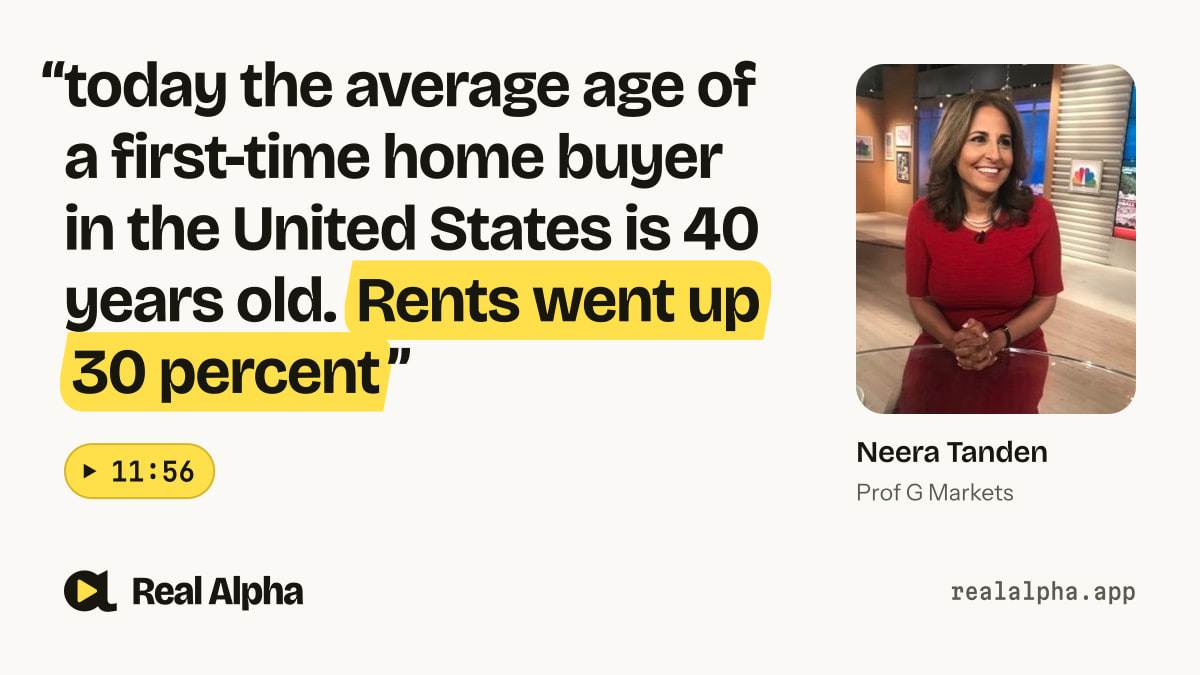
“today the average age of a first-time home buyer in the United States is 40 years old. Rents went up 30 percent”
 Neera Tandenat 11:56 · Prof G Markets
Takeaways
- The average first-time home buyer is 40.
- Rents rose 30% from 2020 to 2023.
- Keeping housing supply constrained protects owners but prices out new buyers.
About this segment
Neera Tanden links high home values to the interests of current owners and points to rising rents and a first-time buyer age of 40. She argues that limiting new housing makes affordability worse for everyone trying to buy or rent.

Neera Tanden is president and CEO of the Center for American Progress.
Helped found CAP and led Biden’s domestic policy agenda, including prescription-drug cost and insurance initiatives.

Ed Elson, Host

Scott Galloway, Host
From “The American Affordability Crisis — ft. Neera Tanden | Prof G Markets”, Feb 6, 2026. Watch the full episode
Thanks. We'll look at and fix what's off.
Transcript
Transcribed by machine (Whisper) from the episode’s audio, so a word may be off here and there.
- 9:51
So there's a lot of different domains to dig into here. I want to dig into housing for a moment. We saw two kind of remarkable interactions last week. I'm just going to play these two clips for you, and I'd love to get your reactions. There's so much talk about, oh, we're going to drive housing prices down. I don't want to drive housing prices down. I want to drive housing prices up for people that own their homes.
- 10:19
And they can be assured that's what's going to happen. We are going to give guidance at some point to see what is a mom and pop that someone, maybe your parents for their retirement have bought 5, 10, 12 homes. So we don't want to push the mom and pops out. We just want to push everyone else out. I mean, those two clips really made the rounds. I think the clip that I'd really like to get your reaction to is Trump saying that he actually wants housing prices to go up.
- 10:49
which is quite remarkable because it seemed that he's been trying to present that he wants to address housing affordability. He's come up with some proposals that we can get into, but then he comes out and he just says outright, no, I want them to go up. What do you make of that clip? How relevant and important actually is it? What does it mean for affordability writ large? We get a lot of conversation from Donald Trump, but every once in a while, he will just honestly tell you what he thinks about an issue. And I think this is really one of those areas. And, you know, for people who understand housing in America, one of the big challenges is that it's a difficult issue, right? Because people who have bought a house, you know, a lot of people's wealth in America is in their house. And so a lot of
- 11:43
incumbents like to keep the people who already own a home like to actually keep housing values up and sometimes oppose the development of additional housing in their neighborhoods, etc. But we're really living through one of the problems with that whole system, which is today the average age of a first-time home buyer in the United States is 40 years old. Rents went up 30 percent from 2020 to 2023, and they've stabilized since then. And in some markets, they're coming down, but people overall have got a rent shock and a housing shock. And I think it really does say a lot about the president, which is, I think, the people he talks to on a regular basis, maybe the wealthiest Americans, really want to keep housing values up because it is key to their wealth. But for working class Americans, middle class Americans who are trying to buy a home or trying to just
- 12:48
make ends meet by having an affordable rent. To say that you don't want any more housing means you want housing prices to go up. You want to make it harder to buy that home. You want to make it harder to afford the rent. That is what that means. And, you know, I think it's just kind of of a classic thing here, which is on tariffs, on this policy, on so much more, you know, the great irony here is the president is making life a lot harder economically.
- 13:19
for working-class, middle-class Americans. Do you think that that quote actually means that we are going to have a policy under Trump of not building more housing? Because, I mean, I guess something that's been interesting to me is I thought that there were just debates over what to... I thought we all agreed we want to get housing prices down. And then the debate or the divergence was like, how do you do that?
- 13:44
Do you do it by addressing interest rates? Do you go out and buy mortgage bonds, as Trump has proposed? Or do you, you know, he's even proposed that institutional investors can't buy single-family homes. Do you just build more housing? That's been the whole abundance thing coming from Ezra Klein. And yet, then he just says outright, no, actually, that's not our difference of opinion here. I want them to go up.
- 14:07
Does that mean that we're actually going to see policies, you think, that will actually increase the price of housing intentionally? Is that what that means? My interpretation of what happened here is the president might have been talking about lowering housing costs because his advisors tell him to say he wants to lower housing costs. It is a really deep concern for Americans. It's a really deep concern for young people, like, you know, people who are trying to buy their first home.
- 14:40
People are in their, like, 30s, 40s. it's like a lot of his constituents, it's people who voted for Donald Trump think housing is too high. So I think that is why his political advisors had told him that. And then I think maybe he was at Mar-a-Lago on a Saturday night where a bunch of really rich people said, well, you know, more housing means that in my neighborhood, like Scarsdale or wherever people live, you'd have more housing. And that, you know, that nobody wants that. Nobody wants housing, more housing in my neighborhood. Nobody wants to devalue like my house. And I think this is an issue where you kind of have to choose. I mean, this is the issue about policymaking.
- 15:21
And when you work in policy, you have to make a choice, oftentimes between two different groups. And, you know, I thought that clip kind of just, in a way, perfectly captured the president's interest, which has been a hallmark of his administration, which is to do what he needs to do for his supporters, donors, network, whatever you want to call it.