The alpha, twice a week
That was 8 min.
Get the best new moments in your inbox every Wednesday and Saturday. It's free.
Check your inbox
We sent a link to your address. Click it to finish signing up. Not there in a minute? Look in spam.
or
TBPN · 8 min · Nov 16, 2026
Huang treated chips as ordinary computers, not defense assets
 John Coogan
 frames Huang as balancing AI’s transformative promise with the belief that chips are ordinary technology.
The episode’s best minutes
Full analysis- 24:55Huang treated chips as ordinary computers, not defense assets8 min
- 13:21Contractors can share responsibility, but the buyer owns the choice3 min
- 9:40Tesla’s Cybercab fee may pay for remote human assistance3 min
- 2 more moments in the full episode
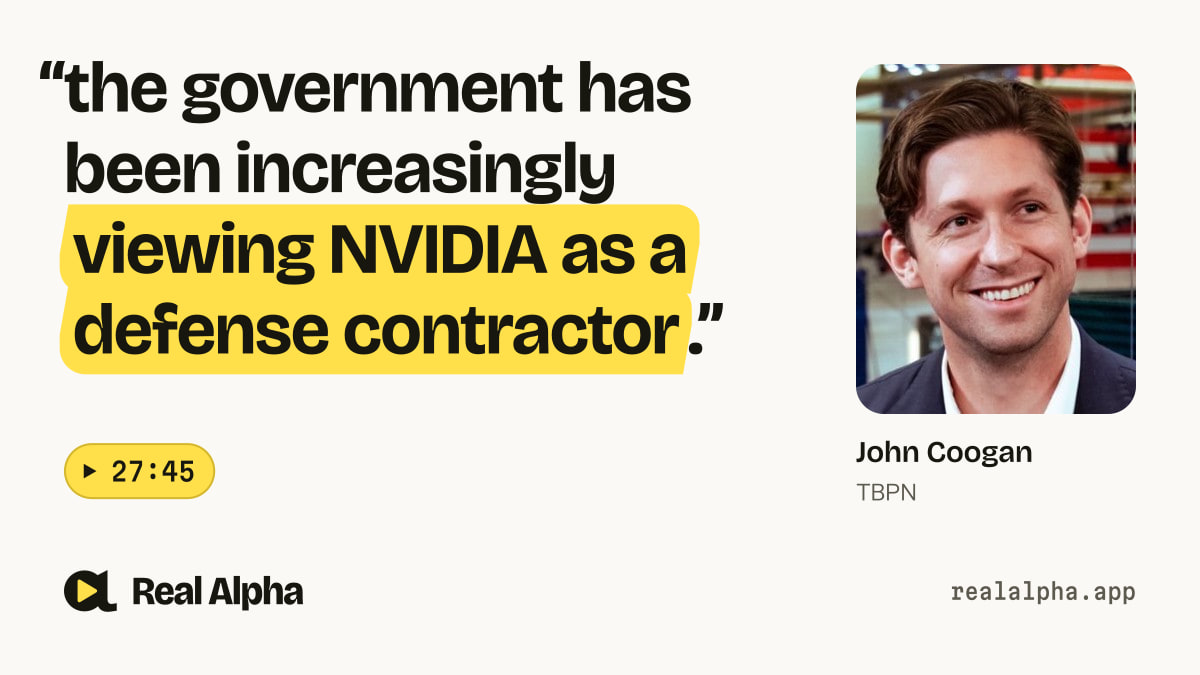
“the government has been increasingly viewing NVIDIA as a defense contractor.”
 John Cooganat 27:45 · TBPN
Takeaways
- Huang wanted to keep competing in China’s large computing market.
- Washington increasingly viewed NVIDIA as a defense contractor.
- Following the spirit of export controls matters, not just their wording.
About this segment
John Coogan frames Huang as balancing AI’s transformative promise with the belief that chips are ordinary technology. That mismatch with Washington’s defense-focused view helps explain the export-control backlash.

John Coogan, Host
Co-host, TBPN
Co-founded Soylent and Lucy; OpenAI bought his show TBPN in April 2026.

Jordi Hays, Host · Co-host, TBPN
Founded Branded Native; co-founded fintech Capital, which Rho bought.
From “Big Week, Ground Stop, Not Just Another Technology, Robert Pattinson is James Bond”, Nov 16, 2026. Watch the full episode
Thanks. We'll look at and fix what's off.
Transcript
From the transcript TBPN publishes with the episode.
- 25:01
He's juggling the fact that AI is so transformative that we need to spend trillions and trillions of dollars on infrastructure and that we're going to solve disease and bring back manufacturing to The US and all these amazing things. Yes. But the way that he at least thought about selling the technology was that it was much more of a normal technology. Yes. Right? That he was selling, fundamentally selling something like normal computers, right? And he wanted to sell them everywhere.
- 25:36
He didn't wake up a loser. He didn't think that he should have to give up the Chinese market. And he in some way didn't believe that he would ultimately be forced to by them developing their own supply chain and ecosystem. I would say what Ben gets into that I think is a good framing is this idea that... And and he talks about some of Besson's comments as well. But this idea that you have, like in in banking and defense, there's much more like self enforcement. Right? Like you you wanna follow the letter of the law but also the spirit of the law. Right? Interesting.
- 26:21
And so in the case of like Mega Speed, it's like Besson's view is that you need... You guys should have done a better job Mhmm. Actually going and making sure it was on you not to just sell products that technically that technically met the export control requirements. Yep. But like, follow the spirit of the law, meaning that the whole idea is that you're not... Like the the the original was just like......
- 26:50
To the... Disconnect. It just didn't have the same level of inter interconnect. Yeah. Right? And so like, there was a bunch of it was not like they were like, totally agree with this law. We support it. We're we're on your side Track the way
- 27:02
team day one as soon as the as soon as the legislation hits, how are we figuring out
- 27:08
how Like to get around banks are still liable when they when they like didn't know something was happening. Right? Totally. Yeah. And Jensen Yeah. Like seemingly his view was like, well, yeah. This bad thing may have happened Yeah. But we didn't know that it was happening.
- 27:24
It would be so weird if you went to like a big American bank and they're like, oh, there's sanctions on Russia. And they're like, okay, sanction on Russia. Day one. How do we set up something in the British Virgin Islands and Switzerland and then go around to the Maldives and then we can... And then let's call Putin and make sure that his money can be moved through there. Technically, that won't get busted. Yeah. And it's like... No. No.
- 27:43
No. The whole point is like, you're just not doing business with this country anymore.
- 27:46
Yeah. Yeah. Like, that's the spirit law. And so like the government, you know, Ben's point is the government has been increasingly viewing NVIDIA as a defense contractor. Yes. Yes. That's a change. And more like a investment from the treasury side is like, you know, even like financial institutions. Yes. Like your your point. Yes. It's not about just the letter of the law, but the spirit of the law. Yeah.
- 28:07
And Jensen was still operating with this framework of like, I'm not I'm not in the ASI fast takeoff business. Yep. I'm in the computer business. Yep. I'm in the computing business, and I want to be in the the world's second, you know, largest computing market Yep. For a very long time. Yep. Right? And so, and and through that, made a bunch of made a bunch of enemies in DC. Right? And and that's part of why we've gotten this this whole media cycle.
- 28:37
Yeah. We should actually revisit the not a car quote because hearing it now, I see it with a different lens. I put it in the timeline. Hopefully, you guys can pull it up. Let's play this full clip from Dwarkesh Patel interviewing Jensen Huang on China. This is the famous not a car, didn't wake up a loser quote. So let's play this and see.
- 29:02
You use words like moat. The single most important thing to our company is our richness of our ecosystem, which is about developers. 50% of the AI developers are in China. It's a little bit long. We don't want to... Shouldn't be asking that.... That up. But we have a lot
- 29:18
of NVIDIA developers in The US, and that doesn't prevent American labs from also being able to use other accelerators in the future. In fact, right now, they're using other accelerators as well, which is fine and great. I don't don't see why that wouldn't be the case in China as well, if you sell them NVIDIA chips, just the same way that Google can use TPUs and NVIDIA.
- 29:33
We have to keep innovating and, you know, as you as you probably know, our share is growing, not decreasing. The premise that even if we competed in China, that we're gonna lose that market anyways. This is the key point. I don't... You're not talking to somebody who woke up a loser. And that loser...
- 29:54
It funny clip that you just Makes lost in no sense. But what he's actually saying is that... We're not a car. He's going to go to China and he's going to win. Like, the loser premise, he didn't wake up a loser. What he's reflecting on is that for literally twenty years, I couldn't even go back any further. The number one GPU brand in China has been NVIDIA. Like, he's been dominating in GPU sales in China.
- 30:20
He's been winning in that market. And so it doesn't matter that Google isn't there. And plenty of other tech companies, Facebook was not able to get a foothold. From his perspective, he's like, I'm... I... You know, there are, like, Apple products that are sold in China. There are Teslas that are sold in China, and I sell computers. And so why can't I go and win? I want to win in every market. It doesn't matter that it's 10, 20% of total revenue.
- 30:49
It's a winner mindset he wants to win in this particular market. And and also, from a long term perspective, if you if you put aside all of the all of the defense contractor conversation, which is a crazy thing to put aside, but clearly he is. If you put all that aside and you just think about markets that you want to dominate after you're The United States, China's clearly number two. It's the biggest high growth country. And if you have dominant market share, why would you ever give that up?
- 31:18
Because it's just gonna keep growing and growing and growing and you're just gonna make more and more and and you're thinking Yeah. And a lot of thirty years in the future.
- 31:25
The the people, the more hawkish people are like, you're... The cards are stacked against you. You're gonna be undercut. Gonna prefer Yeah. Totally. You know, to support their national champions. And he says, I don't care. I can win. I can still win.
- 31:37
And and and to some degree, that's been the story of the Model y in test... In China being the number one car. Like like, all of those factors are a little bit more muted. They're not quite as extreme, but they do exist. And that does exist for Apple, it has for a long time. Now Apple is also losing share in in China. Same thing with Tesla. And who knows? But even even Rolex and even
- 31:59
like American the movies. Roughly 15 to 20% market share Yeah. Smartphones in China, which is, you know, not It's not insignificant. It's possible that they have a, you know, they... I'm sure they have a greater share of the profits in that.
- 32:16
Yeah. Yeah. And for... So from his perspective, he's just saying, it doesn't... Even if I had 15% market share, I'm gonna go win every day. I'm gonna wake up and I'm trying to get to a 100%. I just wanna win. And that's a very... It's a very old school perspective. It is the the boomer perspective to some degree. Yeah.