The alpha, twice a week
That was 3 min.
Get the best new moments in your inbox every Wednesday and Saturday. It's free.
Check your inbox
We sent a link to your address. Click it to finish signing up. Not there in a minute? Look in spam.
or
Decoder · 3 min · Oct 26, 2026
Inference costs may preserve a market for frontier models
 Kevin Roose
 expects a few large AI companies to survive because customers will pay for top models and inference remains compute-heavy.
In this episode
Full analysis- 12:34AI's history could vanish without deliberate reportingPro pick 3 min
- 23:03Belief can drive the compute bets that put labs aheadPro pick 4 min
- 55:16AI may excel at testable problems and still be brittle4 min
- 3:01Journalism companies struggle to make YouTube’s long-term bet6 min
- 32:20Researchers give three reasons they keep building despite risk2 min
- 37:46DeepMind could have led if reinforcement learning had scaled3 min
- 46:26AI labs’ small social circle helps enforce shared norms5 min
- 51:04Inference costs may preserve a market for frontier models3 min
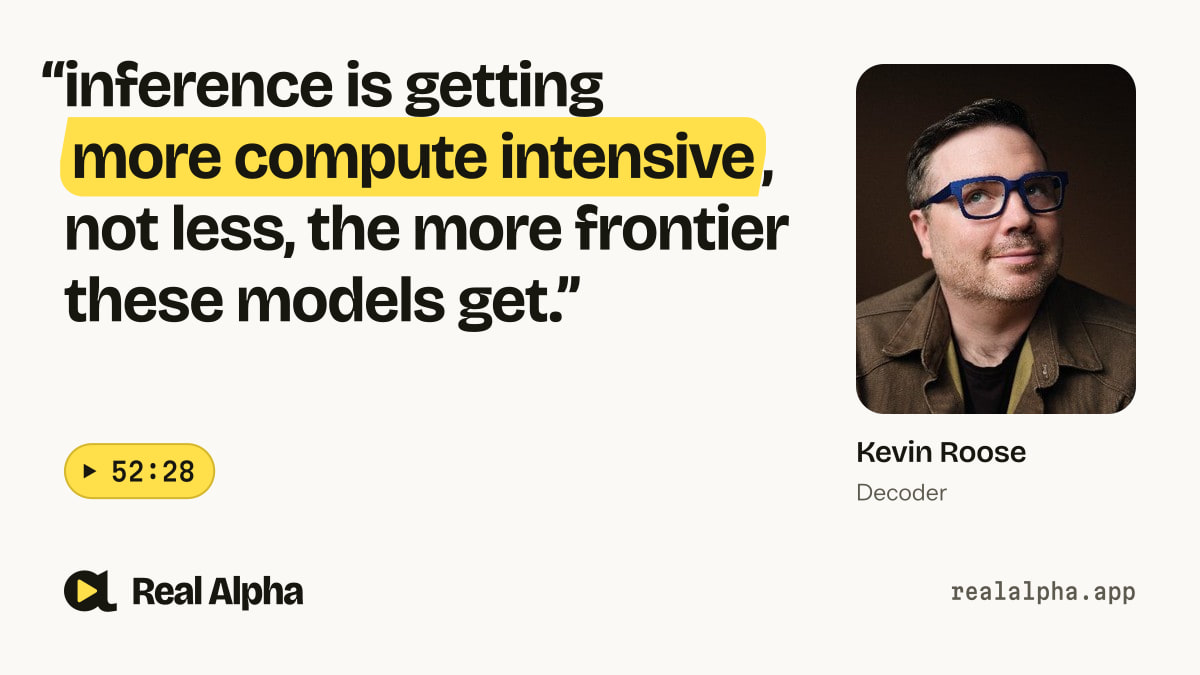
“inference is getting more compute intensive, not less, the more frontier these models get.”
 Kevin Rooseat 52:28 · Decoder
Takeaways
- Frontier inference may keep demand for compute high.
- Some customers will keep paying for the best model.
- Distillation may be what keeps open and closed model quality aligned.
About this segment
Kevin Roose expects a few large AI companies to survive because customers will pay for top models and inference remains compute-heavy. He says open models may not stay close to closed ones if distillation is curtailed.

Kevin Roose is a journalist, author, and cofounder and cohost of Machine Gods.
Wrote The Shift column at The New York Times; co-hosted Hard Fork.

Nilay Patel, Host · Editor-in-chief, The Verge
Helped start The Verge in 2011 and has hosted Decoder since 2020.
From “Kevin Roose is AGI-pilled. Why aren’t you? | Decoder”, Oct 26, 2026. Watch the full episode
Answers “Is open-source AI catching up?” See all 25 answers
Thanks. We'll look at and fix what's off.
Transcript
Transcribed by machine (Whisper) from the episode’s audio, so a word may be off here and there.
- 51:14
What does make it mean in your mind? They're all going to be trillion dollar multi-AGI variant successes? Yes. I think, look, there will probably be those three and then maybe one or two others that sort of make it. And make it for varying definitions of making it. There will be one or two big enterprise AI companies, one or two big consumer AI companies, but there just are network effects and winner-take-all dynamics or winner-take-most dynamics in these markets.
- 51:46
And so, yeah, I expect that there will be, you know, there's some people who believe in the kind of like the mono AGI, like the singleton theory, it's often called like there can only be one because once you have one AGI, it's then going to go around like melting the chips. to, to the other AI labs and they won't be able to build theirs. Um, but I think we'll probably end up with like a small handful of AGI's. What do you make of the idea that, yep, it is a pretty simple recipe. Yep. There are open weight models. Yes, there is a China, all the pricing power will be destroyed because a mid range open weight model can do everything that you probably want it to do on a, on like a Mac. I don't think so. Um, because you still have to pay for inference on those models, even the open weights models have to run on computers. And inference is getting more
- 52:39
compute intensive, not less, the more frontier these models get. And so, yeah, training budgets may fall, but inference budgets will be robust for the foreseeable future. So yes, you can run some tasks locally, but I think this is something that has been predicted since the first open weights models that, oh, they were going to just get commoditized and destroy demand. But I think what we're starting to learn is, A, that there are a lot of people who will pay and want to pay for the absolute best model.
- 53:09
They don't want to be working with the slightly crappier model from six months ago. And then I also think once you crack down on distillation, which is this process whereby you can take a closed model and make a slightly dumber open version of it by just basically DDoSing the inference for the smarter model. Once you eliminate that, it's not clear to me that the quality of the open models will continue to sort of be closely correlated with the quality of the closed models. Yeah. The thing that really grabs me at that is they all did it to each other for