The alpha, twice a week
That was 4 min.
Get the best new moments in your inbox every Wednesday and Saturday. It's free.
Check your inbox
We sent a link to your address. Click it to finish signing up. Not there in a minute? Look in spam.
or
Relentless · 4 min · Nov 17, 2026
Investors must distinguish ambition from deliberate deception
 Josh Wolfe
 contrasts disclosed performance, like magic, with knowingly misleading investors.
In this episode
Full analysis- 0:16Founders can turn old pain into lasting drive5 min
- 22:01A company’s story makes its mission matterPro pick 6 min
- 45:46Understate the odds and deliver beyond expectations6 min
- 28:02Capital gives founders time and options when plans fail7 min
- 1:01:56FTX was a small financial bet with larger reputational stakes6 min
- 14:02Investors must distinguish ambition from deliberate deception4 min
- 36:36Lux uses technology trends to spot directional progress3 min
- 59:14Lux uses role-play to see how founders think off-script2 min
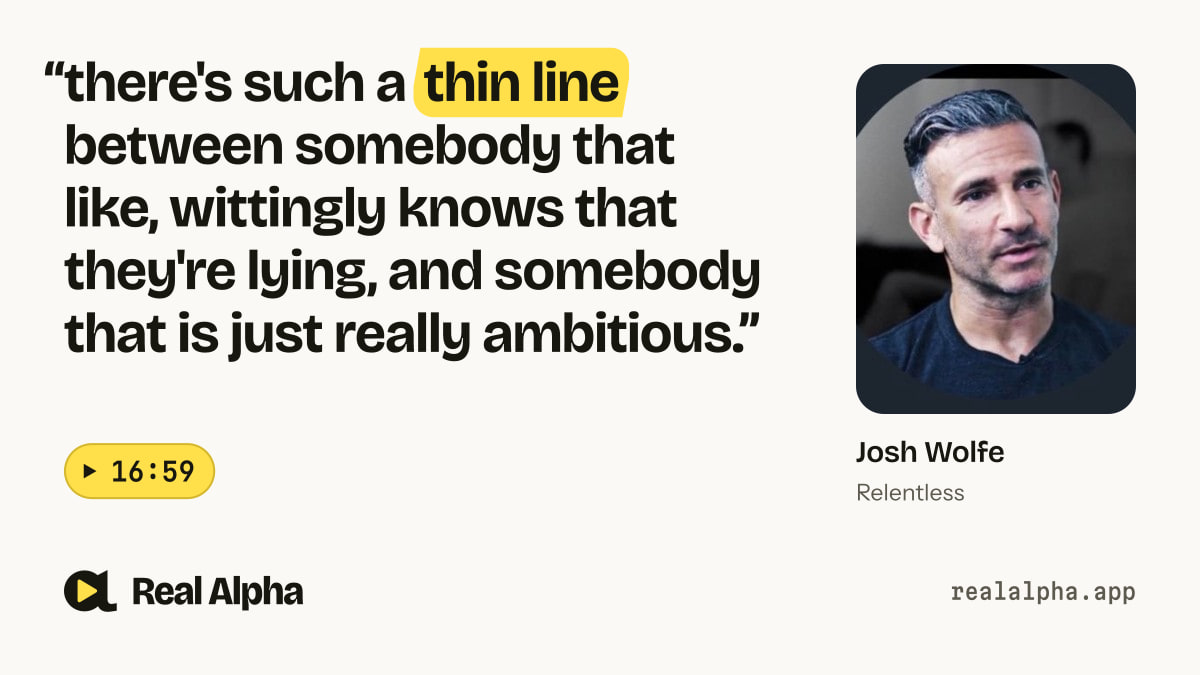
“there's such a thin line between somebody that like, wittingly knows that they're lying, and somebody that is just really ambitious.”
 Josh Wolfeat 16:59 · Relentless
Takeaways
- A disclosed trick differs from misleading an audience.
- Test whether a founder understands the problem and a path to solve it.
- Engineering and physics can expose claims that consumers may accept.
About this segment
Josh Wolfe contrasts disclosed performance, like magic, with knowingly misleading investors. He says ambition and self-deception can resemble a lie, so diligence must find the boundary.

Josh Wolfe is co-founder and partner at Lux Capital.
Co-founded Lux Capital and backed category-defining companies across AI, automation, biotech, compute, defense and robotics.

Ti Morse, Host · Host, Relentless
Interviews hard-tech founders on Relentless; guests include Sam Altman, Brian Armstrong and Hadrian's Chris Power.
From “What drives the world's greatest founders | Josh Wolfe, Lux Capital”, Nov 17, 2026. Watch the full episode
Thanks. We'll look at and fix what's off.
Transcript
Transcribed by machine (Whisper) from the episode’s audio, so a word may be off here and there.
- 14:07
three or six years. It just, it felt financially dishonest. I've studied a bunch of like company failures and like where founders went wrong or like you know the history of fraud and generally when i find someone that commits fraud once this is like a systemic thing or that they do like across time they don't just do it once and like you know bring it off kept on being a fraud all the way up uh to like 50 billion dollars of AUM or something and of course it wasn't real but people believed it and he did for someone like elon it almost feels like to me in my mind he either would do it at one point or wouldn't do it do you kind of understand what i mean yeah um that it was like selective like if he needed to do it or like generally like have you ever come across a fraud that only did it in one aspect of their life and then like did it once one time and then never did
- 14:56
it again i'd have to go through and really catalog this but um but i i do think that there as a reward incentive, if somebody does something wittingly, right, not accidentally, but wittingly, and you know that you're duping people, and you get away with it, and you reap rewards or benefits, that positive feedback loop has been there where you're like, I can do this again, right? There are people that do this virtuously, where they are honest liars, which are magicians.
- 15:24
And they get rewarded because people are like, oh my god, that's amazing. But they're telling you it's a trick. You know, you watch Penn and Teller with the cups and balls trick. Not only Are they telling you it's a trick? They are using transparent cups as they are doing this to show you how skillful they are at deceiving you. And all you have to do is basically suspend the willful disbelief. And there's something that's beautiful about that. And there's something that's beautiful about magic in general, to me as somebody that is obsessed with science and technology and thinking about how you engineer something. I still marvel at the magic of certain Apple devices. And I certainly marvel at today, the geniuses in AI.
- 16:01
But when you are not being honest with the audience, whoever that is, an audience of investors about the deception, and there's a big difference between somebody that's like, you know, we're going to develop a weapon system and it's going to be the most important in the world. And, you know, that's ambition. That might even be entrepreneurial naivete. But if you say we're developing an autonomous electric truck and we're driving it down the mountain, but you actually have it in neutral and you're letting gravity do the work, Trevor Milton went to prison. I think that there are things like that that founders do and can get away with, the sort of fake it before you make it. By definition, anybody that is starting something is starting something with some vision and some ideal and saying with utmost confidence, which you
- 16:46
have to do as an entrepreneur, you have to do as a starting off investor, if you're raising a fund, you're like, this is what we're going to do. And you may have the authentic conviction internally, and you're exuding that to others, and they are believing in you. The entire word of credibility, credit, it's the root of credere to believe. But there's such a thin line between somebody that like, wittingly knows that they're lying, and somebody that is just really ambitious. And to me, there's always been this through line, partially because of where I grew up in Coney Island, Brooklyn. Somebody's always trying to run some scam. Somebody's always trying to cheat you.
- 17:20
Somebody's like always, and so you grow up sort of squinty eyed and distrusting of people and human nature. And I always say to this day, science and technology and human progress, like I am so long that, but I've always been sort of more tepid, if not cynical about human nature. My favorite line from Shakespeare are there's daggers and men's smiles. And again, we evolved to deceive each other in endless ways. There's deception in sports. There's deception in politics. There's deceptions in business. And we deceive ourselves. And you could argue that some of the best entrepreneurs actually self-deceive themselves in a way that... And there's a brilliant evolutionary biologist, Robert Trivers, who I think recently passed, who studied the why do we self-deceive?
- 18:00
Why is this evolutionarily selected for? And it's fascinating. But I think some of the best founders, entrepreneurs, some of the best politicians believe their own bullshit. And so are they actually lying? No, they're just really good self-deceivers, and it's an adaptive mechanism. But being able to discern that thin line between somebody that is wittingly bullshitting you and lying to you, and somebody that is just sort of bullshitting themselves and has ambition, that's an important distinction of the difference.