The alpha, twice a week
That was 4 min.
Get the best new moments in your inbox every Wednesday and Saturday. It's free.
Check your inbox
We sent a link to your address. Click it to finish signing up. Not there in a minute? Look in spam.
or
Founders · 4 min · Oct 12, 2025
Keep mistakes small and fix them quickly
 Michael Dell
 says companies often fail through their own decisions, not just competition.
The episode’s best minutes
Full episode- 1:01:54A five-day supply chain created a cash and cost advantagePro pick 4 min
- 29:52Companies must remake their processes for AIPro pick 3 min
- 24:54Keep mistakes small and fix them quickly4 min
- 5 more moments in the full episode
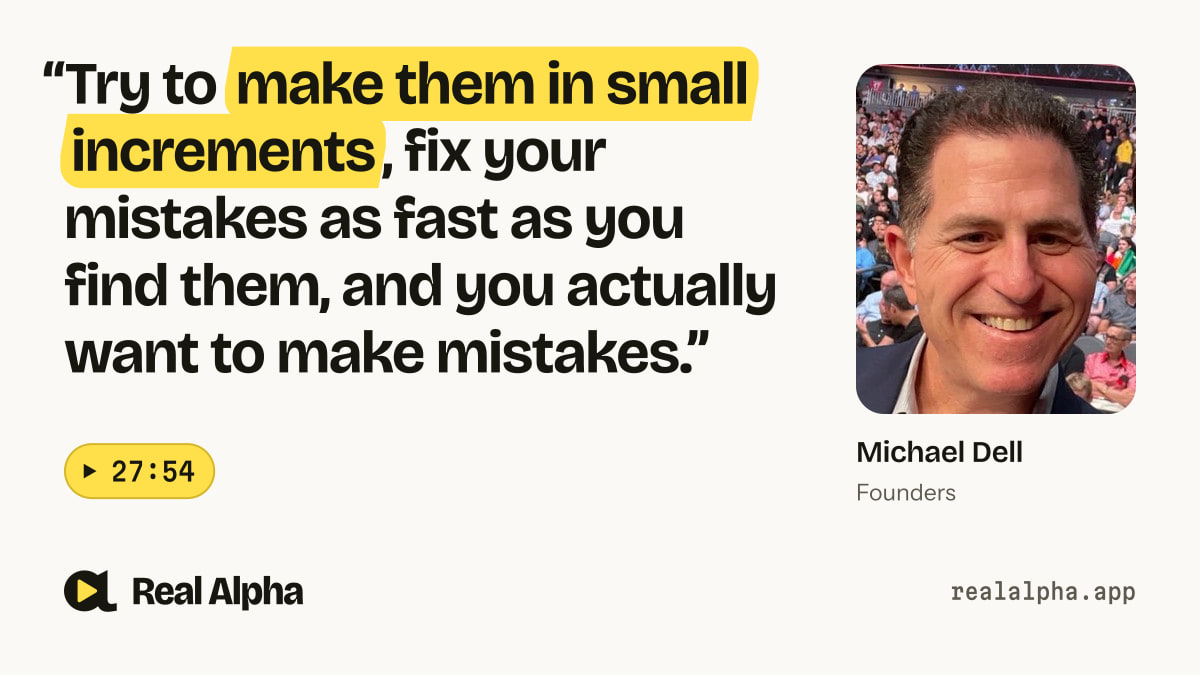
“Try to make them in small increments, fix your mistakes as fast as you find them, and you actually want to make mistakes.”
 Michael Dellat 27:54 · Founders
Takeaways
- Understand why a business is working or failing.
- Experiment when there's no established playbook.
- Make mistakes small, then fix them quickly.
About this segment
Michael Dell says companies often fail through their own decisions, not just competition. When there's no playbook, he favors small experiments, quick fixes and scaling what works.

Michael Dell is founder, chairman, and CEO of Dell Technologies.
Founded Dell Technologies and committed $6.25 billion to investment accounts for 25 million American children.

David Senra, Host · Host, Founders
Has read an entrepreneur's biography every week for Founders since 2016.
From “Michael Dell, Dell Technologies | David Senra”, Oct 12, 2025. Watch the full episode
Thanks. We'll look at and fix what's off.
Transcript
Transcribed by machine (Whisper) from the episode’s audio, so a word may be off here and there.
- 25:00
And you said something that terrified me unintentionally, that most of the entrepreneurs and founders that you've known were never taken out by competition, that they sabotaged themselves. Can you say a little bit about that? Yeah, I mean, I think you could make the argument that they made mistakes along the way that, you know, were fatal and, you know, ultimately, you know, the companies didn't succeed.
- 25:35
But it's all of their own doing, right? You have to make the right choices in order to continue on and survive and ultimately thrive. What do you think are some of the causes of mistakes? You have obviously smart, talented, competitive people, right? Charlie Munger has this great line where it's like intelligent people are taken up by three things, ladies, liquor, and leverage. So, like, have you seen any common, like, causes for somebody to sabotage themselves or to not live up to what they should have?
- 26:07
Charlie's right about those three things. You know, we stay away from those. Yeah. I sort of go back to understanding things and curiosity, and it's like you've got to know why something is working or not working. And if you're in the middle of a super competitive endeavor and you don't really completely understand what's going on, well, you're going to make mistakes, right? And so when I look at the competitors that are no longer around, yeah, they had either overzealously expanded or made design errors or they failed to understand the competitive landscape.
- 27:11
I mean, there's lots of ways to fail, right? You have a great example of one in the book with Adam Osborne, where he had a very successful—I think the Osborne one was relatively successful, right? Yeah. Okay. Yeah. And he's like, all right, now we're coming with Osborne 2. It's even new and improved, and it's great. And you make the point. It's just like, yeah, maybe, but it didn't ship in time. And so now you just made this big announcement where, like, we have this great new product.
- 27:35
It's even better than one. What are you telling to the market? The Osborne effect. I don't think people talk about it so much anymore. But back then, the Osborne effect was a thing where you introduce a new product that's better than your first product, and nobody buys your first product anymore, and you're out of business. And so, you know, yeah, don't want to do that. So go make some mistakes nobody's ever made before.
- 28:00
Try to make them in small increments, fix your mistakes as fast as you find them, and you actually want to make mistakes. You just want to make them small and, you know, iterate and fix them quickly. I mean, one of the things when you're creating a new business in an area that has never been done or with some new technology, new business model, there's no playbook. There's no, like, book you can read.
- 28:29
It says, here's how you do it, right? And if you hire the people from the adjacent, you know, industry companies and ask them to go do it, well, they're just going to go do what they were doing before, right? And so that's not going to work. So you need a lot of creativity and you need to sort of intuit your way to the answer by experimenting. It's like, okay, here's a theory that we think will work.
- 28:58
Let's try it, right? And, you know, does it work? Great. Okay, let's do 2x that. Okay, let's do 10x that. Let's do 100x that. Does it work? Okay, let's stop, you know, restart, come up with another theory, and just keep experimenting until you find the answer.