The alpha, twice a week
That was 4 min.
Get the best new moments in your inbox every Wednesday and Saturday. It's free.
Check your inbox
We sent a link to your address. Click it to finish signing up. Not there in a minute? Look in spam.
or
The Mishal Husain Show · 4 min · Nov 20, 2026
Khanna's travels show how once-thriving states can collapse
 Parag Khanna
 recalls visiting the Berlin Wall at 12, then revisiting places his parents had lived and seeing them collapse.
In this episode
Full analysis- 8:38Tariffs are a narrow measure of globalization4 min
- 12:16Affordable housing connects protests across countries3 min
- 20:20Economic stagnation helps explain the AfD’s appealPro pick 4 min
- 16:45Migration rebounded beyond pre-COVID levels by 20224 min
- 25:43European law limits returns to unsafe countries4 min
- 3:06Khanna's travels show how once-thriving states can collapse4 min
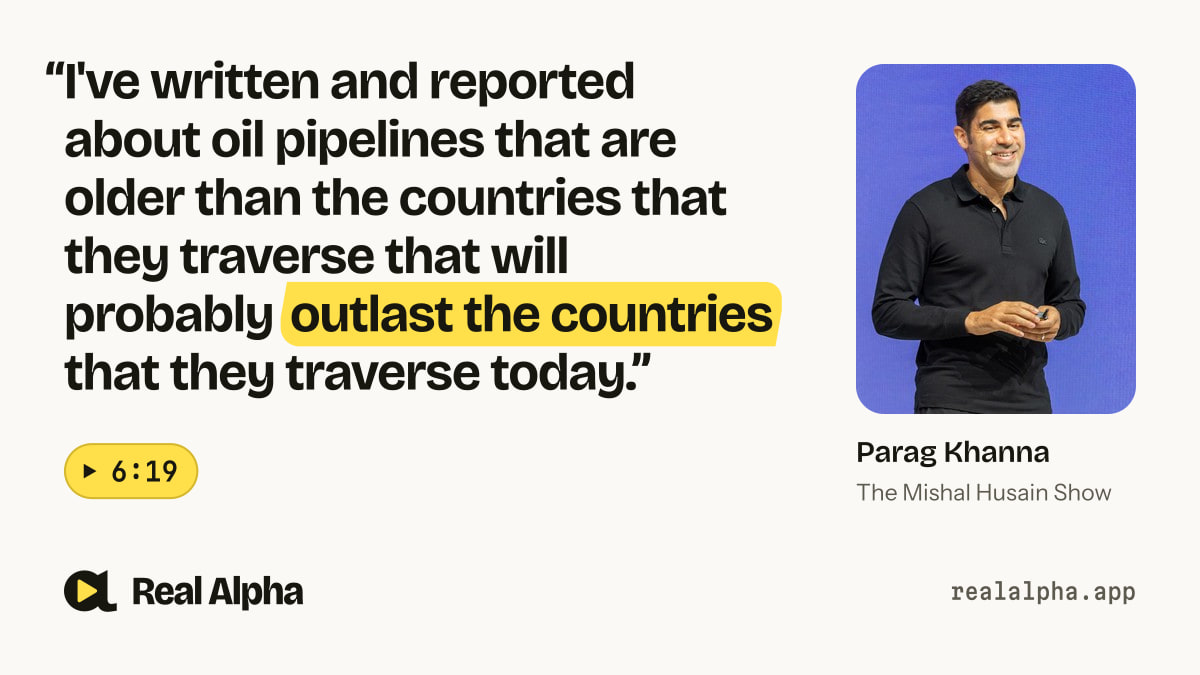
“I've written and reported about oil pipelines that are older than the countries that they traverse that will probably outlast the countries that they traverse today.”
 Parag Khannaat 6:19 · The Mishal Husain Show
Takeaways
- A 1989 visit to the Berlin Wall became his geopolitical awakening.
- He contrasts his parents' memories of thriving Khartoum with its present war.
- He says pipelines can outlast the countries they cross.
About this segment
Parag Khanna recalls visiting the Berlin Wall at 12, then revisiting places his parents had lived and seeing them collapse. He calls this post-colonial decay, with infrastructure sometimes outlasting the states it crosses.

Parag Khanna is a geostrategist and author.
Founded AlphaGeo, an AI-powered geospatial analytics platform, and authored seven books on global change and geopolitics.

Mishal Husain, Host · Host, The Mishal Husain Show
From “Globalization, Trade and Trump: Geostrategist Parag Khanna | The Mishal Husain Show”, Nov 20, 2026. Watch the full episode
Thanks. We'll look at and fix what's off.
Transcript
From the transcript The Mishal Husain Show publishes with the episode.
- 3:15
And my father had actually even lived in Germany doing a kind of economic internship. My father had been to Germany before he had been to the Gulf countries, for example, which is strange for an Indian. So he had this particular attachment. When the Berlin Wall fell, November 9th, 1989, for those who don't remember that auspicious date, my father came home from work. He said, guys, we have to go see this. And so we look back and we say, that's the year Christmas came early. So we petitioned our school teachers to let us go. And my parents, brother and me, we packed up. And by early December, There we were. We flew to Frankfurt and we drove to Berlin overnight.
- 3:52
To witness the wall having come down. It was a few weeks later, but I sat on top of the wall. We got a hammers and chisels. We paid Deutsche Marks to rent this equipment and to hack away at the wall. And I put it in little Ziploc bags and I handed it out when we returned home. But that was a moment for me again. Did I understand the full geopolitics and the circumstances of that when I was 12? No, but it shaped my entire life since.
- 4:17
And when you brought those pieces of the wall back to your classmates in the US, were they impressed? Or did you realize that you were maybe engaging with the world at a deeper or different level than they were?
- 4:28
You know, it was great because it was actually my history class. And so everyone was attuned. And our teacher was, I would say, a very worldly man himself. And so I just remember the conversations being very in-depth and us thinking, we're living through the world changing. And there have been times in the last couple of decades where things feel steady and sleepy, but I became a traveler. So I was never at any point in time in a place that was just calm. I've been kind of backpacking around and seeing the turbulent parts of the world and the places in the world that have been trying to catch up and modernize. I think one thing that is somewhat tragic in all of this, particularly for people of exactly our age, is that we are now old enough And we've traveled enough and seen enough that some of the
- 5:13
very places that we were optimistic about in the 1990s and 2000s, during that heyday of globalization and modernization, westernization, have actually collapsed. And we have to be honest about that and say, what went wrong? Because that was on our watch. Places like Lebanon, places like Libya, a fair number of Middle Eastern countries, right, to be clear. And this all became a theme in some of my books where I talk about post-colonial decay. And it does go back to my parents being in Sudan before I was even born in the early 1970s. And I interviewed my parents, not formally, but I remember at Christmas time saying, mom, dad, of all the places you've lived, what was your favorite?
- 5:51
And I thought they would talk about Abu Dhabi or talk about, you know, Europe, of course, America, New York. And they said Khartoum, Sudan. And I think almost no one alive today would hear Khartoum, Sudan and say, oh yes, a lovely leafy bucolic expat hub. It's the site of the worst civil war in the world right now. But that photographic evidence reminds us that there was community. It was multicultural. It was a thriving economic entrepot, a hub.
- 6:19
So for me, the almost legacy or homage to my parents is traveling back to all the countries that they had lived in. And sadly, not all of them have made it. I've written and reported about oil pipelines that are older than the countries that they traverse that will probably outlast the countries that they traverse today. That's post-colonial decay. But I don't want to be overly pessimistic, but some countries have suffered that fate. Yeah.