The alpha, twice a week
That was 3 min.
Get the best new moments in your inbox every Wednesday and Saturday. It's free.
Check your inbox
We sent a link to your address. Click it to finish signing up. Not there in a minute? Look in spam.
or
The Pragmatic Engineer · 3 min · Nov 16, 2026
Legacy products need staged AI-driven hardening
 Satya Nadella
 describes applying AI to Windows vulnerabilities and GitHub's scaling demands without abandoning existing systems.
In this episode
Full analysis- 9:55AI coding shifts engineering toward intent and verification4 min
- 15:32Software factories make codebases easier to learn and operatePro pick 5 min
- 46:03Companies need control of their own AI learning loop7 min
- 20:52Legacy products need staged AI-driven hardening3 min
- 29:19Microsoft's voluntary exits give employees a way to change course7 min
- 6:48Model jumps forced Microsoft to rethink its coding interface3 min
- 36:29Hiring may pick up once AI-native teams are configured2 min
- 53:49Local models can handle sub-agent tasks alongside cloud models3 min
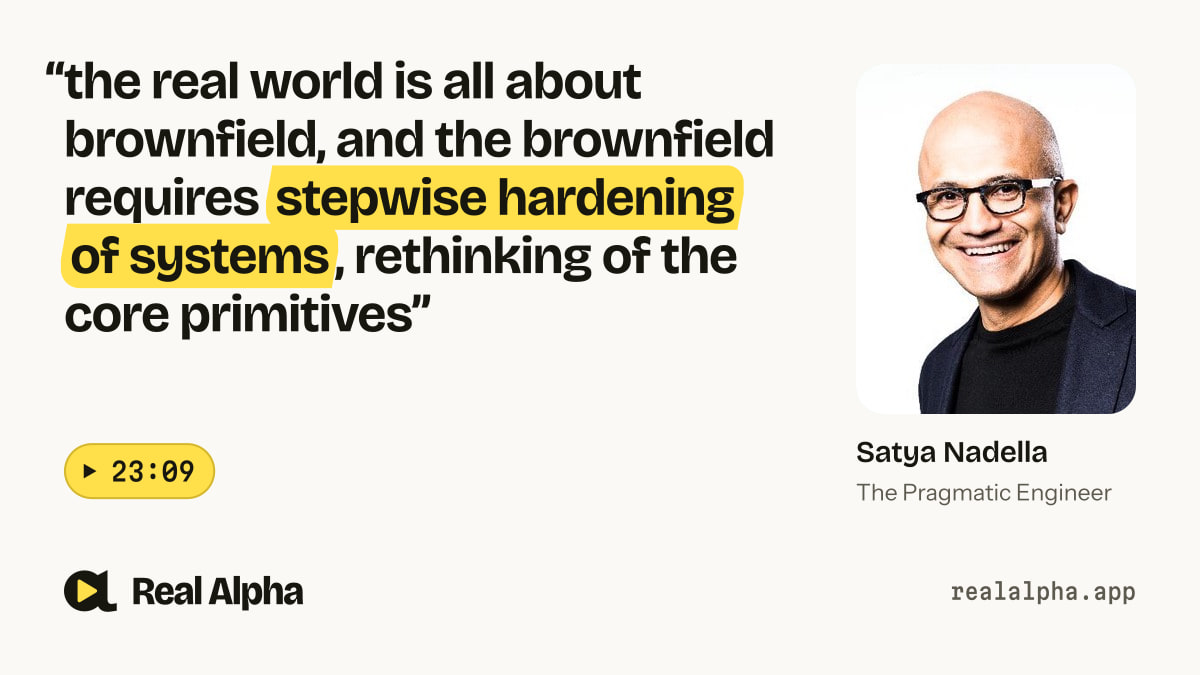
“the real world is all about brownfield, and the brownfield requires stepwise hardening of systems, rethinking of the core primitives”
 Satya Nadellaat 23:09 · The Pragmatic Engineer
Takeaways
- AI-discovered Windows vulnerabilities create a new fix pipeline.
- GitHub is reworking its Git protocol and storage for agent scale.
- Brownfield teams need staged changes to builds and source control.
About this segment
Satya Nadella describes applying AI to Windows vulnerabilities and GitHub's scaling demands without abandoning existing systems. The work means hardening builds, source control and CI/CD around real products.

Satya Nadella is CEO of Microsoft.
Led Microsoft's cloud infrastructure and services transformation, and has been CEO since February 2014.

Gergely Orosz, Host · Host, The Pragmatic Engineer
Spent four years at Uber heading mobile, web and backend teams; shipped part of its payments system.
From “Software engineering after code becomes cheap with Satya Nadella”, Nov 16, 2026. Watch the full episode
Thanks. We'll look at and fix what's off.
Transcript
Transcribed by machine (Whisper) from the episode’s audio, so a word may be off here and there.
- 20:58
Just sticking to practical level, like at a place like Microsoft, you will have teams that can experiment and they're building new factories or their platform teams. And maybe they have extra cycles and they're doing all these things. But you also have product teams who actually have a product. You have real customers. And this is where I see a lot of companies struggle with who do have a real business.
- 21:16
And they're seeing these aspirational things from AI labs or maybe even they're listening to you right now. And they're thinking, hang on, like I can't just drop everything and build a factory because what am I going to do with the thing? How are you thinking about both this balance and especially inside of Microsoft? What do you tell engineers? How is your job changing, especially when you're working on a product?
- 21:35
That is a good product. It's a profitable product. Customers depend on it. Yeah, it's a great point. First of all, we don't get permission to do things that are not adding value to customers. Let's start there. To your point about a little bit of it, and we made our share of mistakes of going and doing random AI things just because they were cool to do. you kind of ultimately are going to... I think everyone's done that.
- 21:58
Everyone's done that. And I've done my fair share of it and learned from it, hopefully, and will get better. But that said, if you sort of say, well, let's take even, let's face it, right? Which is today, when I look at the CVEs in Windows, right? Because you now have AI models that are finding... Yeah, the critical vulnerabilities. Yep. And so we now need to go fix them all. And so therefore, there's a new pipeline.
- 22:19
So in fact, if I look at even the Windows from crash traces all the way to fixes, they're building out essentially a new type of software factory. Except this is a brownfield, right? Which is the build system of Windows is still the build system of Windows. In fact, if you think about in all these brownfield projects, the most difficult part is builds and CICD. And then of course, you got to really, even if I look at the amount of change that underneath even GitHub, right?
- 22:49
Which is, if you think about it, right? We've had, I mean, Suddenly, all these coding agents showed up at work at GitHub, and the scale has gone through the roof. That's a superhuman level. Yeah. And so, therefore, we have to fundamentally change the entire Git protocol, the storage system. So, we are working on every part of this to make sure that we are living in the brownfield as opposed to, I mean, the greenfield stuff will always do.
- 23:13
But the real world is all about brownfield, and the brownfield requires stepwise hardening of systems, rethinking of the core primitives, right? All the way from source code control to build to CICD that works in a brownfield project. And that takes time, that takes investment, that takes thought. And the sequence of operations or the order of operations is very, very critical. So one of the things that I want our teams is not about, well, one nice thing I like about the transformation is this is not about, oh, here is some new shiny object and here is the team that's doing that.
- 23:46
And everybody else lives in the old world. Like everybody across the company gets to use the new tool chain and the new ways of working and tackle the challenge in front of them on any product, whether it's Windows or SQL Server or a cloud native service, what have you. And that, I think, is what we're seeing.