The alpha, twice a week
That was 3 min.
Get the best new moments in your inbox every Wednesday and Saturday. It's free.
Check your inbox
We sent a link to your address. Click it to finish signing up. Not there in a minute? Look in spam.
or
Founders · 3 min · Nov 1, 2026
Lion Studios grew from a broken partnership into a $250 million business
 Rafael Vivas
 explains how a partner’s squeeze pushed him to build a competing game publisher.
The episode’s best minutes
Full analysis- 30:14Lion Studios grew from a broken partnership into a $250 million businessPro pick 3 min
- 20:54AppLovin leaders stay hands-on to keep work focusedPro pick 3 min
- 44:01A falling stock price drew Vivas back to AppLovin3 min
- 5 more moments in the full episode
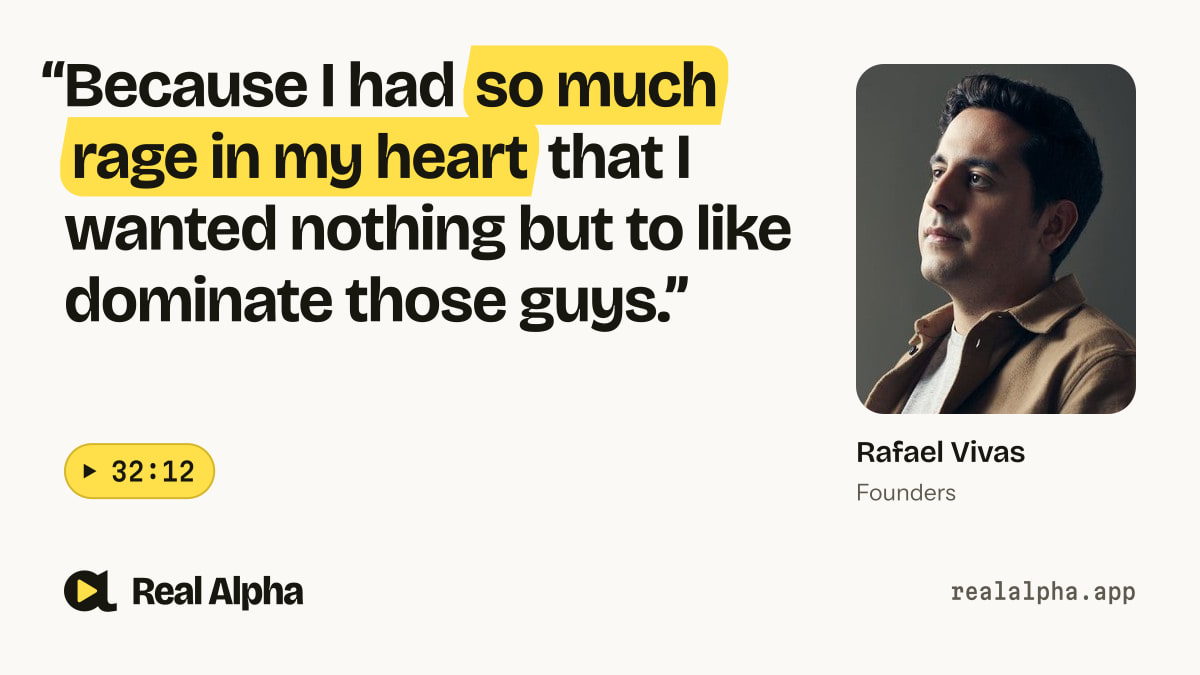
“Because I had so much rage in my heart that I wanted nothing but to like dominate those guys.”
 Rafael Vivasat 32:12 · Founders
Takeaways Pro pick
- A bad partnership exposed the risk of depending on one distributor.
- Lion Studios used AppLovin’s distribution to publish games.
- The business grew to over $250 million in revenue in two years.
One of Pro's picks, open to you here. Try Pro free for 7 days
One of Pro's picks. The rest of the summary and the 3 takeaways are in Real Alpha Pro; the video, the quote and the transcript stay free.
Read it with Pro, 7 days freeAbout this segment
Rafael Vivas explains how a partner’s squeeze pushed him to build a competing game publisher. Lion Studios reached over $250 million in revenue in two years, profitably.

Rafael Vivas is a founding team member of AppLovin and cofounder of Lion Studios.
Co-founded Lion Studios, which generated over $250 million in revenue in two years, after joining AppLovin's founding team.

David Senra, Host · Host, Founders
Has read an entrepreneur's biography every week for Founders since 2016.
From “High School Dropout to Multi-Billionaire: The Relentless Drive of Rafael Vivas”, Nov 1, 2026. Watch the full episode
Thanks. We'll look at and fix what's off.
Transcript
Transcribed by machine (Whisper) from the episode’s audio, so a word may be off here and there.
- 30:19
Wait, the ad platform first, then the games business, because what was the reason for just starting the games business after the ad platform? You know, we did a lot of business in Asia. China's like one of my favorite places to do business because the founders are so intense. They move very quickly. They're intelligent. Just like everything you'd want in a business partner. It's no bullshit. One of our partners at the time was this company called Chino Mobile.
- 30:41
And they were one of our biggest publishers. And what they would do is they would just squeeze us, right? Squeeze us in every way possible you could imagine. And like we had an agreement signed with them and they were like, screw the agreement. We don't care about it. And they would just break it all the time. You know, there were so many nights I'd stay up when I was staying in the States till 4 or 5 a.m.
- 31:00
to like go and manage them and then, you know, spend a lot of time in Asia with the leadership over there too. But throughout this journey, you know, I was thinking to ourselves, like we will never be in a position where we are so dependent on like one of these partners. And we'd also seen what Netflix had done at the time. And we thought there was this great opportunity, you know, for owning the vertical, really.
- 31:20
Like, you know, great. We have that platform, but also having our own content as well. You know, you have better economics, you have a distribution advantage and overall you build more enterprise value. And by the way, this is not an uncommon business tactic in Asia. The biggest gaming companies in the world are all also distribution companies, like Tencent being a perfect example, NetEase being a perfect example.
- 31:41
These are companies that have other things outside of the games and they use that to distribute their games. So that's how we got into the games business. But Cheeto really pissed me off so bad. It kind of like I told you the story earlier about how we started the ad platform because one of our partners fucked us. I came back to this partner had pushed to the end of me and I went to Adam and I said, it's very simple.
- 32:04
I'm going to leave to go and build this competitor against Cheo Mobile or I'm going to do it here. And I really want to do it here because- Wait, wait, pause there. Why is that simple to you? Why would you leave to go build the competitor? It's Cheetah, the animal? Yes. Okay, to Cheetah. Because I had so much rage in my heart that I wanted nothing but to like dominate those guys. It wasn't about like, you know, You know, I'm a very simple guy, David, you know, and we talked, I stay in the $200 hotel.
- 32:30
Take the, you know, the shitty, you know, commercial airline flight. So, like, money to me, like, of course, like, it's important. But, like, I don't, you know, some people are like, hey, I'm going to make more money and buy the big house. I don't care about any of that, right? Like, for me, when I work, like, it's for purpose. And that company would push me to a point where I was like, my purpose at this point was to destroy these guys.
- 32:52
And so that was really the start of, at the time, Line Studios. And why did I call Line Studios? because the lion is the only animal that can kill a cheetah. And our thesis was, let's go work with the best developers in the world. We have one of the largest distribution platforms in the world, and we'll help distribute their games. And within two years, we built that from zero to over $250 million in revenue profitably.
- 33:14
It was a great business. But throughout that, it was really fucking tough for two reasons.