The alpha, twice a week
That was 3 min.
Get the best new moments in your inbox every Wednesday and Saturday. It's free.
Check your inbox
We sent a link to your address. Click it to finish signing up. Not there in a minute? Look in spam.
or
Moonshots · 3 min · Nov 7, 2026
Local governments can trade data-center access for public benefits
 Alexander Wissner-Gross
 argues that states should welcome data centers but negotiate for benefits such as school lunches or medical care.
In this episode
Full analysis- 39:50AI researchers may already be driving AI researchPro pick 7 min
- 47:41Hard takeoff could bring breakthroughs and explainable modelsPro pick 7 min
- 1:18:21Compute access could become a barrier to new companies7 min
- 16:57Local governments can trade data-center access for public benefits3 min
- 25:22Power limits could leave 15 gigawatts of compute idle6 min
- 58:11Frontier model releases could become continuous by early 20273 min
- 1:10:38AI revenue does not capture the value of its compute6 min
- 1:28:25Physical controls can limit bio risk without regulating AI thoughts6 min
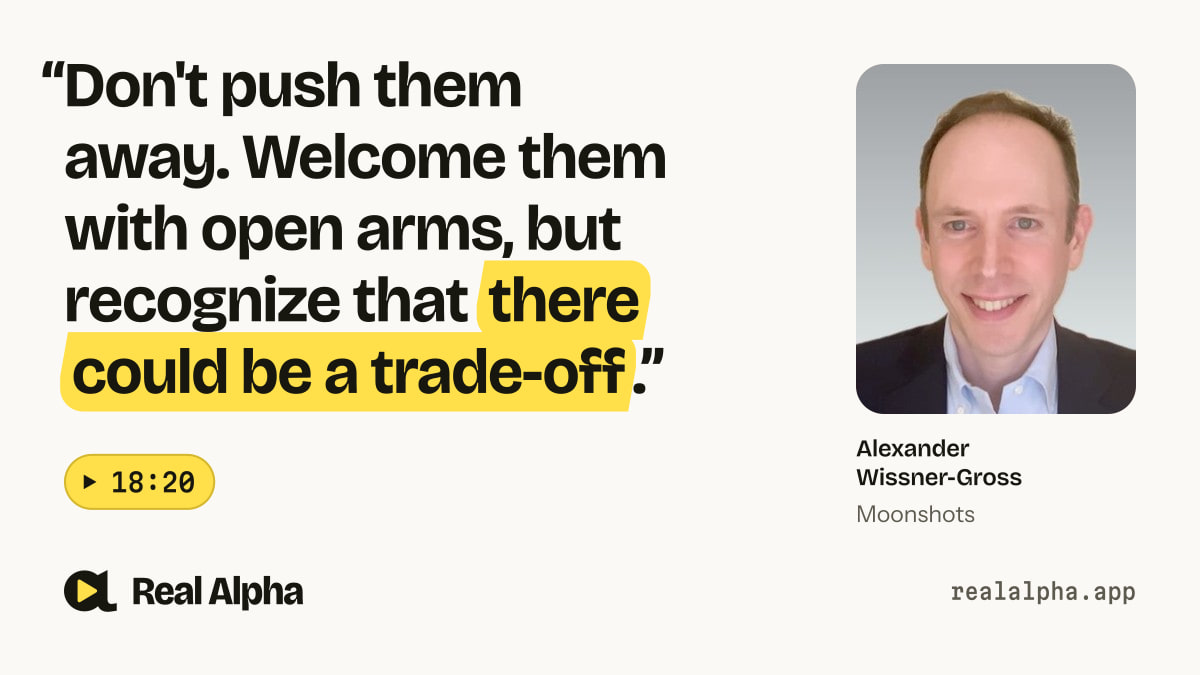
“Don't push them away. Welcome them with open arms, but recognize that there could be a trade-off.”
 Alexander Wissner-Grossat 18:20 · Moonshots
Takeaways
- Use powered land and energy access as bargaining chips.
- Ask hyperscalers to fund services or tax rebates for residents.
- Local leverage may fade as compute moves off Earth.
About this segment
Alexander Wissner-Gross argues that states should welcome data centers but negotiate for benefits such as school lunches or medical care. Local leverage may fade as compute shifts off Earth.

Alexander Wissner-Gross, Host
Computer Scientist & Founder, Reified
Has backed and advised 40+ tech companies, directly and through 021T Capital and Reified; writes The Innermost Loop.

Salim Ismail, Host · Founder, Open ExO
Co-wrote Exponential Organizations; was Singularity University's founding executive director; sold Ångströ to Google.

Dave Blundin, Host · Founder & GP, Link Ventures
Has co-founded 23 companies; founding CEO of Vestmark and chairman of insurance marketplace EverQuote.
From “Anthropic’s IPO in Question, Midterms Hit AI, Nasdaq Drops 5%, and RSI Accelerates | #309”, Nov 7, 2026. Watch the full episode
Thanks. We'll look at and fix what's off.
Transcript
Transcribed by machine (Whisper) from the episode’s audio, so a word may be off here and there.
- 17:04
we as a civilization, not myself in an individual capacity, where superintelligence really does promise solutions to humanity's greatest problems. Disease will be one. Just solving the problems that universal basic fill in the blank will address is another. And so optimistically, I think the best case outcome here might not be in the next two years, but call it the next and yours is A grand bargain between the capital, which in this case is superintelligence, and for the moment, the frontier labs behind it, and what we've historically called labor, which is basically everyone else, the entire un-augmented, for the moment, human population, where we get our UBI, or equivalent. We get our curing all disease, or equivalent. We get general uplift of the human population or equivalent. And I think municipalities, if they're smart, well, regardless of whether
- 18:03
they're smart, what they should be doing is recognizing that for the moment, they have leverage. For the moment, before we have the Dyson Swarm fully realized, if you're a state or if you're a local government, rather than just blanket banning data centers and everything that goes with it, recognize that in many cases, if you have energy, if you have powered land, if you're otherwise attractive to data center developers. Don't push them away. Welcome them with open arms, but recognize that there could be a trade-off. Maybe, you know, what is it you want? You want the hyperscalers to pay for free school lunches? Ask for it. You want the hyperscalers to cover all medical care in your county? Ask for it. You want tax rebates for the humans, not for the hyperscalers, ask for it. There is a trade, there is a grand bargain to be struck. And what I worry
- 18:57
about is all these municipalities are not looking to the end game of what is the grand bargain to be struck with terrestrial data centers and terrestrial compute before it all just moves to orbit. So the message for smaller states and states that are interested, if you want to open your arms to the data centers, you've got a massive advantage in that period of time. And you look at what's going to happen in Tennessee with their GDP in Virginia, which is already embraced at centers, and you can see a huge uplift in the economic outcome. So there's a counterpoint for you. Okay, so let's go to the next point, which is what has been the industry response, right?