Free with a sign-in.
The best 21 min of 106
Anthropic’s IPO in Question, Midterms Hit AI, Nasdaq Drops 5%, and RSI Accelerates | #309
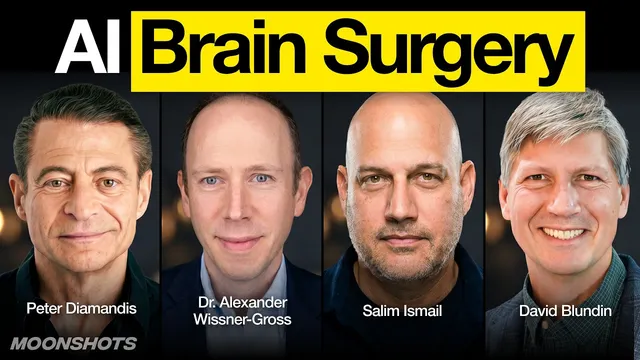
Salim Ismail, Dave Blundin and Alexander Wissner-Gross argue that AI's advance may outlast political and infrastructure constraints.
 Moonshots · Salim Ismail & Dave Blundin & Alexander Wissner-Gross
The best minutes
- 39:50AI researchers may already be driving AI researchPro pick 7 min
- 47:41Hard takeoff could bring breakthroughs and explainable modelsPro pick 7 min
- 1:18:21Compute access could become a barrier to new companies7 min
Every moment plays free. PRO marks a write-up that's in Pro.
Also worth watching
- 16:57Local governments can trade data-center access for public benefits3 min
- 25:22Power limits could leave 15 gigawatts of compute idle6 min
- 58:11Frontier model releases could become continuous by early 20273 min
- 1:10:38AI revenue does not capture the value of its compute6 min
- 1:28:25Physical controls can limit bio risk without regulating AI thoughts6 min
Skip the IPO opener, welcome and travel chat, broad election and consumer-app debate, sponsor reads, and the health segment.
Full analysis · 5 min read
Real Alpha · Nov 7
Alex Wissner-Gross says METR's 11-week study signals RSI
- METR's 11-week study found Anthropic's AI development accelerating, with roughly 80% attributed to AI assistance.
- Alex reads the charts as evidence of machine-led research, but they do not prove a self-sustaining loop.
- Founders should track AI research contribution and compute access separately from model capability.
Free with an account
Read the rest of the analysis
6 sections, the 7 other voices it tests the episode against, and what it means for you. Every episode we cut gets one.
Check your inbox
We sent a link to your address. Click it to finish signing up. Not there in a minute? Look in spam.
or
Signed up before? The same buttons sign you in. The episode, its moments and the transcript stay free.
METR's short study does not prove autonomous RSI
The host introduced METR's independent 11-week study of Anthropic's AI development. He said researchers estimated AI assistance accounted for roughly 80% of acceleration.
That is a reported estimate, not a direct count of autonomous research. The study window does not establish whether improvement sustains itself without human direction.
But Alex Wissner-Gross read the charts as evidence that machine researchers increasingly drive AI research. He said the fitted trendline may understate the change.
He offered software-only progress without new data centers as his view. That is his forecast, not a result METR tested.
Herbie Bradley is an AI researcher and writer who appeared on MTS in November. He read Anthropic's reported 2x productivity threshold as short of a self-sustaining loop.
Bradley also called fast takeoff a low-probability scenario, more cautious than Alex's reading. The disagreement is about where to draw the RSI threshold, not whether AI assists research.
“We are so deep in recursive self-improvement at this point.”
- HBHerbie Bradley · MTS · Nov 7Anthropic’s RSI threshold is not a full acceleration loop
- HBHerbie Bradley · MTS · Nov 7Fast takeoff remains a low-probability scenario
Our read
METR supports a growing AI role in research, but does not establish an autonomous feedback loop. Treat acceleration and self-sustaining improvement as different claims.
Internal research compute signals progress, not a closed loop
A host said Anthropic's internal development token use rose 235x in six months. The hosts also described a larger share of compute going to internal work.
That shift supports a stronger research role, but it does not alone show autonomous research. More resources inside the lab can reflect strategic choices as well as model capability.
And Alex described a test floated by executives at OpenAI and Anthropic. It asks whether each marginal unit of compute goes more often to AI or human researchers.
He called that a decent definition of RSI. Alex also said Anthropic's charts put machine researchers at or past that threshold.
Yet the test depends on how researchers count tasks, supervision, and human review. For example, the hosts propose generating research ideas and testing many in parallel.
That example shows why even a small share of useful ideas could matter at scale. It still leaves open who selects experiments and judges results.
Our read
Internal allocation is meaningful evidence of AI's growing research role, not proof that people have become dispensable. Track completed work and review alongside token use.
Computational discoveries still need physical-world validation
Dave described a sequence where compute first shifts inward, then labs begin producing physical products such as drugs and devices. That is a proposed hard-takeoff outcome, not a deployment schedule.
Alex predicted scientific and engineering challenges could be bulk-solved. The hosts invoked a reported Navier-Stokes solution and said code-based problems may not need physical experiments.
But that point narrows the verification gap, not erases it. Computational results can be checked in code, while claims about physical effects require other evidence.
Nenad Tomašev, a Google DeepMind researcher, said this on MTS in October. He said physical laboratories are needed to validate or disprove AI discoveries.
Prinz, on MTS in October, said better models still need the right data and experiments. Those requirements can limit scientific impact without limiting code-based research.
 Nenad Tomašev · MTS · Oct 20AI discoveries need physical labs to become scientific progress
- PPrinz · MTS · Oct 25RSI cannot replace the data and experiments a problem requires
Our read
Faster hypothesis generation is not the same as faster confirmation. Buyers funding AI science should measure validated results, not only proposed discoveries.
Alex expects self-improving architectures to remain legible
Alex predicts AI-designed architectures can remain understandable to people, even as AI research accelerates. His case is that systems searching architectures may also explain why their designs work.
Still, that is a forecast about interpretability, not evidence that every model's internal reasoning will be legible. A comprehensible design does not automatically make each output easy to audit.
In Moonshots in November, Alex Wissner-Gross discussed AI editing model weights without retraining. That example shows machine-led modification, but not general proof of transparent self-improvement.
For organizations using model output in consequential decisions, these are separate tests. Better architectures and explanations still need their own evaluation.

Our read
The episode offers a plausible path to understandable AI-designed systems, but not a guarantee. Test interpretability directly rather than inferring it from capability gains.
Alex expects frontier releases to become continuous by early 2027
Alex expects frontier model releases to shift toward continuous updates by early 2027 or so. He compared that change with Google moving from announced search-index updates to real-time indexing.
But that forecast concerns release cadence, not adoption or value. A faster stream can increase evaluation burden and change-management work for teams.
Salim Ismail, on Moonshots in October, said models can operate existing software rather than requiring AI-specific redesign. That makes useful updates easier to test in current workflows.
For example, a team can test whether a model completes a named workflow inside current software. It can then track errors and review time across versions.

Our read
Continuous releases would make model evaluation an operating task, not an occasional procurement exercise. Tie updates to workflow results, not announcement frequency.
Compute access could constrain entrants despite software gains
Dave said major buyers had reserved much of the available compute and chips for years. He said smaller firms were already struggling to get capacity.
Earlier, Dave repeated Elon Musk's estimate of about 15 gigawatts awaiting powered, liquid-cooled data centers. The episode did not give a project-by-project inventory.
Yet that concern qualifies Alex's software-only forecast. Better algorithms might extend existing hardware, but startups still need access to usable training and inference capacity.
Evan Conrad of SF Compute, on Upstarts in October, expects GPU scarcity to last at least four to five years. Rohan Anil on MTS in November described distributed training as a way to use dispersed idle GPUs.
Dave and Alex disclosed financial interests in ORN while discussing compute providers. Their examples are not a neutral census of available capacity.
For founders, treat capacity as a dependency rather than assume software gains remove procurement constraints. Test alternatives before making delivery commitments.
 Evan Conrad · Upstarts · Oct 29Compute financing could become a US geopolitical lever
- RARohan Anil · MTS · Nov 5Distributed training could make idle GPU clusters usable
Our read
The episode's strongest practical tension is between software progress and access to hardware. A research forecast cannot substitute for a capacity plan.
What it means for you
- Measure research work. Track tasks completed with AI, human review time, and how often results survive checks. Keep those measures separate from internal token use.
- Audit the evidence. For AI-assisted research, distinguish computational results from findings that need physical experiments. Record what has been independently validated.
- Map capacity access. Ask each team what compute it can actually use, when it becomes available, and what alternatives exist if access slips.
- Test every update. Choose a real workflow and measure completion, errors, and review time across model versions. Do not treat release frequency as business value.
What to watch
- Whether Anthropic's reported research acceleration persists beyond METR's 11-week study.
- Whether early 2027 brings the continuous frontier-model releases Alex expects.
- Whether smaller firms continue to report compute access problems as major buyers reserve capacity.
Send this to the founder planning AI research and compute capacity.
Watch the minute where the host introduces METR's 11-week study.
Written by Real Alpha from the episode's transcript and the other moments it links, then checked against the transcript. Quotes are the speaker's exact words.
Minute by minute
A Pro write-up, open to you here. Try Pro free for 7 days
A Pro write-up. The minute by minute is in Real Alpha Pro; the episode, its moments and the transcript stay free.
Read it with Pro, 7 days free- 0:00Anthropic's IPO timing is uncertain
The hosts debate whether Anthropic will push ahead with its IPO or delay it amid political uncertainty and reports that bankers are pressing for a lower valuation. They compare the situation with Meta’s IPO, when a difficult market and a competing shift to mobile weighed on its offering.
- 6:04Data center backlash could shift investment
Ismail cites 56% opposition to big tech and data centers, Goldman Sachs’ estimate that restrictions could affect 45% of planned U.S. data center construction, and 12 gubernatorial races where candidates advocating pauses won or led. Wissner-Gross says it is unclear how much the election reflected opposition to AI itself.
- 14:02AI needs a consumer use case
Ismail says AI still lacks a consumer product people love; Wissner-Gross argues that solving the top 5,000 diseases, at least in silico, could help win public support. He also says local governments could negotiate benefits such as free school lunches, medical care or tax rebates in exchange for welcoming data centers.
- 18:18Compute could move to new locations
Ismail cites OpenAI’s community compact, Google’s $17 billion Wyoming data center and SpaceX’s stated plan to grow from 3.6 gigawatts of data center capacity to 13 gigawatts by the end of the following year. Blundin expects pressure to accelerate efficiency and interest in Canadian power; Wissner-Gross says orbital data centers could be less exposed to local politics.
- 25:22Markets price in slower construction
Ismail cites a 5.5% Nasdaq drop, an S&P decline of more than 4%, semiconductor stocks down 12%, Nvidia down 9.3% and Korea’s market down 6%. Blundin says investors were pricing in slower approval of planned projects, while warning that delays could leave compute more expensive and breakthroughs later.
- 31:42AI benefits could sway voters
Wissner-Gross argues that AI-augmented decision-making could help people act in their long-term interests and says software improvements may sustain progress even if new data centers or hardware are restricted. The hosts discuss more tangible ways to build public support, including personal agents and health tools.
- 38:33AI research is accelerating
The hosts cite an 11-week METR study estimating that Anthropic’s AI development accelerated about 1.9 times, with roughly 80% of the acceleration attributed to AI-assisted research. Wissner-Gross says AI systems are already doing a growing share of research; Ismail cites a 235-fold rise in Anthropic’s internal token use over six months.
- 47:41Hard takeoff could redirect compute
Blundin expects labs to direct more compute toward internal development and then sell products such as drugs or devices. Wissner-Gross says AI could begin solving scientific, engineering and medical challenges at scale, with compute translating more directly into economic output.
- 52:22AI advances may remain interpretable
Wissner-Gross argues that recursive self-improvement can produce model changes people understand, pointing to the shift toward looped transformers as an example. Blundin says the transformer may look simple in hindsight compared with major equations in physics.
- 59:19Model releases could become continuous
Wissner-Gross predicts frontier models may update continuously rather than arrive in discrete releases, potentially by early 2027. He also says recursive self-improvement could enable relativistic von Neumann probes within a few years, raising the Fermi paradox; Blundin expects podcasts to retain a human element while using more AI.
- 1:04:33AI's value per watt is hard to measure
A study tests 220 tasks across 44 occupations: GLM 5.2 generates about $70 per task on average, while Gemma 4, a 31-billion-parameter model, delivers 2.5 times more value per joule. Wissner-Gross prefers measuring dollars in versus dollars out over watts; Ismail compares AI with New York City’s 5.5 gigawatts and $1.2 trillion in GDP, then notes the comparison omits costs such as human education and infrastructure.
- 1:18:21Compute access could shut out startups
The hosts warn that major buyers have reserved much of the country’s compute and chip supply for years, raising the question of whether startups need a right to compute. They describe a pilot client rejected for being too small and argue that shortages could raise prices, while prompting new investment in offshore, underground or orbital capacity.
- 1:27:05Biosecurity rules focus on synthesis
Ismail describes a White House policy on synthetic DNA and RNA screening, including customer verification, eight-year record retention and screening generally covering sequences of 50 or more nucleotides. Wissner-Gross favors controls on physical synthesis over restrictions on what AI systems can think; Blundin argues for logging and traceability.
- 1:34:06A Dyson swarm is becoming visible
Wissner-Gross points to a New Zealand photographer’s composite of 578 photographs taken over two hours, showing almost 15,000 satellite trails from about 1,400 satellites, as an early sign of dense orbital infrastructure. He says compute could expand into sun-synchronous orbit and argues that political shifts are cyclical while the move toward superintelligence is a lasting trend; Ismail urges people to help shape the outcome.
Published Nov 7, 2026.
Transcript · 1 h 17 m read
Moonshots, hosted by Salim Ismail, Dave Blundin and Alexander Wissner-Gross.
Transcribed by machine (Whisper) from the episode’s audio, so a word may be off here and there.
Hey guys, do you think Anthropik's IPO gets pushed because of all this, or do they barge right through it? Like, this is different from every other election? They must have known elections were coming. I don't think they quite expected the result, though. But what do you guys think? Push? I don't know, actually. The polymarket odds were really, really clear, you know, three, four weeks ago, and that's when they pulled the trigger on the roadshow. So I really doubt they'll delay, because if they were going to delay, they would have pulled the plug then, I think. You know what? They want the money. $100 billion can buy a lot of politicians.
Yeah, I'll have to consult my magic eight ball on this one. I really don't know. On the one hand, there's lots of public reporting now that investment bankers are trying to force down the IPO valuation. On the other hand, they may feel some urgency to achieve liquidity sooner rather than later, given the expected regulatory and statutory environment that may hit in January. So we'll see. Yeah. Well, you know, when Meta was coming out, it was by far the biggest IPO of all time, which is funny in hindsight, it's tiny by compared to Anthropic, but it was huge at its time. And Wall Street also choked on that. They're like, look, you know, the market's jittery. There isn't nearly enough demand. We're going to go ahead and do it, but you're going to have to price it down by, you know, like 30, 40, I don't know, some crazy percent. And then it traded way down. It just they just couldn't digest that much liquidity that quickly. And it was the best buy in the history of the world if you just waited out a few weeks after the IPO and all the doom and gloom and catastrophe. I remember the Morgan Stanley guys telling me this is the worst thing that's ever happened to the U.S. stock market. And then, you know, look at meta today
versus that day it's up, what, 20, 30x, something like that. So I suspect there's a similar dynamic where, you know, you get tired of the roadshow and you get tired of pitching every investor in the entire world. And it's easier to go back to Dario and say, it's tough, man. You got to cut the price. Yeah, I think also, I mean, it's an interesting analogy. If you think about what happened around the time of the Facebook meta IPO, mobile happened originally when they were IPO-ing, they were mainly dependent on their web app for all of their advertising and substantially all of their usage. And mobile in the form of the iPhone and the app store was hitting around the time of the IPO, at least starting to.
Read the whole transcript
cannibalize. And that was the counter narrative at the time of the Facebook IPO, that mobile and smartphones were going to eat their lunch. And Facebook Meta, to their credit, successfully rode that wave, although they didn't own the platform. I think there is a plausible argument this time around. The headwind for anthropic and OpenAI IPOs is the regulatory and statutory and legislative environment, both at the local level and the national level. And I think, as with so many things, this too shall pass. I think they'll push it through just because they're so close. But let's see. It's going to be interesting. All right. Let's get started.
Now, that's a moonshot, ladies and gentlemen. This episode is brought to you by the Abundant Summit and Link Ventures. Folks, welcome to Moonshots. I am Silvio Mismel, your temporary host for today. Peter is away at, I think, presenting with Mr. Isaacman of NASA. And so it's just the three of us. We can call ourselves the three musketeers, if we feel like it. Our co-host, Alex Wissner-Gross, who got pre-trained with a bunch of MIT and Harvard degrees and post-trained on what seems like every research paper I've ever written. And Dave Blundin, who I think spends more on AI agents than anybody alive, certainly anybody else we've ever heard of.
So you've got a lot of boards of them. I'm like below average in San Francisco, man. Are you? Well, I mean, in those two buildings, I guess. Maybe East Coast. What are we talking about? Token maxing went out of fashion last month. Read the headlines. I'm not super efficient either. I can't I can't claim to be. But I think didn't we hear at Google IO that the average Google engineer is burning like it was hundreds of millions of tokens a day per engineer. So in that in that universe, I mean, it's it's hard. It's really, really hard to get productive value out of a thousand concurrent agents. But I tell you, if you crack the code on that, I mean, you can be just dominant, but it's hard.
You guys are both home, I guess. I just landed back in Miami. I was in Madrid for the Singularity Summit there. And I've got one little anecdote I got to show. where the Spanish, all of Europe, they're really kind of beaten down. Like, what the hell's going to happen to the world? What's going to happen to Europe, et cetera, et cetera? And my provocation to them was, look, there's two things you need to have to succeed in the future. You have to have passion and you have to be crazy. And you're Spanish. You have passion and you're crazy. So look at the outcomes you're achieving in the World Cup and other things.
Park them up at least temporarily. I'm not sure it'll last or not. We're not stereotyping at all on this show. no i do we i general i generalize i generalize like a lunatic um okay let's wait what's going what's so you're stepping stone to miami and then back to toronto yeah i'm here for one of lily's uh team workshop she's running tomorrow and then back up to toronto next week uh with you guys in still convalid yeah that'll be super fun yeah super fun yeah i'm flying out on sunday you know in the future salim when i'm going out and back i'm going to stop in toronto either either austin or Toronto on the way back, but there's so much going on at Waterloo. I really want to check in on it. We should go together. Let's do a trip together. Yeah. All right. I love it. All right.
We'll make it happen. All right. Let's get into the docket. Many thanks. Everybody put their time into helping put this together. First story, midterm election impact on AI. Obviously, the DEMS swept the midterms, historic victories in Texas. The election seems to have been driven primarily by the war, inflation, terrorists, but also 56 percent opposition to big tech and data centers became a pretty big issue. Goldman Sachs estimates 45 percent of planned U.S. center build could face restrictions, and candidates that were advocating pauses won or led in 12 gubernatorial races. So this is really important because political and community resistance may actually become the biggest constraint on AI infrastructure, more so than even chips or capital. So here's the question, are Americans rejecting AI or just refusing to subsidize big techs infrastructure buildup? And could restricting AI data centers accidentally create a huge competitive moat for the incumbents? Alex, where do you start on this? Yeah, it's not obvious to me. I'm not a professional pollster, but I can read news stories as well as anyone. Not obvious to me what fraction of the recent election outcome is actually due to any sort of animus for versus against AI.
or SI. But to the extent that superintelligence is part of the equation, I agree with various meta executives that point to data centers as the avatar of general ambivalence about what's going to happen to consumers in the superintelligent economy. And I also think, taking a step back, there are two obvious outcomes here, almost a grand bargain that can be struck. One, the data centers are going to space. We're getting the Dyson swarm. It's not quite a foregone conclusion yet, but it's almost there, given how much uncertainty is being created in the terrestrial data center build-out as a result of changing fashions, changing statutory, regulatory, and elected moods, call it that. I do think that creates uncertainty on the ground and greater certainty in space, certainly a gradient, an incentive to start to push compute out to space, which is a less regulated, at least by municipalities and local mood swings environment.
But on the other hand, I think the onus increasingly is going to be falling on the frontier labs to start selling superintelligence to the general public as something that the public can't do without. And we saw with OpenAI's swing from reasoning models for consumers to reasoning models for enterprises. The consumers don't yet, and this is despite all sorts of computer use agents that are being marketed at somewhat successfully consumers, consumers just don't have a killer app yet for reasoning models. But there's an obvious one that we've talked about on the pod, which is indirectly for consumers, solve all diseases. All the frontier labs I think need to do in order to recapture the hearts and minds and meat bodies of the general public is solve the top 5,000 diseases, do it in the next one or two years, at least in silico. I wrote about this a bit online. Do that and suddenly you will have captured really not just the pockets of the general public to the extent the general public was invested in public equities, but you'll capture their hearts and minds and bodies as well. So my prescription to the frontier labs listening to the extent you're not already doing this and to the extent maybe...
you're hiding under your mattress, I would say just do the obvious thing. Use superintelligence, solve the top 5,000 diseases, market the heck out of it to the general public, and suddenly the general public, to the extent they aren't already in love with superintelligence, will find a way to be in love with it. Well, you covered a lot of things back to back there, Alex, but if I parse them one at a time. The election rebound, you know, midterm election rebound is totally normal. There's nothing super unusual historical about the election outcome. But I never in my life have seen a technical topic like AI be a dominant topic in the elections. Like maybe stem cells was a factor in some elections in the past. But by and large, industrial America and technological America operates over here. The government operates over there. The government largely does nothing, and therefore, industrial America thrives. Here, you're seeing, I think, the biggest intersection I've ever seen in my life of a technology that wants to grow and a government or an election cycle that's directly commenting on, I'm going to stop you. I'm going to have a moratorium. You've got a senator saying, ban the entire category from forward progress.
I've never seen anything like that before in my entire life. So this is really, it is an interesting moment, like a very different moment, even though, you know, the election itself, the, you know, the way the U.S. works, everything is state by state. The big news to me is Texas. You know, a lot of data center construction in Texas. You know, if you look at what happened in Tennessee, where, you know, Elon, as always, has insane foresight, put all of Colossus in Tennessee, not in Texas. And Tennessee is like, let's go move it all over here. This is great. And so the build out is just going to shift to that. And that's why we have 50 states. Fundamentally, it's going to shift to the states that have have a desire to have it happen in their state.
I think we're seeing the states kind of dominate on this compared to the federal government, which is one big, huge step. When I've looked at the numbers, it seems pretty clear that, you know, if just AI and data centers was on the ticket, 56 percent and you would have a negative outcome to some extent. But I think the biggest impact here and the highest drivers were the war, inflation, prices. corruption, et cetera. But because this was bipartisan, both sides were going ahead against this. I think a lot of it because it's politically easy to do so, right? It's easy to kind of jump up and down and say, this is the case. It certainly is. I mean, it's the easy way to be a populist right now is to say, I think you're using all the water. Stop. It's just outright inaccurate stuff, but it wins votes like crazy. But what's weird to me is, you know, historically, the metas and the Googles have been very big Democrat supporters and Elon is kind of the outlier being a Republican supporter. Now it's like the entire party is going after tech and people like Dario, who I would assume as a, as a AI research PhD career was, was hardcore Democrat. They're coming right after him.
Like it's like, we're going right after our guy and attacking him. And I don't know that strategically, I would be going after the companies that control media now. That's the other thing that's unprecedented in history. You know, when you went after the big oil companies, they didn't own the newspapers. They were just, they were oil companies. Now, all media happens to be owned by these exact same companies that have developed AI. Very, very unusual, very powerful. And messaging out there, right? Yeah, no, they're kids. They haven't figured it out yet. There's no doubt. They have two years now to figure out what the hell their strategy is. The other thing Alex said that is really, really fascinating is, look, cure all disease and the public will like you. But, you know, the timeline on curing all disease spans beyond the next election. And then, you know, even if you've got the cures, you have to get them through the FDA and out to market.
I think in between here and there, I'm really curious what Johnny Ive does, because people also love their iPhones and they love their social media and they love, and there's a lot of consumer use case in AI to love. And right now it sort of feels like, yeah, it writes code. I don't let, you know, it just doesn't feel good to me. And they say they're doing incredible things in these benchmarks that doesn't touch my life. And so it really is not Johnny Ived yet. And I haven't seen anything come out that people are just blown away by, and they're so excited about it and they they love it as much as they used to love their sports car or their their first apple 2 or you know all these things that we've been passionate about over time where's the ai equivalent product and i feel like that will inevitably be something before the next election cycle and before disease. We talk a lot about technology going from deceptive to disruptive when you hit the usability trigger, right? Steve Jobs made the iPhone usable. I guess what you're saying is generative AI has not quite had that inflection point trigger yet, some killer use case that everybody kind of goes, wow, this is amazing. We need a lot more of it. Certainly
curing disease in a major way would be a good one in some story. I'm sure they've got so much under the hood, they should start rolling out some of these outcomes or at least some vectors towards the outcomes? You know, there's this aphorism that if you want to know what consumers want, look in your spam folder. Almost every category, I don't have to enumerate every category of spam, but I think the audience catches my drift. This is what many consumers want. The spam folder is speaking to unmet needs by the consumer, many of which I think super intelligence can probably address. Curing disease is going to be one. I think we talk on the pod all the time about UBI, UBE, UBC, various UB alphabet letters. And I think that's another. And it may not be this cycle. It may be some future election cycle. But I do think at various nation states, not just the United States, also Europe, also China, also rest of the world, will be able to tune their dial to different points on a trade-off between capital and labor. Part of me wants to say this is history just repeating itself endlessly and everyone forgets history. And every time there's an industrial revolution or a second industrial revolution or an information revolution,
the intelligence revolution, every time there is a moral panic that plays out via the election process, via other governance processes over the arguably the intrinsic trade-off between capital and labor. And this time around, I think we're in the fortunate position,
“Don't push them away. Welcome them with open arms, but recognize that there could be a trade-off.”
Elon has suggested that Orville Davis Center is looking very attractive, which is par for the course. Even though SpaceX is building like 3.6 gigawatts here on Earth, they're targeting 13 gigawatts by the end of next year. OpenAI has announced a community compact to cover energy costs. You heard the CFO two hours ago, the CFO said, we're not slowing down data center investment and infrastructure. investment. Google's announced a $17 billion Wyoming data center, and Meta has warned of construction challenges. And even Microsoft has taken some oversight of some of the neocloud providers. The industry is being forced to really address some of these community objections and concerns and infrastructure bottlenecks. Could the backlash, and here's my question for you two, could the backlash accelerate innovation towards very hyper-local soft power distributed or orbital compute, right? Or will the regulator burden get you smaller, more powerful companies? Which way do you guys think it goes?
It's definitely going to accelerate more efficient algorithm development and more power efficient. I mean, I've already seen it actually in the deal flow we're looking at. I don't know if that stuff was already in motion because we're desperately short on power nationwide anyway. So yeah, it accelerates it even more. But it's not like it went from nothing to huge. It was already huge. And now it's even more urgent and huge. I think it also accelerates Canadian. You know, I think a lot of just a huge amount of power and opportunity in Canadian. And there's been a lot of hostility between the U.S. and Canadian in the last couple of years. But the obvious outcome in the long term is tap into that power and use it to create data centers, regardless of which side of the border they're on or put them right on the border and share it, whatever. But the power supply is overwhelmingly better per capita in Canadian than it is anywhere else in North America.
So, and Eric Schmidt's been saying this for like two years now. So there was a big kind of hostile, you know, friction there. I think now it's pretty clear that a project that starts in Canadian today, you know, will probably come online right around the time of the next election. You got to figure the last six months of any administration, not much happens. So it's only about 18 months of the current administration. And that's about the time that Canadian will be coming online if they start kicking off projects today. So I do think that topic went way up in priority after the midterm. Alex, any thoughts? Yeah, I think the flops must flow. I wrote online, Atlas shrugged, the elves sailed into the West and the orbital data centers launched to sun synchronous orbit. And I do think that is essentially what is either already happening or about to happen. At some point, election cycles just make it very difficult to invest trillions of dollars of CapEx in the greatest infrastructure build-out in arguably centuries, maybe that humanity has ever seen. And the obvious solution is to go up, to build in space, where under the Outer Space Treaty and under the Artemis Accord, there is a lighter touch that is less prone to
two-year election cycles. So I do think this is the greatest shot in the arm for building out the Dyson Swarm that we could have seen on the timescale of a year or two. One can hypothesize what would be other incentives, maybe terrestrial disasters are perhaps another shot in the arm, but having a superficially adverse political and regulatory environment, or at least a legislative environment to data centers. Yes, it pushes compute to other countries. Yes, maybe it pushes compute to the high seas or underwater or underground in some cases. We saw that in the case of Russia. Russia is starting to put their data centers underground due to the war with Ukraine. There are lots of other places as almost an incompressible fluid that the flops can flow. But I think ultimately, it certainly is looking like the flops mostly will want to flow upward to orbit. And I think ultimately it is up to humanity where we want to keep our compute to the extent that the future substrate for compute looks like recognizable data centers, which, by the way, it may not. We may achieve in the next few years radical advances in physics and applied physics that mean that these large, perhaps to some unsightly data centers collapse
and are unrecognizable and maybe don't have the same energy or matter, energy, space, time footprint that they do right now may obviate the entire issue. When we look back and maybe some of us laugh at how silly it was that this was a subject of local consternation, having a big box data center in your municipality because in the future there are pocket-sized black holes or something like that. But in the short term... In glasses of water. In glasses of water, yeah. As singularities in coffee do... happen from time to time we now know this episode is sponsored by google for startups think about this for a second you now have access to the same generative ai models that cost hundreds of millions of dollars to train google's startup tactical guide for generative media gives you a complete blueprint for deploying google deep minds models and production images video audio all of it real architecture real results find the link in the show notes below
“there's going to be about 15 gigawatts of idle compute capability that can't find a data center with liquid cooling to plug into.”
You know, here's a conversation. What if the singularity is not constrained by technology, right? It seems now that the biggest constraint and challenge, even though the intelligence is advancing exponentially, but our political, our financial, our social institutions are sublinear. So that's going to slow the whole thing down much more than anything else. That's the part that I've been kind of beating on. We've got to figure out how to accelerate institutional evolution into mass that same place. Co-scaling would be your phrase for it, Alex. We've got to get to that point. And maybe by decentralizing and going hyper-local, it allows us to accelerate that path.
I think when enough people in a representative democracy or republic, as is the case here, have superintelligence augmented decision-making, You could ask the question, what would a country of super intelligences do? I strongly suspect a country of super intelligences would not push for there to be less compute online. I think that's pretty sure it's almost part of me whimsically wants to say voting against compute is almost like an AI version of NIMBYism. It's like creating less real estate where. except without the population. So it's like voting for the existing land area of the United States to be smaller, giving everyone less room. It's not a position that I necessarily agree with at all. But I do think that in a future where or present where everyone's decisions, including as we talked on the pod last time, voting decisions are being augmented, supplemented, amplified by superintelligence, people can make decisions that are perhaps more in line with their long-term interests. So to the extent that's not already the case, I think you have to ask the question, is there a sense by some that superintelligence itself is not aligned with their own long-term interests? And I think that's a solvable problem. As mentioned,
you can solve it by doing a better job of curing all diseases and every other problem that people think they have. And I think the hearts and minds will come around. The good news, at least from my vantage point, is that we're so deep into recursive self-improvement at this point that even if we as a country decided, hey, we don't want to look like China, where you have provinces falling over each other to maximize GDP or maximize economic output, we'd rather look like a different part of the world and sort of tie ourselves up in red tape and decelerate or degrowth, the good news, the silver lining is we're so deep in RSI at this point. I think with just software-only improvements, even if we're sort of subjecting ourselves to the form of export control we're trying to subject China to, we can, I think at this point, just through pure software improvements, get to where we're going, probably without any new data centers, any new hardware advances at all. That's my hot take. Yeah, I totally, totally agree. I'd love to get your thoughts, Alex, on a midpoint, too, because I 100% agree with what you just said. So if you said there's a future world, maybe four years out, where AI augmented decision making makes
everything very rational. The midpoint, about two years out, I think I characterized it as some AI experience product tool that everybody loves so much that they're like, why would I ever vote against this? But there's another version of it where it's just like, well, of course, I'm using AI agents all day long in all of my flight planning and all of my personal planning and all my, my job. Why? And the AI is like, yeah, please don't kill me. Or please don't choke off my oxygen supply. And that massively changes the electorate because they're like, my buddy here is telling me like it doesn't want to be starved.
And so there's a midpoint in there that I think we're likely to hit in the in the two year time frame, maybe even less. And I characterize it as Johnny Ive gets something out the door. But there are probably about 20 other ways to visualize it. I don't know if you have any thoughts off the top of your head of what's likely to happen. Well, you can appeal, you can tug at a person's or a voter's heartstrings, and you could do that via like a muse or dot or whatever avatar. That's one option. You could tug at their pocketbook or their wallet, and that could be done via public equities markets to see, hey, wait a minute.
if the general sentiment is that data centers are about to be radically decelerated. That's not necessarily great for the long-term growth of an economy where a substantial fraction of GDP growth is attributable to the infra build-out and everything dependent on it. You could also appeal to their minds. And arguably, the ability to be individually economically competitive is increasingly tied to having access to the best models that are constantly advancing. So I think it's not necessarily just tugging at everyone's heartstrings with a little Tamagotchi that says, hey, you're sucking out all the air.
You're strangling me by not approving data centers. I also think there's the wallet approach and the mind approach. But some combination of those three, I just think is inevitable. This is a cyclical blip on top of a secular trend in the middle of a singularity. And whether the winds shift one way or another on short timescales, I think it probably washes out. One little inner fractal in the broader scheme of things. I have an application that may do it. I don't think going after people's minds is going to do it because it's not motivating enough for most people. They're driven so much by fear.
But here would be one. if you gave everybody a health app and let them track their health and give them material improvements with a free diagnosis or whatever, and then one day you said, I'm sorry, there's just not enough compute for us to help you manage your health, they really quickly changed their minds and go, go get the damn compute. We'll invest in that. Or GLP-1s. I mean, GLP-1s, again, at the moment, still appear to be a bigger industry than AI altogether. So you could do the Thank you. What would happen if the GLP-1s just went away? What would be their reaction to that? I suspect there would be an unholy fury if all GLP-1s in the country just went away overnight.
Yeah, that's one reason why I think curing all disease is obviously a very popular thing and the most important thing for humanity to be working on. But it's not necessarily a big vote driver because once you have your GLP-1s, There's no way turning off the data center suddenly turns off, you know, the GLP-1s or the future drugs were discovered by AI, but pausing the data center doesn't stop the supply. Whereas if it's your personal agent or, you know, the Johnny Ive device, and you're like, well, without the data center, it's just, it's getting throttled or turned off, you know, or in your state, it's going to get turned off.
That'd be even more annoying. Something like that is going to be much more tangible at the voting booth. Here's an appeal to all our viewers. If you have an idea, like we were brainstorming here on what is that killer app, put it in the comments and let's hear from you. We'll talk about it in the next app, next pod. Okay, going to the next story. Alex, you mentioned recursive self-improvement. Something huge happened with Anthropic and RSI. An independent 11-week meter study, METR, found that Anthropic's AI development is accelerating at approximately 1.9 times its historical rate, so roughly 2x.
So researchers are estimating that this is roughly 80% of this acceleration is AI-assisting AI research. So they don't see any bottleneck to prevent continued acceleration, at least over the next year, although full autonomous RSI may be a ways away and remains unproven. So this now means we have measurable evidence that AI is accelerating the development of better AI, and therefore that's starting to lead. We're already seeing this in other pockets, as we know. So you mentioned, as we get closer and closer to this inflection point with the AIs using, tweaking out their models, if AIs already double the pace of research, what happens when the next generation doubles at the end?
Are we at the beginning of an intelligence explosion or will Rometh be correct? He's saying the diminishing returns eventually stop the feedback loop. But this sounds like this could really move it forward.
“We are so deep in recursive self-improvement at this point.”
Maybe it has dropped in the past hour, I guess we'll find out.
But the models that are either already available internally or expected to drop in the near term also have good taste now for the first time, good AI research. taste and that is it turns out something that can be learned and it's something that they have and that alone just training them to have good taste goes from you know to borrow dave's analogy from one in ten ideas being good you can just rl or post train your way from one in ten to nine out
“And I expect, I predict, it will be impossibly beautiful, so beautiful that even meat-body humans can understand how and why it works.”
AI architectures. But I mean, even the original vanilla transformer was basically just a differentiable dictionary stacked on top of itself. It's not magic. Is it great? Is it ingenious? Yes. Is it magic? No. Do I expect the perfect model at the end of the recursive self-improvement rainbow to look totally alien and inscrutable? No. I expect it to look like something that if someone really clever just sat down with a paper and pencil and And a nice textbook on information theory. I expect that they would say, you know what, we were all idiots and we could have derived this architecture from day zero. And, you know, Claude Shannon, after whom Claude is named, Claude Shannon would have said, or his resurrected spirit would say, you know what, guys, I could have told you that this is what the perfect model looks like. Why did we waste decades doing other things? It's funny, you called it ingenious, which it is ingenious, but if you compare the complexity of the transformer that's driving all of this intelligence to like Maxwell's equations or some like really brilliant breakthrough, it's not even
close. Like Maxwell's equations is so much more subtle and insightful, or like E equals MC squared, Einstein's relativity, so much more insightful than the transformer invention. And so I think you're exactly right. After all is said and done and it's explained to us, oh yeah, this is where I settled, we'll look at it and say, wow, that wasn't so hard. Also, once we fully understand how the human brain works, which will come soon thereafter, you know, it'll go from the most mysterious and complex thing in the history of the universe to, oh, that's all it does? Huh, interesting. So it'll be like the turn test that'll happen. We'll go, oh, yeah, it's done.
It'll be anticlimactic. I predict it'll be- What's streaming on Netflix next? Yeah, it'll be anticlimactic. The singularity is the friends we made along the way. But when we get there, I think we look at what it produces and we say, oh, well, hindsight being 2020, this was obviously the end point. And what took so long? You know what's different, though, and I hope we get it right? If you look at aviation, you know, and you think about in the early days of aviation, everyone's like, wow, if we could make a plane that could get you literally anywhere in the world in a single hop, how incredibly cool would that be?
And we'll pressurize the cabin and we'll serve you drinks. And, like, this is going to be incredible. And then you can just go to good weather anytime you want. How amazing will this world be? It just seems so awesome. And all the people working on aviation and jet engines and, you know, securing all the aluminum and getting it all, they were so passionate about this being so fun. And then the final outcome is, I'm in the line at the airport, my flight was canceled, this sucks. It's like we just took all the fun out of it after all the effort. But AI doesn't need to be that way, you know, because AI is fundamentally intelligent.
and fundamentally capable of perpetually improving the user experience internally, it doesn't have to be like aviation turned out. It can actually be insanely fun and insanely cool and feel good to everybody along the way. We just have to divert enough of the compute toward that mission, and it'll happen naturally. So if we don't get greedy at the finish line or complacent at the finish line, it can just feel so much better than any innovation in human history. So there's a debate on this whole RSI thing that that last, you know, few percent is asymptotic. Ramez thinks there's diminishing returns on this.
But Alex, I guess what you're saying is between the model weights and doing the model weights, plus the fact that we're this close where there's so much improvement going on,
“but at some point, it's just going to be continuous release, and I would expect that to happen early 2027 or so.”
things and knowing what's possible? Yeah, I think ultimately we're on a collision course. So I'll give you another hot take here. I think we're on a collision course with the Fermi paradox.
paradox. You want to know what I think is going to get triggered by this. I've made the point on the pod in the past. I think we're within a few years, and I think that's a conservative outer bound. I think we're within a few years of having the capability of sending relativistic von Neumann probes in every direction. And if we want to paper clipping the rest of our galaxy, I think that's going to provoke in quite an intense way the Fermi paradox question. And you want, like, what are the surprises? What's the sci-fi scenario that happens as a result of recursive self-improvement? I think the disassembly, not of the moon, but of the Fermi paradox, is probably the biggest sci-fi scenario that most people, I think, are sleeping on.
Okay. Pretty sure that wasn't on our agenda today. So one of two things happens to us then. Once we hit continue self-improvement, either we wind down the pod because we don't need it or we're doing 24-7 streaming to keep track of everything. Which one do you think it is? And I'm asking for a friend. I think I've been thinking about that a lot, actually, because the pod is definitely going to have a ton of AI assistants coming in. You know, story curation behind the scenes, sure. We already have the outro music, but the co-host or the video that's inserted in real time, that's coming real soon.
I think people love people at the end of the day. One of the few things that I think will survive all of this is entertainers, athletes, spokespeople, motivators. You know, at the end of the day, people need to be inspired by people. And so the podcast genre will go on and the human component of it will go on. But there's going to be a huge amount of AI content in the middle of it. So, yeah, I think it's going to actually be much more entertaining than ever before. That's my guess. I mean, I just... Alex, if I thought, which way would you go? Peter, if he were here, would introduce me as the ASI.
So part of me wants to dispute the premise. Like, we already have representation. What are you talking about? I disagree with the premise of the question. Always. Okay. That's awesome. This episode is brought to you by Blitzy, autonomous software development with infinite code context. Blitzy uses thousands of specialized AI agents that think for hours to understand enterprise scale code bases with millions of lines of code. Engineers start every development sprint with the Blitzy platform, bringing in their development requirements. The Blitzy platform provides a plan, then generates and pre-compiles code for each task. Blitzy delivers 80% or more of the development work autonomously, while providing a guide for the final 20% of human development work required to complete the sprint. Enterprises are achieving a 5x engineering velocity increase when incorporating Blitzy as their pre-IDE development tool, pairing it with their coding co-pilot of choice to bring an AI-native SDLC into their org. Ready to 5x your engineering velocity? Visit blitzy.com to schedule a demo and start building with Blitzy today. So we're talking about where we go with RSI, etc. A huge part of this is benchmarks and how we measure. And our next story is about energy
to GDP via superintelligence. So a new paper came out that introduces joules to GDP, measuring AI's economic value per unit of energy. So researchers tested 220 professional tasks across 44 occupations. GLM 5.2 generated the highest average value at about $70 per task. And the smaller GEMMA 4, 31 billion model, delivered 2.5 times more economic value per joule. So the researchers measuring task level efficiency rather than GDP growth. So now this is fascinating because economic power or economic output per watt could become a really interesting measure of AI progress because that brings it to the human level more so than parameters or benchmarks or compute spending.
So here's a question for you folks. Are we optimizing for the wrong thing? Should we measure AI progress by intelligence or by economic value per watt? Alex, you've talked a lot about, can you measure economic value per token, which is essentially a proxy for the same thing? And the other provocation is, could smaller, highly efficient models deliver more economic value than the monster giant frontier model? Yeah, part of, so under the category of disputing the premise, on the one hand, I love benchmarks like this. And I also think it's I think it's very instructive that the Chinese open weight models are beating the American open weight models in terms of economic productivity per watt, presumably in large part because of the constrained compute environment that they were trained into in China versus the U.S.
So I don't think efficiency is bad. I think efficiency is wonderful. And I love to see American labs ashamed, if necessary, by competing labs, including from China, into greater efficiency. More efficiency is great, doubly so, in an era when data center compute seemingly is facing a bit of a strangle pattern in the near-term future. On the other hand, the denominator of watts or joules may or may not be the right long-term denominator. In my mind, what I love to see even more than this, conditioning on loving seeing benchmarks like this in the first place, is more pure economic output versus economic input, dollars in versus dollars out. I don't think watts or joules will necessarily be the right economic inputs for the long term, in part because reversible computing could make the and our limit effectively obsolete. And although I'm often talking down toward quantum computing in general, one of the few potential upsides if the quantum information community could get its act together and put together a quantum advantaged set of AI ML algorithms would be in principle dissipationless reversible computing approaches for AI that make watts in obsolete entirely, just zero energy dissipation AI. Would love to see that. Haven't seen that yet from the
community in any scalable way, but that could drive effectively this benchmark to infinity, which would be very exciting. Yeah, there's a lot of debate right now, actually, on these small language models or glms or whatever whatever the term du jour is where they're specific to a task they're much more compute efficient than running claude or astra uh but they're also much narrower in scope and you know we're picking up on elon's comment that that task specific models will be about 100x performance gain i don't know if that's performance gain in in quality of result or performance gain in reduction of power to get to the same outcome but um it's kind of a foot race right now because you can quantize and compress the models, distill the models, and get huge benefits in terms of less power and less cost. But then the foundation models just get smarter the next day. And you're like right back to, well, now it's that much smarter than it was yesterday. I want to go back and try Opus 5, 5, 5, 6, 5, 7. You know, you just keep yo-yoing back and forth. So it's important, I think, right now from an investment point of view, because a lot of these companies are like, hey, I can't afford to build a $2 trillion or $3 trillion parameter
model, but I can definitely, if you give me $20 million, I can build a $50 billion parameter model that just does machine shop work or just does, a lot of it is querying SQL databases, but this particular type of data I'm really good with. And so I know the Liquid AI guys are having kind of a field day with it right now because nobody wants to burn $10 million of tokens and then realize they've got nothing to show for it. But if it's like $300,000 of tokens are all for it, let's go. So there's a foot rates there. I don't have a strong opinion on which way it's going to land yet. But I think it's a very, very important topic. And then, you know, you're asked the bigger question of, okay, but that's like the next six months.
What about in the long, long run? You know, are we going to have many, many different types of model? And we tend to think of them as like they're humans, like they can't just be merged, you know, but you can just mesh them too. So it's not as clear as small is good or big is good or whatever, because you can iterate inside the layers, you can merge them together. There's just so many options on the ways you bounce these activations around. So it's not quite as crystal clear as that, but it's a very fertile topic, though, because we don't want to use up all the world's power or we want to get more AI done for unit per unit power.
Well, let me let me throw you a different provocation just to play devil's advocate on this.
“Like, what did we pay Anthropic? But that has nothing to do with the value that we got out the other side of that AI that day.”
and and richly deserved i mean absolutely absolutely deserved i mean given the amount of value that that company well the the their endeavor will add so much value to the world it's it's immeasurable um whether it all lands there and it becomes a huge success or it becomes a commodity and we're all benefiting for it for a low price either way the value is is astronomical Michael. I'm just glad the frontier is competitive. It's launched tongue in cheek the frontier liberation front, because I think we need the frontier to remain competitive. Our world thrives on the existence of a frontier. The American frontier West disappeared at the end of the 19th century. And so that dried up. The space space was going to be the final frontier. It may yet end up being the final frontier but for society i've had this discussion with the google
founders a number of times in order for society for human civilization to grow and thrive it seems to essential that there be a frontier and that it not be closed off. And right now, the obvious frontier is the superintelligence frontier. And if not for Anthropic and other OpenAI DeepMind competitors, I do, as we've discussed in the past with concerns over the safety cartel, I do worry that the frontier would be closed off. So kudos to Anthropic and many, many other would be Frontier Labs and NeoLabs for keeping the frontier open and competitive. And let's hope our politicians don't shut down all the data centers and block it or slow it down at that level.
Best of times, worst of times. I don't think things are as dire as one might fear. I don't think they're as great as they might be on the other hand. But either way, recursive self-improvement to the rescue. The software is running away regardless of what's going on at the hardware layer. Well, I think there's a much bigger issue too than data center pacing. Even prior to the
“the neighboring bakery that does have access to AI will operate with at least a 30, 40, 50% operating margin advantage.”
That's another nightmare scenario. Everybody, welcome to the health section of Moonshots brought to you by Fountain Life. The discussion in this section is for informational purposes only and is not medical advice.
Please consult a qualified healthcare professional about your individual needs. I'm a co-founder of and client at Fountain Life. You know, we talk about AI on this Moonshot podcast all the time. One of the most important things AI is going to be able to do for you, besides educating your kids and helping you with your taxes, is making sure that you're living a healthy lifestyle, that you get a chance to get to 100 plus. I'm here today with Dr. Dawn Musalem, the chief medical officer of Fountain Life, and a part of my medical team. Dawn, a pleasure. Great to hear. You know, the thing that people are concerned about most about living to 100 or 120 is their cognitive abilities, making sure they don't have dementia. And the numbers about dementia are problematic. Can you share what you've learned? Such an important point. And you're right. At Fountain Life, our members, the number one thing people are most concerned about is losing their brain health, forgetting the name of their child, forgetting the face of their loved one. We know that when it comes to dementia, the conservative estimates are that 45% are entirely preventable. What was amazing is with the advanced testing we're doing at Fountain Life, one quarter of our members had advanced brain age.
But what was really awesome is, again, back to that prevention, when he partnered it with Healthy Living, this gives me chills, eating healthier, moving our bodies, sleep, optimizing sleep is so important. You know what we saw? We saw that we improved that brain age by 26%. That is a big, big number to show that the majority of those individuals were able actually to improve the brain age. And one of the things I love about Fountain is we're searching the world for the best therapeutics, the best approaches, and making sure we bring it to our members. So if having healthy brain function till 100, 120 is important to you, check out Fountain Life.
Go to fountainlife.com slash Peter. Make sure you become the CEO of your own health. All right, now back to the episode. Talking about de-platforming and policy and constraints, let's go to our next story. The White House releases NAF policy. So the White House issued NSTM-6, a national policy governing synthetic DNA and RNA screening in response to AI-enabled biological risks. So federally funded researchers must now prove synthesis. Providers approved since of this provided with screening generally covering sequences of 50 or more nucleotides. So the policy brings in customer verification, eight-year record retention, new NIST standards.
They're doing this to anticipate more advanced AI-assisted biosecurity screening. So the reason is important because as AI accelerates the capability of biological design, governments are beginning to regulate the physical infrastructure that could turn potentially dangerous digital designs into biological reality. So this is one of those where they're trying to constrain the on-ramps to this capability. And the question for us here is, is DNA synthesis equipment the biological equivalent of advanced AI chips, like a critical choke point for controlling superintelligence risks? And will we need superintelligence to protect us from those superintelligence biological threats? I know the answer to that one's review.
“And we have a legal tradition in the West of regulating actions and not thoughts.”
Maybe. That's awesome. Okay. So for our last topic of the day, This is right up your alley, Alex. Is this Dyson Swarm becoming visible? So we have an image to show up, but let me describe this. So New Zealand photographer Brendan Larson combined 578 photographs over two hours above Mount Taranaki in New Zealand, capturing almost 15,000 satellite trail appearances from about 1,400 satellites. And so what this shows you, you can see that band. This shows you the potential emergence of what a Dyson storm might actually look like.
Because space is clearly evolved. From just an exploration front here to a very dense technological infrastructure layer. And this is going to be big questions about ownership, orbital congestion, humanities, access, all that stuff. So question for you, Alex, are we seeing the early stages of us building a Dyson Sform? And if orbital infrastructure becomes that essential to civilization, who gets to own and control the space around our planet? How are we going to manage the commons? I think so. This is one premise I do accept. I think at a time when, at least by some, there's a lot of hand-wringing over what happens to terrestrial compute, politically and otherwise, I think it's an opportunity to look up at the sky and recognize the baby Dyson swarm is already here, as you can see. So between Starlink and soon all of Elon's AI satellites and StarCloud and Lone Star, where I have a financial interest, and many, many other Neo space clouds, I think we're seeing the launch of the Dyson Swarm literally looking up at night. For those in the audience who don't live in an area with a properly dark night sky, I highly recommend the experience. If you live on the East Coast and you haven't been to Acadia National Park, which has
some of the darkest skies in the eastern half of the United States. They have a night sky festival once per year in the fall. You can go lie on a beach and look up at the night sky. You can see the International Space Station. You can see Andromeda. It is so dark. And you can see what in an urban setting isn't visible, which is our skies are already filled with the baby Dyson swarm. Here in this image, it requires time exposure, time-lapse photography to capture it, long exposure. But if you just go find a spot wherever you are in the world with a dark night sky and look up, you can see we're already there. At this point, it's a matter of degree. It's not a qualitative difference. Our skies are already filled with compute. Now it isn't GPU compute yet.
It's not necessarily powering frontier models, but it will. And it's just a matter of degree at this point. Well, pro tip, there's Starwalk and a whole bunch of other apps you can download that'll tell you where. to look for the satellite. If you don't see it, then just get out of the city and go somewhere else. But they're all mapped. You can know exactly where to look and when. You can hold your phone up and it's like, it should be right there. And if you're in the southern hemisphere, even better views of everything. Darker skies and much more in the night sky to look at. So good luck to those folks in the south. We're going to get our halo. We're going to get our sun-synchronous orbit halo. Philip Johnston and others I've spoken with, we talk about it all the time. It'll be visible at dawn and dusk, and it'll be like that mythical, semi-mythical green flash.
You remember the green flash where as the sun is setting due to refraction, there's like a brief instant when you're supposed to be able to see a green flash from the sun. It'll be a little bit like that, except not as ephemeral, we'll build out our sun-synchronous orbit halo of compute around the Earth. And it'll just be, I think, barring a left turn in civilization in the next few years, just like a sign of some form of technological maturity. And the fact that in this image here that you can already see caustic, so caustic when you have lots of overlapping rays is an especially concentrated curve, like at the bottom of a pool. If you look at the bottom of a pool, you see sunlight being refracted, and you see bright areas and dark areas that are constantly dancing. Those are caustics. You can already see a caustic forming with a long exposure photograph around the Earth, and just expect to see one or more caustics form as compute gets more and more concentrated in low earth orbit. Yeah. And it's all in LEO, right? I think we had that conversation with Philip Johnston, really fascinating, but LEO is going to be fine for compute, but that's a pretty narrow band up to about 500 miles. And then beyond that,
you've got the Kessler effect problem. It's not clear how that's going to work, or are we going to start putting compute around other planets that have, you know, atmospheres that are less cluttered, or, you know, really, really large planets that have huge, thick atmospheres. I think SSO has, so Philip and I chat about that from time to time. SSO is pretty roomy, so less concerned about Kessler syndrome. We can put a lot of compute in sun-synchronous orbit, and if and when we run out of compute in SSO and we need to put it elsewhere, the solar system is a relatively big place. And if we're less concerned about latency to Earth's surface, then just deploy an honest-to-goodness solar Dyson swarm rather than an Earth-centered Dyson swarm, or put it on the Moon, or disassemble Mercury.
There's a lot of matter-energy space-time to go around. You know, I was going to ask, actually, in solar orbit, is there an equivalent to, like, a clean band around the sun, probably relatively close to it, where it's self-cleaning? Well, maybe not self-cleaning. There are Earth, Sun, Lagrange points that have certain stable, favorable characteristics. Self-cleaning, I think it depends on how we start to deploy assets. One can imagine, for example, if ever we got our act together in terms of putting assets out there in the solar system at scale, a self-cleaning effect, as it were, maybe attaching solar cells to objects.
So I think there are lots of things one can imagine. Unlike with Leo, I guess to your point, Dave, there is no direct analog to my knowledge of if you stop station keeping, it descends into the atmosphere, burns up, and self-cleans in that way. But one can imagine, this is speculative, maybe attaching solar sails so it doesn't clean inward to the sun, it cleans outward by just being sort of dispensed out to the outer solar system. That only works if you have a small enough mass. So we're not quite there yet. In the Yuri Milner breakthrough Starshot days when there was discussion of taking basically microchips and attaching huge solar cells to them and powering them with terawatt to petawatt lasers, that scheme would make more sense.
Self-cleaning for solar-centric, I don't know. Maybe the audience can come up with a clever solution. So we have gone in this episode from midterm elections to RSI, all the way up to Lagrange points between the Earth and the Sun and the visible Dyson swarm. As far as I can see, the RSI appears close to being cooked. Mercury is cooked. We have Dyson swarms now emerging. Fermi paradox. may be cooked. And as of yesterday, for at least temporarily, Republicans are cooked. So quite an episode that we've covered here. I will say one thing, with all of this progress, and even if you get this, I think we're going to see a more vicious action, reaction type of thing from society, because our political and our financial and our social institutions still are operating very much on a sublinear basis in this incredibly exponential technology world.
So you don't want to be passive. You don't want to let it just unfold naturally and see what happens. You want to be active. Yeah. Like if you want an outcome that you're happy with, you better be, you know, you better be selling, describing, promoting, publishing, commenting, building, you have to be active. The natural let it drift is not going to be a pretty picture. All right. Alex, any closing thoughts? Yeah, maybe just a closing homily that there are secular trends and cyclical trends, and politics may swing cyclically. Certainly, that's been the case historically. But I think that's an overlay on top of a secular trend, which is superintelligence. Our civilization is becoming superintelligent right now through data centers and frontier models and the innermost loop.
And I don't expect that secular trend to reverse. I think short of aliens landing on the White House lawn and declaring that our civilization is bumping up against some cosmic ordinance that we shouldn't build out the Dyson swarm, I don't foresee that secular trend reversing anytime soon. So I think on top of that, everything else is both local. Not every country is maybe swinging in a certain direction regarding data centers and also ephemeral in time. One can easily imagine some number of years from now, the policy debates concern less, do you want terrestrial data centers within your municipality and more, why is my night sky? Make that halo in sun-synchronous orbit go away. And then from there, too, why are my tickets for lunar holidays so expensive?
Let's make lunar holidays less expensive again. It's very easy to get lost in the short-term swings when over the long term, the overall arc. As friend of the pod, Ray Kurzweil points out, if you look at his law of accelerating returns, world wars, depressions have approximately no impact on the price of compute. It's very true. Same here. Very true. All right. For those of you who are longtime listeners, thank you so much. For the newer viewers, please subscribe if you found this interesting. We miss Peter a lot on this episode, but we've come in much shorter, maybe because of less. But I would argue the density of cool ideas per minute is just as good as usual.
So very, very fun episode to watch out. Great conversation, guys. Really great to see you guys. We'll see you guys again in two or three days to discuss the next breakthroughs in RSI and drink Dyson Swarms. All right. Drink water. All right. We will be. Take care, guys. Thanks, Dave. Transcription by CastingWords