The alpha, twice a week
That was 3 min.
Get the best new moments in your inbox every Wednesday and Saturday. It's free.
Check your inbox
We sent a link to your address. Click it to finish signing up. Not there in a minute? Look in spam.
or
Masters in Business · 3 min · Oct 30, 2026
LPL ties its strategy to 25 annual initiatives
 Rich Steinmeier
LPL sets five strategic pillars with five initiatives each, then repeats them through town halls and live questions.
In this episode
Full analysis- 51:48AI could shift advisors from process work to client service3 min
- 29:40LPL aims to scale without erasing acquired firms’ strengths7 min
- 42:36LPL retains advisors by earning their business every day4 min
- 49:28Rising platform costs will keep driving industry consolidation3 min
- 4:01Merrill’s crisis leadership shaped Steinmeier’s view of transparency3 min
- 23:04LPL ties its strategy to 25 annual initiatives3 min
- 25:59LPL recognized the whole team after a major conversion4 min
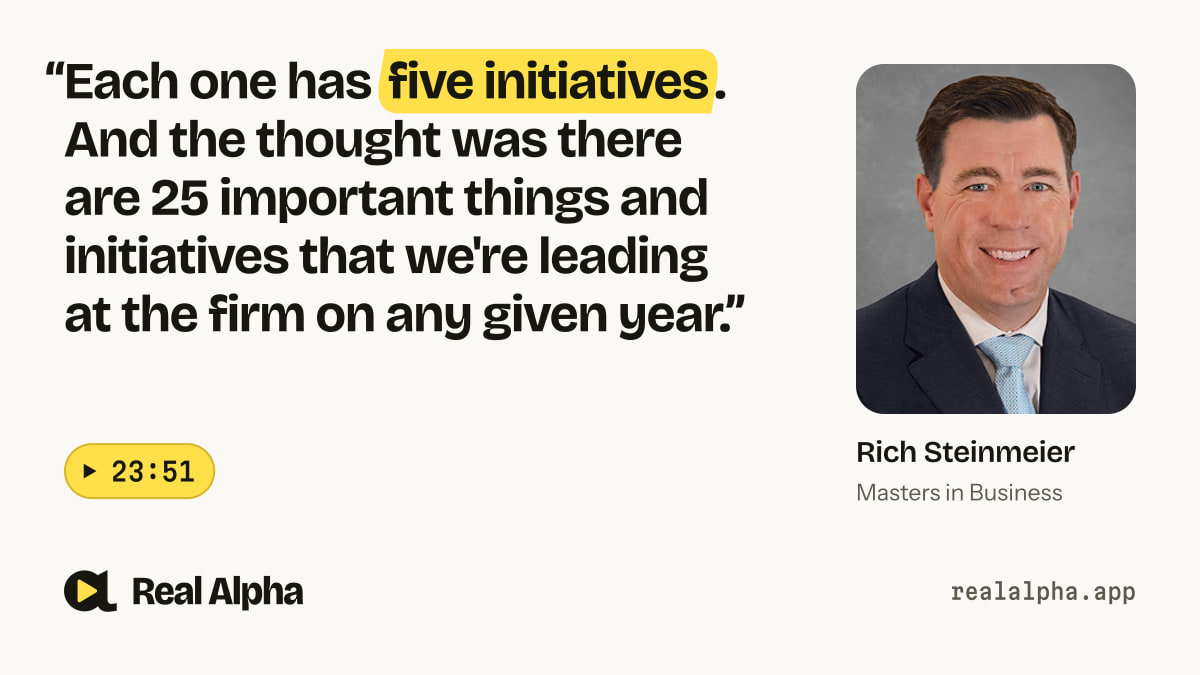
“Each one has five initiatives. And the thought was there are 25 important things and initiatives that we're leading at the firm on any given year.”
 Rich Steinmeierat 23:51 · Masters in Business
Takeaways
- The five-by-five plan creates 25 annual initiatives.
- Quarterly town halls repeat the strategy and take live questions.
- The goal is to connect employees’ work with client outcomes.
About this segment
LPL sets five strategic pillars with five initiatives each, then repeats them through town halls and live questions. Rich Steinmeier says this helps employees connect their work to client and firm outcomes.

Rich Steinmeier is CEO of LPL Financial.
Led LPL’s growth and advisor recruiting, onboarding more than 7,700 producing advisors and 100 institutions.
From “The Future of Financial Advice: Masters in Business with Rich Steinmeier”, Oct 30, 2026. Watch the full episode
Thanks. We'll look at and fix what's off.
Transcript
From the transcript Masters in Business publishes with the episode.
- 23:17
Tell us about your five by five playbook, five objectives, five initiatives. Yeah. That's shared with every employee. Yeah.
- 23:25
When I became the CEO, what I realized was that I want to make sure that all of our employees go on the journey with us together. And it wasn't always clear what our strategy was to the more granular level across, you know, we have nearly 10,000 employees at the firm and you want to make sure that they are able to reflect that to our clients as well. And so what we did was we worked through, we first started by changing our values and our articulation of the values of the firm. And then a level below that we started with what our strategic pillars are like, how will we win in the marketplace? And then specifically underneath those kind of pillars, we said, okay, what are the top initiatives? And so it was five pillars. Each one has five initiatives. And the thought was there are 25 important things and initiatives that we're leading at the
- 24:11
firm on any given year. And if you are one of those 10,000 people across the firm, you should see your work reflected there. And so you can see specifically how you're contributing to the success of either our clients or our firm.
- 24:24
So 32,000 advisors that are independent contractors or partners, I don't know how you describe the relationship, and 10,000 employees. When you roll something out like five by five, what are the challenges communicating that to 32,000 people all over the whole country, every state?
- 24:46
Yeah, the challenges are that they don't all hear it. The challenges are that if you do it one time, They won't ingest it. The challenges are that you take things out of context. And so when I see a list and say, these are the pillars and these are the priorities, I don't understand them. And so for us, one of the things that we've realized as we roll out, we're trying to simplify the strategy so that it can be consumable, but it is still complex. And so it is repetition.
- 25:12
You've got to make. Sure that there is repetition, that there is availability. We do town halls quarterly. I do advisor town halls as well. And on all of those, we take live questions to make sure that our audiences are not just hearing what we have to say, but also either challenging it or asking questions. And so we're on a journey. We are trying to be an incredibly transparent firm that makes it clear how we're going to market, how we do business.
- 25:39
And so much of that means then you've got to take a lot of time taking all of this that sits up in the head and distilling it into something that's consumable so that folks can say, Okay, I'm with you. Or alternatively, I don't really like the path you're on and can choose an alternative path. But it's not, I don't think that not sharing is a good idea. I think it is really important to be as forthright and transparent as possible so that folks can understand when times get tough and you have to make difficult decisions, they understand the context by which you make decisions.