The alpha, twice a week
That was 3 min.
Get the best new moments in your inbox every Wednesday and Saturday. It's free.
Check your inbox
We sent a link to your address. Click it to finish signing up. Not there in a minute? Look in spam.
or
Bloomberg Businessweek · 3 min · Nov 27, 2026
Madoff would tax inheritances as income and recognize investment gains
 Ray Madoff
 proposes recognizing investment gains when assets transfer and taxing inheritances through recipients' income tax.
In this episode
Full analysis- 12:48The wealthy can avoid income tax by avoiding taxable income4 min
- 19:03Estate-tax loopholes let fortunes pass to heirs untaxed4 min
- 32:32Teach children to use AI and to work without it4 min
- 29:46Schools cannot future-proof children by predicting tomorrow's jobs2 min
- 22:52Madoff would tax inheritances as income and recognize investment gains3 min
- 6:37Prediction markets need federal rules to police cross-border trading4 min
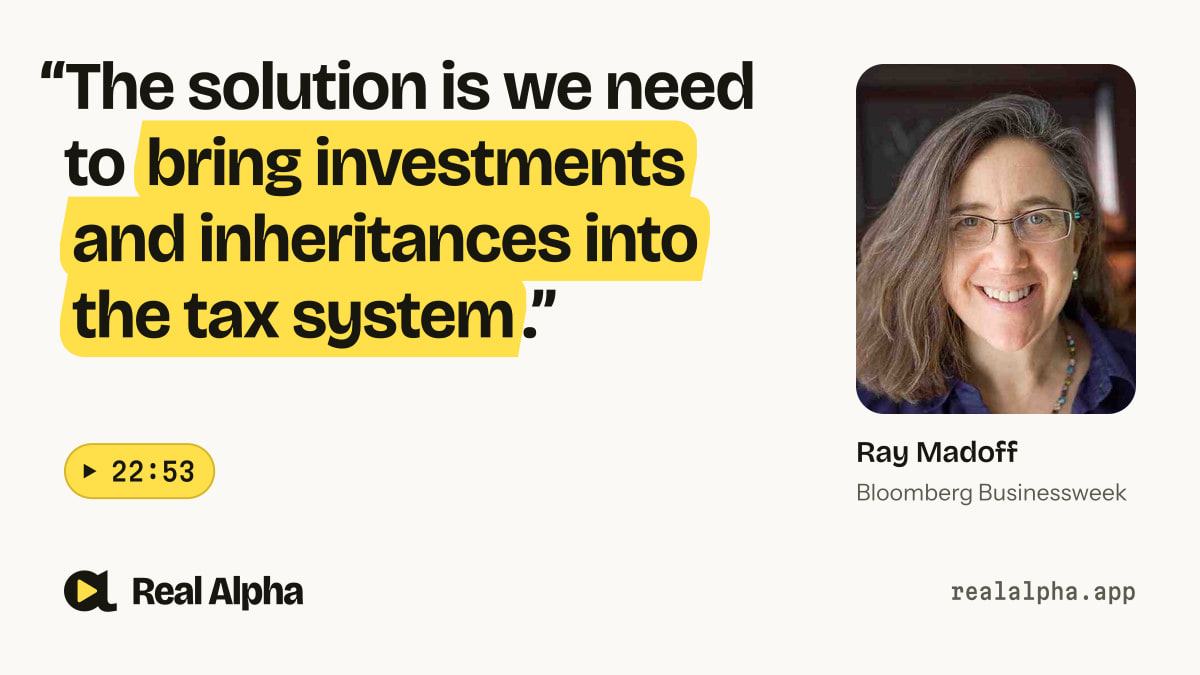
“The solution is we need to bring investments and inheritances into the tax system.”
 Ray Madoffat 22:53 · Bloomberg Businessweek
Takeaways
- Recognize gains when assets are sold, gifted or passed at death.
- Tax inheritances and gifts through recipients' income tax.
- She says annual wealth-tax valuations would be more complicated.
About this segment
Ray Madoff proposes recognizing investment gains when assets transfer and taxing inheritances through recipients' income tax. She argues this addresses gaps an estate tax has failed to close.

Professor of law, Boston College
Authored The Second Estate, arguing the tax code entrenches wealth and creates an American aristocracy.
- CM
Carol Massar, Host

Tim Stenovec, Host · Co-host, Bloomberg
Interviewed leaders including Reed Hastings, Stephen Schwarzman and Mary Barra as a Bloomberg Businessweek co-host.
From “Bloomberg Businessweek Weekend - November 27th, 2026 | Bloomberg Businessweek”, Nov 27, 2026. Watch the full episode
Thanks. We'll look at and fix what's off.
Transcript
From the transcript Bloomberg Businessweek publishes with the episode.
- 22:55
Yeah. The solution is we need to bring investments and inheritances into the tax system. For the investments, we can do what I talked about, adopt the Canadian rule, tax the gains who are never transferred. For inheritances, the problem with the estate tax is that because it was imposed on the dead person, right? For some people, it really was a double tax. They paid a lot of taxes during their life, and then we hit them with taxes.
- 23:19
And what people didn't focus on was the recipients. And what we need to do is we need to get rid of the estate tax and bring inheritances and gifts and life insurance into our income tax system. Decide that people should be able to inherit however much we think sounds fair. It's a preference for inheritance if we want to give it. And tax it as income?
- 23:39
And then everything else should be taxed as income. Absolutely. Just the same way that money found on the street or lottery winning surprise money or a car that you went on a game show. Everything is income. And the only reason these things aren't income is because they've been written out of the system on the assumption that the estate tax was going to do a good job. And we know the estate tax is doing nothing because in 2025, when Trump had the power to have a full tax bill that he wanted, they kept the estate tax.
- 24:11
Isn't part of also thinking about this is, like, how do you value wealth? And how do you put, like, obviously if there's real estate or stocks, but then there's art and so on and so forth. Like, how do we fully get that picture?
- 24:24
But we have a system that does it, right? Our estate tax has years and years of having rules specifically about valuation. So it's there.
- 24:31
Because we've been doing it, yes, since 1916. Right. So that is not a problem. I think it is too much of a problem.
- 24:37
On the wealth tax area, one of the reasons I think is that if you were to have an annual tax, it's very different taxing things one time in a person's life than taxing them twice. Than valuing each year. That really can be quite complicated to do. Is there political appetite for that? I think definitely. Why? Because we have a couple of reasons. First of all, one of the values of the California thing and of the ProPublica leak, which showed how all these rich people don't pay taxes, is that no longer does anybody say with a straight face, rich people are paying a lot of taxes. A lot of people know that they're not paying taxes. They might not know how, but they know that that's the case. And the other thing that we have is we have Working class people are struggling. Somebody who earns $ 60, 000 as an Uber driver has to pay
- 25:21
$ 13, 000 in taxes. That is a huge burden for someone trying to get by. And on top of that, we have this enormous, we had a deficit of $ 2 trillion. Every year we're running these deficits of $ 2 trillion because we take in seven, we spend, we take in five, we spend seven. Do you know how much the richest 1% had when we couldn't cover this $ 2 trillion? $ 50 trillion. Yeah. And I'd say that it makes sense to say that, you know what, it matters if these people pay taxes.