The alpha, twice a week
That was 2 min.
Get the best new moments in your inbox every Wednesday and Saturday. It's free.
Check your inbox
We sent a link to your address. Click it to finish signing up. Not there in a minute? Look in spam.
or
Bloomberg Businessweek · 2 min · Nov 27, 2026
Schools cannot future-proof children by predicting tomorrow's jobs
 Daniel Susskind
 says tomorrow's jobs are too hard to predict, so schools cannot reliably train children for a fixed set of roles.
In this episode
Full analysis- 12:48The wealthy can avoid income tax by avoiding taxable income4 min
- 19:03Estate-tax loopholes let fortunes pass to heirs untaxed4 min
- 32:32Teach children to use AI and to work without it4 min
- 29:46Schools cannot future-proof children by predicting tomorrow's jobs2 min
- 22:52Madoff would tax inheritances as income and recognize investment gains3 min
- 6:37Prediction markets need federal rules to police cross-border trading4 min
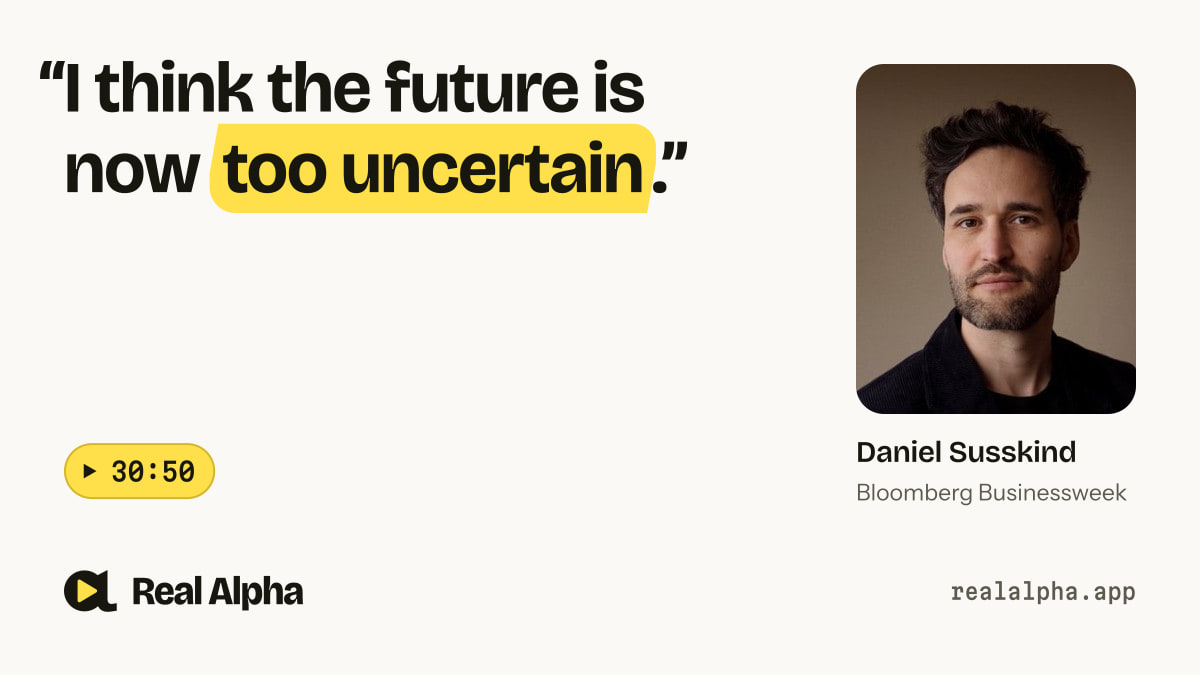
“I think the future is now too uncertain.”
 Daniel Susskindat 30:50 · Bloomberg Businessweek
Takeaways
- Future jobs may exist but require different skills.
- Specific job forecasts are too uncertain to guide schooling.
- England's coding mandate preceded AI systems excelling at code.
About this segment
Daniel Susskind says tomorrow's jobs are too hard to predict, so schools cannot reliably train children for a fixed set of roles. England's 2013 coding mandate, he says, shows how quickly a future-proofing plan can age.

Mercers’ School Memorial professor of business, Gresham College
Explores how AI reshapes work and society; wrote Growth: A Reckoning and A World Without Work.
- CM
Carol Massar, Host

Tim Stenovec, Host · Co-host, Bloomberg
Interviewed leaders including Reed Hastings, Stephen Schwarzman and Mary Barra as a Bloomberg Businessweek co-host.
From “Bloomberg Businessweek Weekend - November 27th, 2026 | Bloomberg Businessweek”, Nov 27, 2026. Watch the full episode
Thanks. We'll look at and fix what's off.
Transcript
From the transcript Bloomberg Businessweek publishes with the episode.
- 29:49
who are being born today, are young, your kids, young, need to be thinking that the jobs that I see out there today are not going to be the ones that are going to be there when I'm ready to go? To hit the workplace.
- 30:00
Well, I think that's certainly true. I think that is certainly true. I mean, I don't think the challenge for now is that there aren't going to be enough jobs for people to do. That isn't the challenge. And I think the challenge I really do for now and in the medium term is that there is work, but it's going to look very different. It's going to require very different types of skills and capabilities. And perhaps most difficult of all, and this is really the starting point in the book, it's incredibly difficult to anticipate, to predict exactly what those jobs are going to have to be done exactly what those jobs are that are going to have to be done. There's been this view for some time, the best way to prepare young people for the future of work is to try and future-proof them, to try and think really deeply and cleverly about the
- 30:45
future and predict exactly what jobs are going to have to be done and then say, these are the skills that they need. And I just don't think we can do that. I think the future is now too uncertain.
- 30:55
So we've never really been at a point like that where we have to think, or do we? Because I just think about conversations I might have had with my parents or something or thinking about, okay, what jobs do I need to be thinking about in the future? This is different. I think it is. It's dramatically different.
- 31:10
I think there was a sort of bundle of advice that you could pass down from parents to kids and kids to their kids. And clearly it sort of got battered around a little bit by the realities of the particular moment, but roughly it was the same. I just don't think that holds. I mean, the example I used to begin the book of how difficult it is, is back home 2013, David Cameron, then prime minister, says that England is going to become the first place in the world to mandate that all kids in primary and secondary schools have to learn to code. And you can see where this is going, right?
- 31:42
Don't have to do that anymore. Well, quite. So yeah. And you know, this was back then bold, radical, creative, almost every country followed suit. We, Fast forward to 2023, what does it turn out that these systems are not simply good at doing, but best at doing? And I, writing code, and I don't think this was a case of bad luck. For me, this was because these, and it's not just politicians, it's all of us have relied on this idea of future-proofing and it's no longer fit for this moment.