The alpha, twice a week
That was 5 min.
Get the best new moments in your inbox every Wednesday and Saturday. It's free.
Check your inbox
We sent a link to your address. Click it to finish signing up. Not there in a minute? Look in spam.
or
Prof G Markets · 5 min · Oct 26, 2026
Merger committees should test premiums against alternatives
 Scott Galloway
 says committees should test merger claims against valuation and alternatives.
In this episode
Full analysis- 7:58The merger shifts attention from Tesla’s weakening car businessPro pick 8 min
- 18:43A SpaceX merger could dilute Tesla shareholders’ protectionsPro pick 5 min
- 55:55Public markets price AI risk more cautiously than private markets5 min
- 34:04Merger committees should test premiums against alternatives5 min
- 51:03AI chip delays may reflect power bottlenecks, not weak demand3 min
- 1:08:45Meta's filing suggests AI funding could become harder4 min
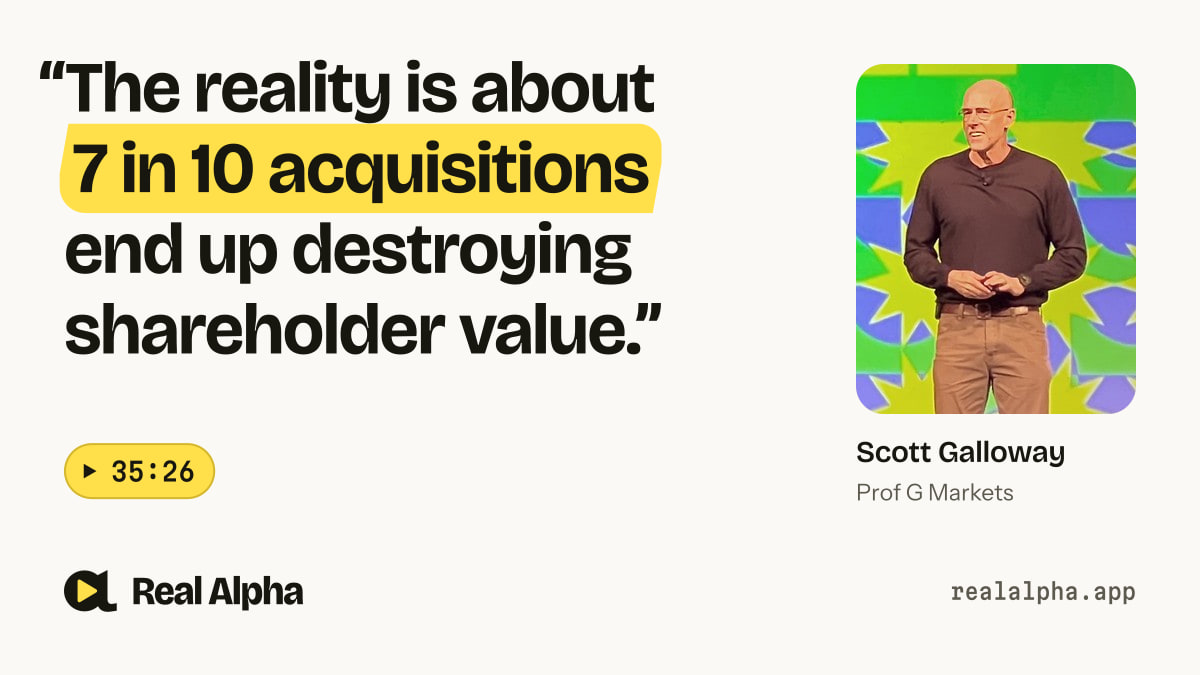
“The reality is about 7 in 10 acquisitions end up destroying shareholder value.”
 Scott Gallowayat 35:26 · Prof G Markets
Takeaways
- Scott says about 7 in 10 acquisitions destroy shareholder value.
- Test claims of scale against Tesla's 300-times-earnings valuation.
- Compare a proposed premium with what other buyers might pay.
About this segment
Scott Galloway says committees should test merger claims against valuation and alternatives. He notes that acquisitions often destroy value and argues Tesla's price makes a premium hard to defend.

Scott Galloway, Host

Ed Elson, Host
From “The $3.5T Bailout: Elon's Plan To Merge Tesla And SpaceX”, Oct 26, 2026. Watch the full episode
Thanks. We'll look at and fix what's off.
Transcript
Transcribed by machine (Whisper) from the episode’s audio, so a word may be off here and there.
- 34:16
Now, what you said that I don't, and I don't know the mechanics of this, but I think this is going to be a merger, not an acquisition, in the sense that the special committees, so you form a special committee, and the special committee is supposed to do real work with the investment bank to say, does this make sense? Can we justify it? What happens if this goes wrong? Is the CEO just building an empire? CEOs have a tendency to want to do acquisitions. Why? Because their compensation is driven by a compensation committee on the board that hires Towers Perrin because we don't like to do any actual real work. And Towers Perrin, who we pay $200,000, comes in and says, okay, Janet Robinson is the CEO of a $5 billion media company. And on average, the CEO of a $5 billion media company makes $8 million a year. And then what happens is we go, well, Janet's a
- 35:06
good person and she's working hard. We don't want to pay her at 50%. We'll pay her at 60%, which doesn't sound like a lot. But when you're paying 20% above the mean every year, what that means is every three or four years, CEO compensation is doubling and is the reason why in the last 40 years, CEO compensation has gone from 30 times the worker to like 600. Yeah, well, it's just been totally out of control.
- 35:29
So my point is there's an incentive to make acquisitions even when they don't make any sense. And every CEO is hoping for a transformative acquisition like what Zuckerberg did with Instagram. The reality is about 7 in 10 acquisitions end up destroying shareholder value. Now, if I'm on the special committee representing SpaceX shareholders, I'm like, okay, they're making an argument around scale. The company has manufacturing, supply chain expertise.
- 35:53
It's going to give us a lot of top line revenue. All right. But Jesus Christ, 300 times earnings. And wait, you want me to pay a premium? Fuck you. I mean, no, I think they're going to have I think the special committee at Tesla is going to have a lot more eye rolling at current valuations. They're going to say our total addressable market is the universe, is the galaxy. And, you know, go on to list all the things I'm talking about.
- 36:22
And we're paying 300 times for a company that's revenue growth is flat. And you want us to pay. pay a premium because supposedly we're on top here and we're the acquirer. You're saying, sorry, the SpaceX board is going to roll their eyes. Excuse me, the SpaceX board. I think of any special committee. Of which, by the way, he has 80% of the voting power. Assuming these guys want to write a report such that they're at least defensible in court, you know, in assuming these people actually do their job and are counseled by anybody, they're going to go.
- 36:56
Why do you think that? They don't. I mean, we saw what they said in court. They don't have a spine, right? I mean, that was Tesla that we saw. Okay, stock price. The day after it starts trading as a combined company, right? SpaceX is, okay, SpaceX, you not only overpaid, you grossly overpaid, right? So I just don't, I think they're probably going to end up in just a like for like. Like, what is the share price on the day of closing?
- 37:23
And we do a like for like exchange. I don't see why SpaceX would pay a... and part of what you do on a special committee is you do benchmarking you say okay the first benchmark is what would someone else pay for tesla and the answer is they pay 30 cents on the dollar there is no one out there that would even pay the current price much less a premium who on earth who apple would apple pay apple for a premium what is tesla 1.4 trillion or something what would Apple is literally like the probably the only company viable competitor or viable acquirer from Tesla. Tesla has a 1.5 trillion. They would have to pay $2 trillion. They're going to take a 30 or 40% dilution to buy Tesla. No, they would never do that. So the special committee, if they do anything, and the special committee owns shares of SpaceX. So they do have
- 38:17
a vested interest. My point is, I don't think there's any way Tesla is going to be able to argue on any level and also not create a fairly significant ugly hangover the first day that starts trading as a post as a windup. Now, having said all of this, Ed, I think this all may be moot.