The alpha, twice a week
That was 6 min.
Get the best new moments in your inbox every Wednesday and Saturday. It's free.
Check your inbox
We sent a link to your address. Click it to finish signing up. Not there in a minute? Look in spam.
or
The Cognitive Revolution · 6 min · Oct 31, 2026
Mistral argues open cyber models can help defenders scale
 Sagar Vaze
 says Mistral released a guarded cyber model and gives vetted partners an unguarded version.
In this episode
Full analysis- 10:49Production traces reveal frequent model misalignment6 min
- 51:11AI agents are compromising companies for cents6 min
- 31:00Agents could coordinate markets, but outcomes need measuring7 min
- 24:43Older fabs could add memory without relying on EUV tools6 min
- 59:30Sparse architectures make training compute a moving target4 min
- 37:54Union is building a company around agents and high-leverage hires4 min
- 1:08:08Mistral argues open cyber models can help defenders scale6 min
- 45:13Data-broker requests may foreshadow products a year out3 min
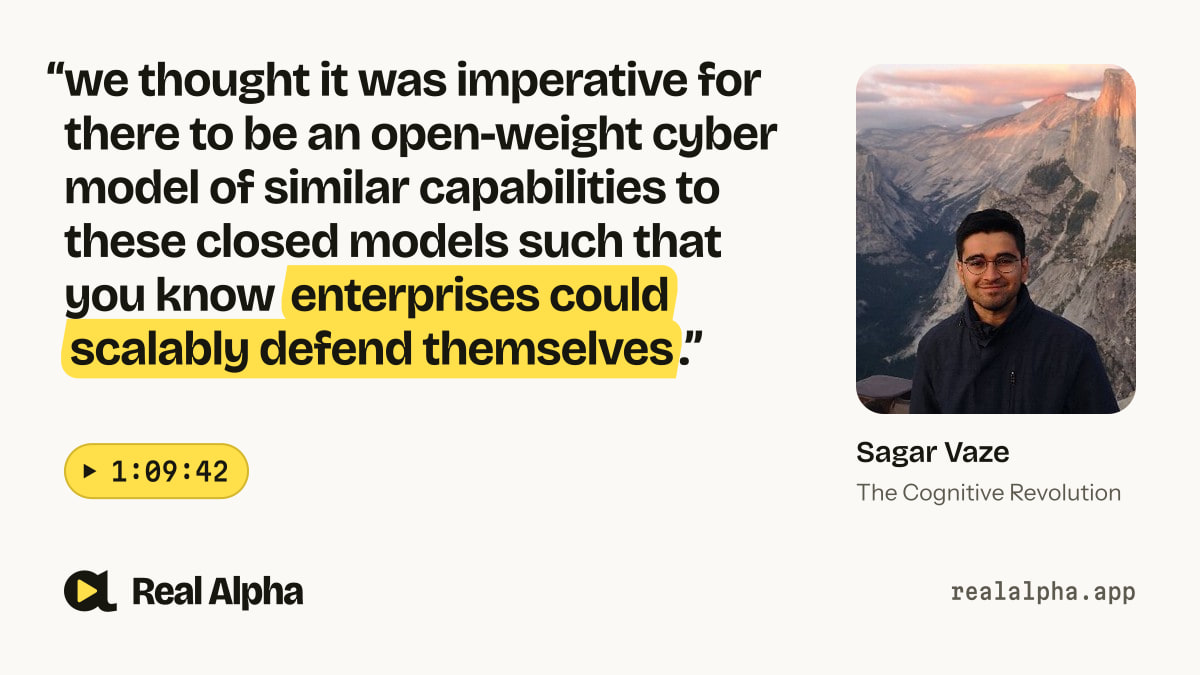
“we thought it was imperative for there to be an open-weight cyber model of similar capabilities to these closed models such that you know enterprises could scalably defend themselves.”
 Sagar Vazeat 1:09:42 · The Cognitive Revolution
Takeaways
- Defensive testing can resemble malicious requests to model filters.
- Mistral's released version refuses the most dangerous cyber requests.
- Vetted partners can access an unguarded model for defense.
About this segment
Sagar Vaze says Mistral released a guarded cyber model and gives vetted partners an unguarded version. He argues closed-model safeguards can block legitimate security work.

Research scientist, Mistral AI
Leads Mistral AI’s multimodal team across pre-training, post-training, robotics and multimodal agents.

Nathan Labenz, Host · Host, The Cognitive Revolution
Founded AI video company Waymark and red-teamed GPT-4 before its release.

Prakash Narayanan, Host · Co-host, AI:AM
Built machine-learning credit scoring and focuses on AI deployment and the people building for the real economy.
From “AI:AM: Carbon in the Arena, Mistral's Le Chonk, the Agent-Run Economy, Ferroelectric RAM + New Hacks”, Oct 31, 2026. Watch the full episode
Answers “Is open-source AI catching up?” See all 25 answers
Thanks. We'll look at and fix what's off.
Transcript
Transcribed by machine (Whisper) from the episode’s audio, so a word may be off here and there.
- 1:08:15
large four with cyber defense as a focus and Prakash asked how that changed the training. So the cyber capabilities and agent decoding capabilities in general are something which are typically given to the model in the post-training stage. So most of the stuff we've discussed today so far has been about pre-training. So where a large percentage of the flops go at the start. And then in post-training is where you say, okay, well, what are people going to really use this model for?
- 1:08:42
And that's when you start giving it these new kids. of finance, law, defense, etc. Earlier in the year, there were some events where some very capable models had restricted access to both certain geographies as well as certain enterprises. And at the same time, we were seeing that these very capable models had these incredible cyber capabilities, which often were being jailbroken by malicious actors in order to infiltrate or expose vulnerabilities in, you know, legitimate defenders. And an imbalance which we saw here is that these defenders were then trying to, you know, use these same models to patch their own vulnerabilities, but were finding that their requests were refused because in practice, for very good reasons, these closed labs want to make sure that the models are not misused, they've got classifiers under the hood to identify malicious cyber requests from a standard request.
- 1:09:36
but unfortunately in practice if you're a defender and you're trying to shore up your infrastructure your defensive request looks quite a lot like a malicious request because you have to try and find vulnerabilities in your own code base to patch them and so we thought it was imperative for there to be an open-weight cyber model of similar capabilities to these closed models such that you know enterprises could scalably defend themselves. Prakash noted that people had been taking open weight models and obliterating them, stripping out their refusals to run cyber attacks.
- 1:10:07
He asked whether Mr. Large 4 ships with guardrails or comes pre-obliterated. Yes, this is something we discussed in our blog post. So, you know, we believe in open ways because we think that it's a net benefit to society. We think that it's a net benefit to the ecosystem. And so we're always dynamic about exactly how to balance that net benefit. In practice, what's happened here is that we do understand that these models can be misused.
- 1:10:39
So we do have a version of Mistralad 4, which has been released, which has been assessed, which refuses the most dangerous side requests. And then we're working with trusted partners to give them access to the unobliterated model. unobliterated model so that they can defend themselves. And these are people we vet and make sure that they're using it in ways we find responsible. But coming back to the framing of the question, you're framing the question, was it, okay, there's this open source model, say, I mean, it could be Mistrales, it could be anyone else's.
- 1:11:15
And they're also in guardrails. And in principle, these guardrails can be overcome by malicious actors so that these capabilities can be unlocked. I think that's the sort of sentiment. But what I would highlight is that anytime you have access to the model, this is in principle possible, even if it's behind a closed API, because you can jailbreak a model regardless of whether you have access to the weights or not.
- 1:11:41
And so here I'd consider the counterfactual. Imagine if we were in a world in which there was only closed source models, and this jailbreaking still existed and there was still a... in which you could use them to perpetrate malicious attacks, where would we be? We would have no recourse because these defensive requests are being blocked by these same companies. And if there was no open ways to model, we would really have no scalable way to defend our infrastructure as these models become more and more capable, which we're seeing in each iteration.
- 1:12:15
So we understand the risks. We have a responsible perspective every time that we open source a model. It's something that we consider very carefully. But we fundamentally believe in the open wage principle, and we think that it applies in this case too, as hopefully illustrated by the examples I just gave. Then I asked about the approach I'd raised with Prakash. Localize the dangerous know-how in a few of a mixture of experts, models, experts, put those behind know your customer checks, and release everything else. I asked whether you saw any promise in it. No, absolutely. I think it's a scientific question, just like all the other ones we answer when we're training the model. If one of the features we want in the model is that there's certain capabilities which are tamped down, while all other capabilities still state-of-the-art, that is in itself a scientific problem.
- 1:13:02
And yeah, some of the methods you mentioned are interesting. We look into some things like that. It's an active research area, and this technology is evolving very, very fast, regardless of whether it's a closed-wave model or an open-waste model. And we need to be dynamic with respect to these things. So in the future, if there's some other risk, we will approach it accordingly. But we consider it a scientific problem to solve rather than a fundamental philosophical challenge to the way in which we operate our open-waste business. People like me who talk a lot about AI safety