The alpha, twice a week
That was 4 min.
Get the best new moments in your inbox every Wednesday and Saturday. It's free.
Check your inbox
We sent a link to your address. Click it to finish signing up. Not there in a minute? Look in spam.
or
The Cognitive Revolution · 4 min · Oct 31, 2026
Union is building a company around agents and high-leverage hires
Samvit Ramadurgam describes an agent-native team using billions of tokens per person daily.
In this episode
Full analysis- 10:49Production traces reveal frequent model misalignment6 min
- 51:11AI agents are compromising companies for cents6 min
- 31:00Agents could coordinate markets, but outcomes need measuring7 min
- 24:43Older fabs could add memory without relying on EUV tools6 min
- 59:30Sparse architectures make training compute a moving target4 min
- 37:54Union is building a company around agents and high-leverage hires4 min
- 1:08:08Mistral argues open cyber models can help defenders scale6 min
- 45:13Data-broker requests may foreshadow products a year out3 min
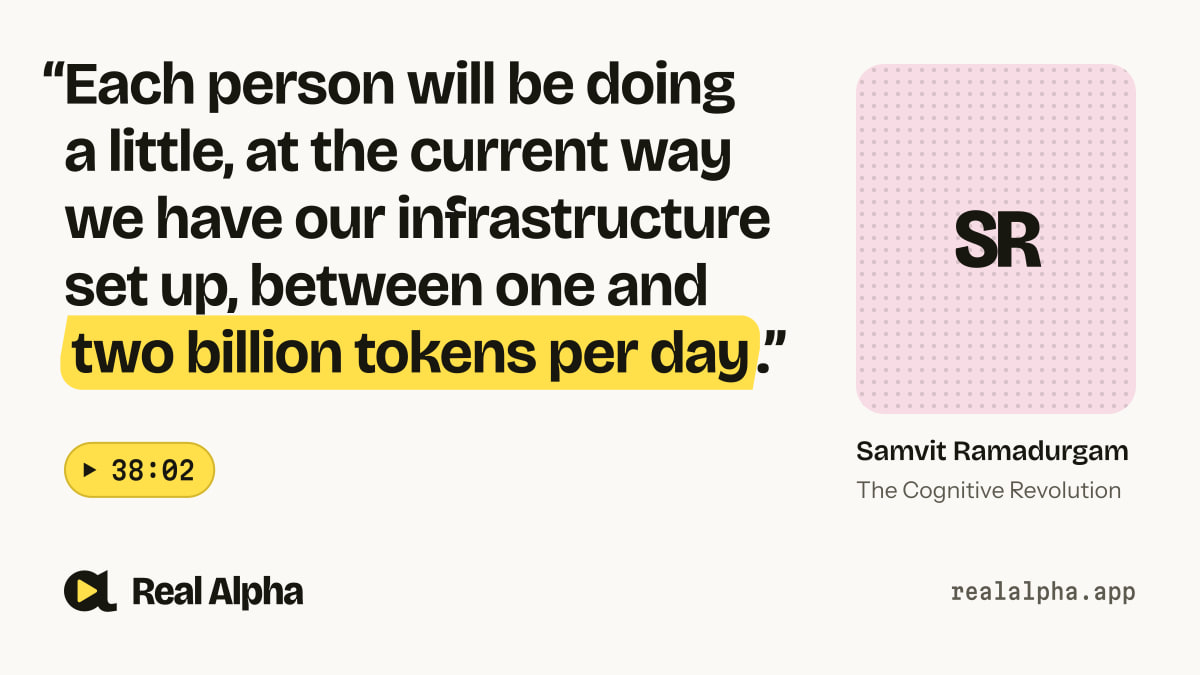
“Each person will be doing a little, at the current way we have our infrastructure set up, between one and two billion tokens per day.”
Takeaways
- Each person uses one to two billion tokens a day on coding agents.
- Agents attend meetings and build from the discussion in real time.
- Union hires for insight that prompts a different course of action.
About this segment
Samvit Ramadurgam describes an agent-native team using billions of tokens per person daily. He says hiring should favor people whose ideas change what the company would otherwise do.
Union

Nathan Labenz, Host · Host, The Cognitive Revolution
Founded AI video company Waymark and red-teamed GPT-4 before its release.

Prakash Narayanan, Host · Co-host, AI:AM
Built machine-learning credit scoring and focuses on AI deployment and the people building for the real economy.
From “AI:AM: Carbon in the Arena, Mistral's Le Chonk, the Agent-Run Economy, Ferroelectric RAM + New Hacks”, Oct 31, 2026. Watch the full episode
Thanks. We'll look at and fix what's off.
Transcript
Transcribed by machine (Whisper) from the episode’s audio, so a word may be off here and there.
- 38:00
This is obviously not the way to optimize for productivity. As a correlate, we want our team usage on the coding agent side. Each person will be doing a little, at the current way we have our infrastructure set up, between one and two billion tokens per day. One and two billion tokens per day. Yeah, productively deployed. So in terms of how we're building the company, this is an agent-native company.
- 38:21
And so we have not only coding agents, we have coding agents that talk to each other. We have an internal organization we've set up of agents. So I have a chief marketing officer who reports to me who's got a bunch of different sub-employees reporting to that AI. And all of them are long-running agents that talk to each other and talk to our coding agent sessions and listen to our team video calls, are in the meetings with us and chime in and chat to build things for us while we're...
- 38:48
I had a meeting this morning where there was some issue with one of our dashboards. we just said hey agent like fix it during the meeting they got updated while we were talking i think the gap between work and meetings is converging it used to be that like hey i want to get out of this meeting so i can get back to work and do real work it's actually changing there's still an element of that for sure but it's changing it's changing because when we're in a meeting if you have like a rigorous discussion that's all creating like really rich context from different perspectives for an agent that then goes and like then you can just Have a debate and say, okay, go do our conclusion with all the aspects that were mapped out there in there.
- 39:25
What do you feel, you know, you had a Forge Global, which you built in the kind of pre-Agentic era. What do you feel is like the big difference between that era and this era in terms of running a company? Here's the metric we have. We're a small team. We're like five people, soon to be 10 people right now. And so the heuristic I have for hiring someone is, are they going to prompt me to do something different than we would have done before?
- 39:49
You don't really need people to do work anymore for the kinds of work we're doing. You need people to have visionary insight that adds the DNA of the company, that really makes you do things that you wouldn't have thought to do otherwise, that you can't prompt an agent to do for you. So I think that we want to build this company in a way that's like building the machine that builds the machine and eventually have more and more agents to spin it up.
- 40:15
So I think that there's a type of company you could start now that does with a dozen people that previously took a thousand people. And so we'd like to be one of those companies and have more that go towards tokens just because let's just be really lean and be really agile and have a concentration of talent and vision. And it raises the bar too. Another thing that changes is that when you hire our people now, the incremental value of interdisciplinary skills increases exponentially.
- 40:42
So if someone is an engineer, that's valuable. Someone's an engineer and a product person and a designer, that's much more valuable than before. Because before, that person didn't have the ability to actually make use of the integration of these different skills. In the modern world, the more skills you can integrate into one system, the more you like coordinate all, if you cut out a lot of inter-human coordination by having it being done in your head, you can articulate a clear vision to our agent systems we have so much leverage that the the bottleneck is not execution manpower the bottleneck is like clear articulation of good ideas and that's like the real bottleneck great stuff it's one of the biggest visions we've heard