The alpha, twice a week
That was 4 min.
Get the best new moments in your inbox every Wednesday and Saturday. It's free.
Check your inbox
We sent a link to your address. Click it to finish signing up. Not there in a minute? Look in spam.
or
TBPN · 4 min · Nov 12, 2026
Model gains depend on data and training environments
 Dylan Patel
 says a new model improved sharply in chip design and software engineering, but not across every field.
The episode’s best minutes
Full analysis- 1:03:35NVIDIA's edge depends on founder-led decisionsPro pick 6 min
- 1:25:12Model gains depend on data and training environments4 min
- 1:56:10AI accelerator customers usually choose lower cost3 min
- 3 more moments in the full episode
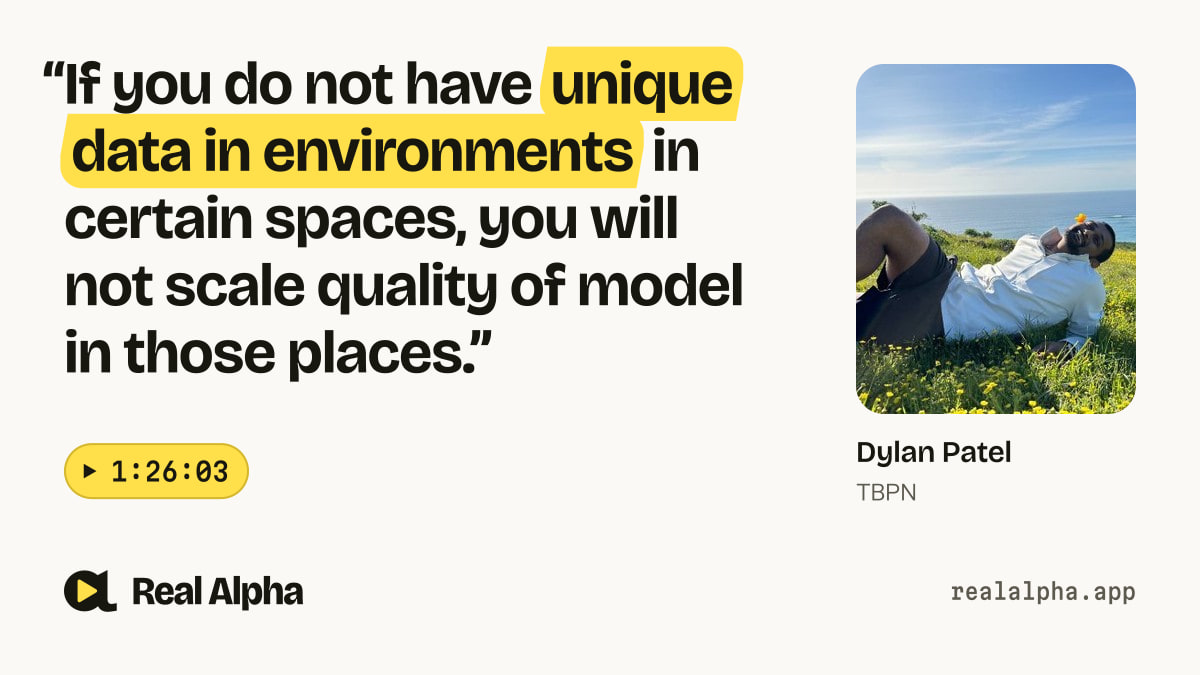
“If you do not have unique data in environments in certain spaces, you will not scale quality of model in those places.”
 Dylan Patelat 1:26:03 · TBPN
Takeaways
- The model improved in software engineering and chip design.
- Reinforcement-learning environments help determine where models scale.
- Scaling requires techniques and data, not just larger models.
About this segment
Dylan Patel says a new model improved sharply in chip design and software engineering, but not across every field. He argues that progress depends on the data and environments teams build.

Founder & CEO, SemiAnalysis
Founded SemiAnalysis in 2020, a research firm tracking the chip supply chain and AI infrastructure buildout.

John Coogan, Host · Co-host, TBPN
Co-founded Soylent and Lucy; OpenAI bought his show TBPN in April 2026.

Jordi Hays, Host · Co-host, TBPN
Founded Branded Native; co-founded fintech Capital, which Rho bought.
From “Jensen Out, TBPN Merch Drop, GPT 6 Cyber, Dylan Patel Live”, Nov 12, 2026. Watch the full episode
Answers “Is AI progress slowing down?” See all 75 answers
Thanks. We'll look at and fix what's off.
Transcript
From the transcript TBPN publishes with the episode.
- 1:25:20
GPT-5.5.5. You surprised by the, like, the moderate jump in progress? I saw the 5.2. Was was it Mythos five point think it Got like 16%. I mean, it speaks to the quality of the benchmark that it wasn't immediately 100%. But take me through a little bit of your reaction to the results there.
- 1:25:44
Yeah. So, GDPX and our benchmark, we launched Yeah. We tested Anthropics model and launched it and it took a day or two to run the tests but Yep. More like two days. But anyways, it was was such a big improvement in some areas, software engineering and chip design. Okay. And and it was... There are areas where it just didn't improve at all. Interesting. Which was like really interesting. I mean it speaks to reinforcement learning environments are the vector for scaling.
- 1:26:11
Yep. If you do not have unique data in environments in certain spaces, you will not scale quality of model in those places. Yeah. And so chip design drastically improved. Right? Exactly. And I think it speaks to like what is Anthropic's focus? Well, just hired a bunch of chip people and we're making a chip. Yeah. And we're making model way better than a chip. Yep. And in the past Anthropic's view was we're not going to make a chip because it's not AGI pill. By the time we get a chip out, it's too slow. Mhmm. Now, the model can make the chip. So it's like, you know, I think I think they're really accelerating on that, front.
- 1:26:39
Likewise, software engineering continues to gain like mad. Yeah. Anthropic is so much better than everyone else in software engineering and chip design. Mhmm. It's incredible. And then other areas, they just didn't improve. I think I think it speaks to the volume of like how important data is Yep. In these data companies and these data vendors. But also, you know, the durability of like some of these categories. Right? Some of these categories, they didn't improve on at all and like they're probably not spending a ton of data on. Yeah.
- 1:27:04
Or, you know, maybe the benchmark is just so difficult, like, you know, that like it's it's... It did improve slightly in all domains, but generally scaling size is not going to get you improvement in every benchmark. You really have to scale techniques, algorithms, and data.
- 1:27:21
On the data side, how much value is there in, like, the data flywheel, the data that comes through the harness directly just given to the company, to the lab for free versus bought from a data broker specifically? Do you have a balance on how valuable each is?
- 1:27:40
Yeah. So we've we've established a relationship with a lot of the chip design data companies Mhmm. And and AI chip design companies. And Drop pick, as far as I understand, buys very little of this. Okay. They've been building it themselves. Yeah. Is is the only answer. Right? How else would they do Yeah. That makes sense. And but at the same time, like some of the spaces like bio, you know, Drop X started their own wet lab. Yep. And they're collecting data there, also they're buying a lot of data elsewhere. Sure. So I think it's it's it's, you know, I think other folks have different strategies Yeah.
- 1:28:10
You know, in terms of what do I build internally, what do I build externally. But I think the data vendors are really important. And given models are getting so good, a general large scale data vendor where we're connecting you to a bunch of people that are like, okay, data labelers, that's not what's valuable. Right? It's experts. It's experts. And so if you're an expert in material science and you're making data there, you can make a great business. But how scalable is that actually going on?
- 1:28:35
Totally. Totally. Yeah. We'll find out next time you're on the show. Thank you so much for coming on. We'll let you get back to work. Have a good one. What a week. Goodbye. Good luck.