The alpha, twice a week
That was 5 min.
Get the best new moments in your inbox every Wednesday and Saturday. It's free.
Check your inbox
We sent a link to your address. Click it to finish signing up. Not there in a minute? Look in spam.
or
Sourcery · 5 min · Nov 3, 2026
Model launches now require compute partnerships
 Gorkem Yurtseven
fal says successful model launches need compute arranged in advance, often through an inference partner.
In this episode
Full episode- 4:33Higher video prices are revealing deeper professional demandPro pick 5 min
- 13:22fal pivoted from Python infrastructure to image models5 min
- 48:49Hollywood adoption is slower than the AI debate suggestsPro pick 4 min
- 37:32Model launches now require compute partnerships5 min
- 9:22AI ads can improve through rapid creative testing4 min
- 27:37fal keeps management flat with hands-on team leads4 min
- 32:14fal screens for agency, hunger and humility4 min
- 45:06Open source persists because studios need model control3 min
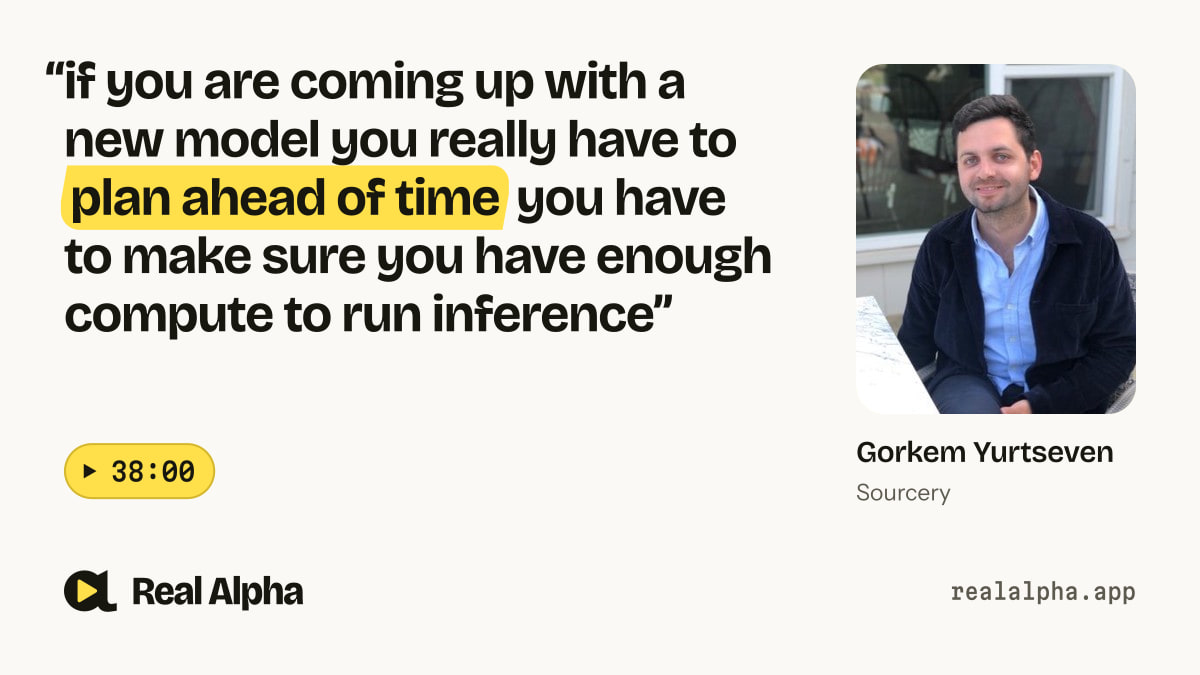
“if you are coming up with a new model you really have to plan ahead of time you have to make sure you have enough compute to run inference”
 Gorkem Yurtsevenat 38:00 · Sourcery
Takeaways
- Model teams may not be able to procure enough inference compute alone.
- fal plans capacity with both model providers and application builders.
- Generative media has many modalities and labs leapfrog one another.
About this segment
fal says successful model launches need compute arranged in advance, often through an inference partner. Its role spans models and customers, so it also has to forecast demand and invest ahead.

Co-Founder & CTO, fal
Co-founded fal and spent years optimizing its inference engine for generative media models.

Molly O'Shea, Host · Founder, Sourcery
Ex-Upfront Ventures investor; has interviewed Alex Karp and Palmer Luckey.
From “Inside fal’s $1.65B Series E & F Led by Sequoia & Bessemer”, Nov 3, 2026. Watch the full episode
Answers “Is there still a GPU shortage?” See all 31 answers
Thanks. We'll look at and fix what's off.
Transcript
Transcribed by machine (Whisper) from the episode’s audio, so a word may be off here and there.
- 37:45
come out sporadically like what it is there any consistent theme between all of them so right now we we play a bigger role in the ecosystem because we are an infrastructure partner for the model providers but we are also the the api partner for the application layer or studios people who are consuming the models so we got a good sense of supply on demand on both sides and we are in such a compute constraint moment right now that um if you are coming up with a new model you really have to plan ahead of time you have to make sure you have enough compute to run inference if if you are successful you are likely not going to be able to procure it on your own so it's usually a good idea to partner up with an inference provider like us to to do your lunch so we work very intimate with the model providers and for customers like they usually use multiple models at the same time
- 38:41
but they really care about model releases because they usually tie their product releases with model releases as well so we keep in very close communication with them as well and then we have to sometimes anticipate how much growth is going to come on the model side to procure our own compute to maybe do some some investment on our side to enable the whole space and someone really has to do that because otherwise all the compute is going to go to coding agents or whoever whoever is like doing the bigger investment by by planning ahead and investing on compute a little bit we we can enable both the model providers and the applications being built on it so that has become our responsibility in the ecosystem these these couple months because compute is so hard to come by i'll add a few more points i think generative media is like very unique in the sense
- 39:34
that in in two ways one i think it's there's just more modalities i think when people think of gen media maybe they only think of video yeah but like you would have to think about text image image editing video 3d text to speech you know speech to text um i don't know if i said 3d like for gaming use cases, whatever. 3D, 4D, 5D. Exactly, all of these. There's actually many modalities within generative media, and there's five to ten companies in each of these sub-categories within GenMedia, so that's one interesting aspect.
- 40:14
There's just a lot more happening, there's more fragmentation. And then the other is, going back to what I said about diminishing returns, I think it's still so early in the space that there's actually a lot more leapfrogging happening between more players. because like we're not at like the 98 point whatever percent we're only at like I don't know 50% of like you know where we're ultimately going to go so there's actually more people leapfrogging there's more diversity in in like the number of labs so it's not just like OpenAI anthropic OpenAI anthropic you know it's more like there's like eight you know players and they're all like leapfrogging each other like one big reason is you're not running out of data there is like so much video data out there and so much new video data is being produced every
- 41:04
day that no one has no one claims to train all of that data right they have to pick the hard problem with training a video model is actually you have to filter out the interesting video data so that you you make a you make a good model so if you need to put more data into the model there is abundance and it's it's seemingly free it's there's enough free video out there that it works very well but also the problem space is bigger right you are trying to reason around like the whole world physics everything so it's not as specific as coding or like as specific as certain llms are trying to optimize around so there's a lot more angles people can take to to create a more interesting and appealing model and it's it's been happening every other month almost i think that's where the naming comes in too there you go you have to differentiate with your naming i mean they've