The alpha, twice a week
That was 3 min.
Get the best new moments in your inbox every Wednesday and Saturday. It's free.
Check your inbox
We sent a link to your address. Click it to finish signing up. Not there in a minute? Look in spam.
or
Lightcone · 3 min · Jul 3, 2025
Ndea is building a meta-learner that writes programs for new tasks
 François Chollet
Ndea's proposed meta-learner assembles task-specific programs from reusable abstractions, combining deep-learning modules with algorithmic ones.
In this episode
Full analysis- 4:55Intelligence is adaptation, not a pile of learned skills7 min
- 20:16Intelligence recombines reusable abstractions to handle noveltyPro pick 7 min
- 11:47ARC tasks use common knowledge, not specialized preparation3 min
- 15:41ARC 2 exposes reasoning gaps while ARC 3 tests agency5 min
- 27:53Learned intuition can make program search tractable4 min
- 31:47Ndea is building a meta-learner that writes programs for new tasks3 min
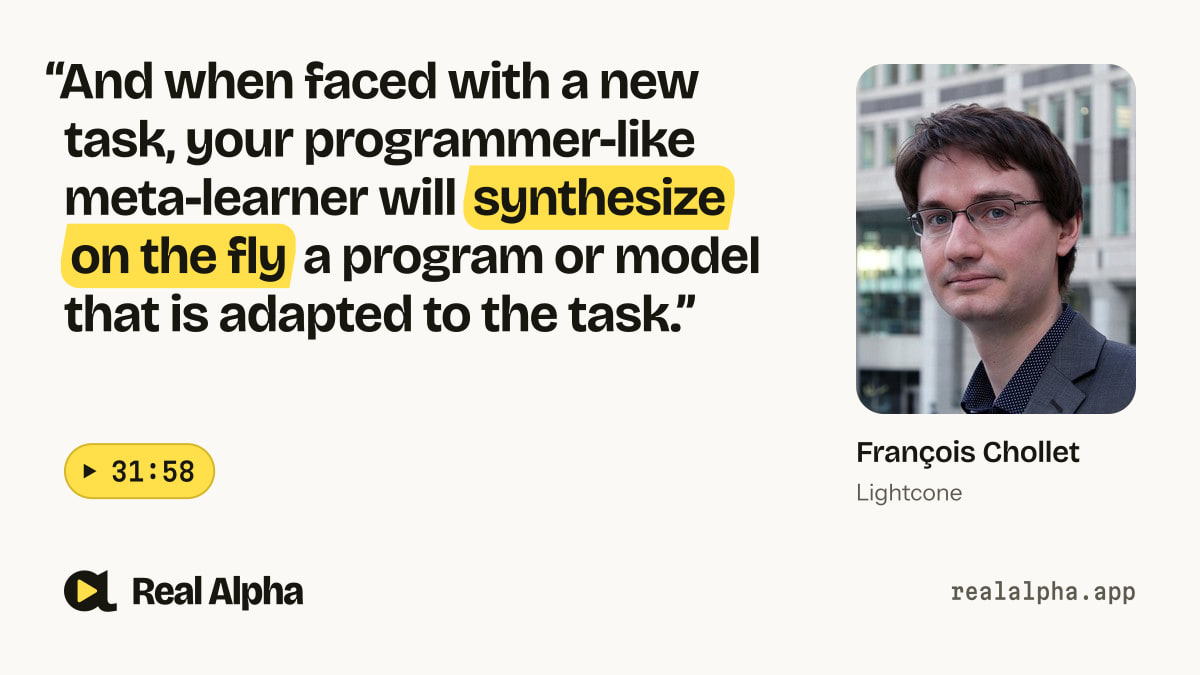
“And when faced with a new task, your programmer-like meta-learner will synthesize on the fly a program or model that is adapted to the task.”
 François Cholletat 31:58 · Lightcone
Takeaways
- Search assembles task-specific programs from reusable components.
- The abstraction library grows as new tasks are solved.
- The first milestone is solving ARC without ARC-specific knowledge.
About this segment
Ndea's proposed meta-learner assembles task-specific programs from reusable abstractions, combining deep-learning modules with algorithmic ones. Its first milestone is solving ARC without ARC-specific prior knowledge.

François Chollet is creator of Keras, author of Deep Learning with Python, and founder of ARC Prize.
Created Keras and the ARC-AGI benchmark at Google, then co-founded Ndea with Mike Knoop to pursue AGI through program synthesis.

Garry Tan, Host · President & CEO, Y Combinator
Co-founded Posterous and Initialized Capital, an early Coinbase backer.

Harj Taggar, Host · Managing partner, Y Combinator
Co-founded Auctomatic with the Collison brothers and later Triplebyte.

Diana Hu, Host · Managing partner, Y Combinator
CTO of Escher Reality; after Niantic bought it, ran AR for Pokémon GO.

Jared Friedman, Host · Managing partner, Y Combinator
Co-founded Scribd, which YC funded in 2006; has advised 20+ YC unicorns.
From “François Chollet: How We Get To AGI”, Jul 3, 2025. Watch the full episode
Thanks. We'll look at and fix what's off.
Transcript
Transcribed by machine (Whisper) from the episode’s audio, so a word may be off here and there.
- 32:00
This is the system that we are currently working on. AI is going to... to move towards systems that are more like programmers that approach a new task by writing software for it. And when faced with a new task, your programmer-like meta-learner will synthesize on the fly a program or model that is adapted to the task. And this program will blend deep learning submodules for type 1 subproblems, like perception, for instance, and algorithmic modules for type 2 subproblems.
- 32:30
And these models are going to be assembled by a discrete program search system that is guided by deep learning based intuition about the structure of program space. And this search process isn't done from scratch, it's going to leverage a global library of reusable building blocks of abstractions. And that library is constantly evolving as it's learning from incoming tasks. So when a new problem appears, the system is going to search through this library for relevant building blocks. And whenever in the of course, solving a new problem, you're synthesizing a new building block, you're gonna be uploading it back to the library, much like as a software engineer, if you develop a useful library for your own work, you're gonna put it on GitHub so that other people can reuse it.
- 33:16
And the ultimate goal here is to have an AI that can face a completely new situation and it's gonna use its rich abstraction library to quickly assemble a working model, much like a human software engineer can quickly create a piece of software of a new problem by leveraging existing tools, existing libraries, and this AI is going to keep improving itself over time, both by expanding its library of abstractions and also by refining its intuition about the structure of program space. This system is what you are building at India, our new research lab. We started India because we believe that in order to dramatically accelerate scientific progress, we need AI that's capable of independent invention and discovery. We need AI that could expand the frontiers of knowledge, not just operate within them. And we really believe that a new form of AI is going
- 34:07
to be key to this acceleration. Deep learning is great at automation, it's incredibly powerful for automation, but scientific discovery requires something more. And our approach at India is to leverage deep learning guided program search to build this programmer-like meta learner. And to test our progress, our first milestone is going to be to solve RKGI using a system that starts out knowing nothing at all about RKGI. And you ultimately want to leverage our system for science to empower human researchers and help accelerate the timeline of science.