The alpha, twice a week
That was 3 min.
Get the best new moments in your inbox every Wednesday and Saturday. It's free.
Check your inbox
We sent a link to your address. Click it to finish signing up. Not there in a minute? Look in spam.
or
Bloomberg Businessweek · 3 min · Oct 29, 2026
Omar Aguilar expects a December rate hike
Omar Aguilar expects a December rate move, with energy driving much of current inflation.
In this episode
Full analysis- 10:41Search monetization and cash flow explain Alphabet’s selloff6 min
- 25:11AI investment needs to prove its returns5 min
- 5:32Microsoft sees ChatGPT hosting as steadier than model training2 min
- 22:08Omar Aguilar expects a December rate hike3 min
- 32:53RIA firms need 70,000 more workers over five years3 min
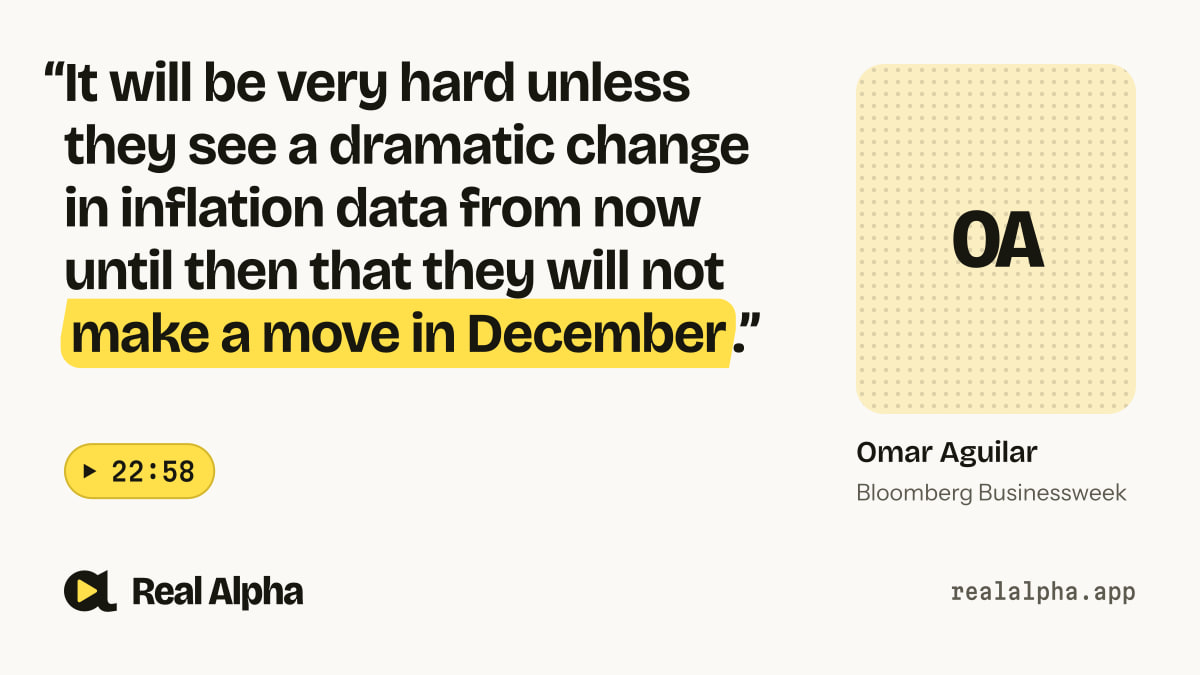
“It will be very hard unless they see a dramatic change in inflation data from now until then that they will not make a move in December.”
Takeaways
- He expects a December move absent a sharp change in inflation data.
- Energy prices account for much of current inflation, in his view.
- Waiting may avoid overreacting, but could leave the Fed late.
About this segment
Omar Aguilar expects a December rate move, with energy driving much of current inflation. He says waiting tests whether pressures persist, though patience risks the Fed falling behind.
CEO & CIO, Schwab Asset Management
- CM
Carol Massar, Host

Tim Stenovec, Host · Co-host, Bloomberg
Interviewed leaders including Reed Hastings, Stephen Schwarzman and Mary Barra as a Bloomberg Businessweek co-host.
From “Alphabet Disappoints, Microsoft's Cloud Sales Grow: Earnings Live from Schwab IMPACT | Bloomberg...”, Oct 29, 2026. Watch the full episode
Thanks. We'll look at and fix what's off.
Transcript
From the transcript Bloomberg Businessweek publishes with the episode.
- 22:11
to start with the Fed decision. How important was it that, you know, we're not getting a lot of clarity about what comes next. We might have fewer meetings where there's actually interest rate decisions or decisions.
- 22:22
That come out. How are you thinking about this new Fed in today's environment? Yes.
- 22:26
Well, first of all, welcome again to Impact. It's always great to have you guys. And the energy around here, it could not be the same without you guys. It's great. Thank you. Well, the decision was not a surprise. I think what we looked at was there's two dissents. That obviously provides a little bit of insight of what's going on in the discussions there. And then the idea that they're going to be committed to look at inflation and It only tells us they're looking at a lot of data. And what that, for us, means, yes, they will likely make a decision in December to rate hikes. It will be very hard unless they see a dramatic change in inflation data from now until then that they will not make a move in December. The communication process is definitely different.
- 23:12
I think it is clearly something that... The chairman has made a conscious decision to keep this a little more vague and then let everybody else try to interpret what they're trying to do. I think in the spirit of what the Fed is trying to do philosophically, I think if we believe that we'll continue to look at data as being the main driver for the decision process, that really doesn't change other than the communication process. But if we believe that the mandate is still the same and we believe that they're still going to continue to track them, Then I think the process, and you can see the market reaction on the futures clearly spiked up by saying December is probably a done deal.
- 23:54
We'll get to December now, and then I want to talk more about communication. Why wait until December? Why not raise rates at this meeting?
- 24:01
If inflation is a problem, right? Why not do it? Yeah, and I think that's a good question. I think if you look at the data that we got on CPI and PPI, and you look at how... A lot of the current inflation is really driven by energy. And a lot of the other components that go into the inflation, whether it's wage growth, whether it's supply chains, whether it's all those, they just started to just play a role.
- 24:29
I think the decision to just wait for a couple more months, it's probably not as a bad decision, given that it's not very clear to me how much is just oil prices being too high. other than there is really a sustainable thing that is going to be hard to break. Now, again, in the past, depending on the Fed, they have been preemptive trying to just not get out of hand. This Fed seems to be a little more patient, which, again, it's a double-edged sword. It could actually mean that if they could be late, that that's always a problem. But also at the same time, it could be that they are not overreacting to just one particular set of points.