The alpha, twice a week
That was 3 min.
Get the best new moments in your inbox every Wednesday and Saturday. It's free.
Check your inbox
We sent a link to your address. Click it to finish signing up. Not there in a minute? Look in spam.
or
All-In · 3 min · Jun 2, 2026
OpenAI argues agent memory keeps models close to customers
 Sarah Friar
 says models become more useful when agents carry personal and company context.
In this episode
Full analysis- 8:27Compute shortages reach beyond chips and power6 min
- 15:57Falling compute costs can improve customer economics7 min
- 0:46OpenAI sees an IPO as a funding option, not a finish line2 min
- 3:20OpenAI says one model across products compounds its advantage4 min
- 22:33OpenAI uses cloud partners to shift compute spending toward opex3 min
- 25:45OpenAI argues agent memory keeps models close to customers3 min
- 29:09OpenAI sees chat intent and memory as a basis for ads3 min
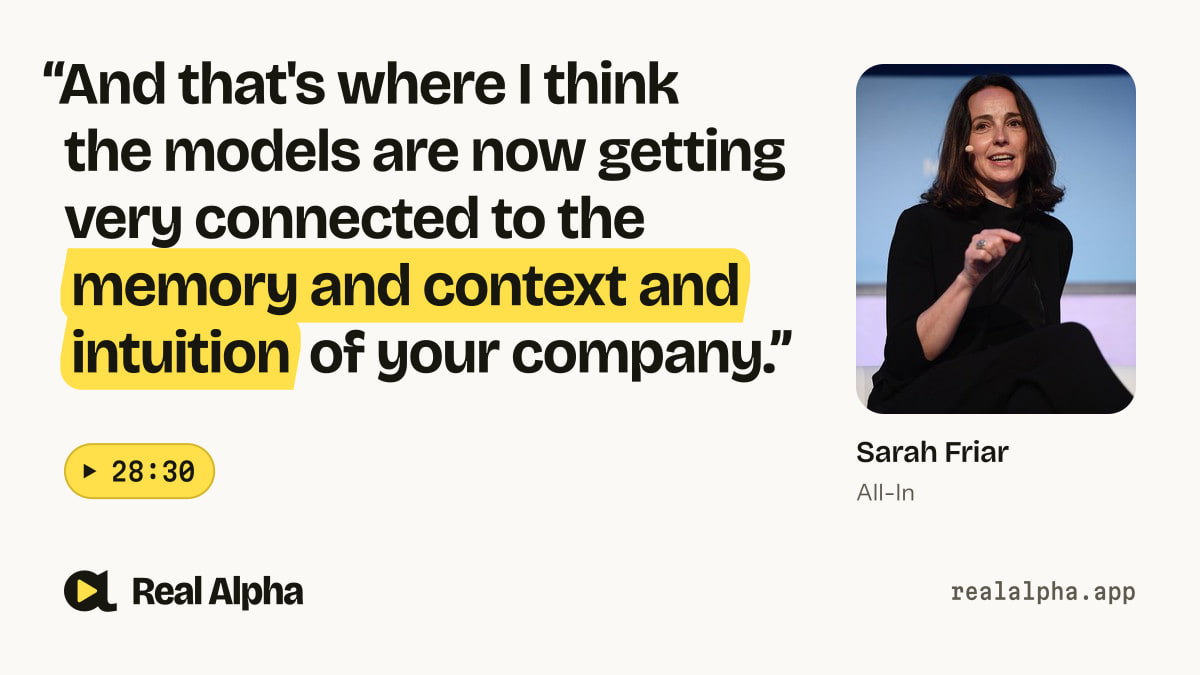
“And that's where I think the models are now getting very connected to the memory and context and intuition of your company.”
 Sarah Friarat 28:30 · All-In
Takeaways
- Agent memory can personalize how a model works for a user.
- Enterprise context can help models reflect company intuition.
- Friar says that connection can drive revenue and efficiency.
About this segment
Sarah Friar says models become more useful when agents carry personal and company context. She sees that memory and intuition as a way to connect AI to enterprise value.

Sarah Friar is CFO of OpenAI.
Leads OpenAI's finance as CFO; previously oversaw Square's 2015 IPO and helped take Nextdoor public as CEO.

Chamath Palihapitiya, Host · Founder & CEO, Social Capital
Led Facebook's growth team; his firm backed Slack and AI chipmaker Groq.

Jason Calacanis, Host · Founder & CEO, LAUNCH
Early Uber angel; sold Weblogs Inc. to AOL; hosts This Week in Startups.

David Sacks, Host · Co-founder & partner, Craft Ventures
PayPal's first COO, founded Yammer; White House AI & crypto czar 2025–26.

David Friedberg, Host · CEO, Ohalo
Founded The Climate Corporation, sold to Monsanto for about $1.1B in 2013.
From “OpenAI CFO Sarah Friar: IPO, AI Rivalries, New Device, and Spending $100B+ on Compute”, Jun 2, 2026. Watch the full episode
Thanks. We'll look at and fix what's off.
Transcript
Transcribed by machine (Whisper) from the episode’s audio, so a word may be off here and there.
- 25:48
Do you think that in five years from now, the stack is just merged together? What do I mean? In traditional or historical markets, you'd have NVIDIA sell the chips, but that's all they do. And then you'd have Microsoft just run a cloud. That's all they would do. And then you would have a consumer app. That's all you would do. But now we see everybody doing everything. You guys have silicon that you're spinning. You have models that you make.
- 26:12
You may or may not eventually decide that you need to be some form of a neocloud yourself. If you look at NVIDIA, they have incredible silicon, but they also have their own open source models. They're increasingly becoming an off-taker. Google is a cloud company first, but they also have a chip. Now they have models. So it's all merging. If that continues to happen, does that make the competitive landscape simpler or easier?
- 26:37
I mean, I think where everyone is trying to make sure they reside is the layer that is closest to the customer, where usually you take the largest portion of the profits of the ecosystem, right? no one wants to find themselves abstracted away. Absolutely. And so that's why today, when I think about our position, it comes back to where I started. Why we want to be that AI intelligence layer is because a year ago, people talked about the commoditization of the LLMs.
- 27:09
And frankly, it's gone the opposite, because as you start building an agentic layer, and we've all started to use this word harness, but the harness is what brings the context, the memory, right? I have in my codex, I have a whole ginormous memory file where it knows that I'm me. It knows I'm the CFO of OpenAI. It knows how I like to write things, how I like to say things. It knows what I'm interested in. It actually also knows that I'm a mom, teenagers.
- 27:39
I mean, it just carries all this memory and that makes the model more powerful for me. Now think about what happens when that memory in that context is brought into an actual enterprise environment. So now it's not just even about the data that resides there. But I always think about the intuition of like back when I worked on Wall Street, right? There was all the data in the world. that told you what a stock should do post an earnings call.
- 28:04
But, give me one second, then you called your trader, and the trader would be like, yeah, the stock's not going up, Sarah. And I'm like, what are you talking about? Like, all the numbers say it did this, did this, did this. And he's like, yeah, no, but I know this fund is under pressure, and they need to sell down their book, and that is going to kill the stock for the next week. That is the intuition of an enterprise.
- 28:26
Like, it's the best example I always think of because I came out of a financing world. But there's this intuition in every walk of life. And that's where I think the models are now getting very connected to the memory and context and intuition of your company. And that's what gets CEOs and C-suite really excited because they're like, okay, now I really see how this is going to add value to drive my revenue line, my top line.
- 28:50
But also, you know, I can think about it as an efficiency play as well. And so back to what you're asking, I think what people want to make sure is they stay as close to that value as possible.