Free with a sign-in.
The best 13 min of 32
OpenAI CFO Sarah Friar: IPO, AI Rivalries, New Device, and Spending $100B+ on Compute
Sarah Friar says OpenAI is funding a long buildout while aiming to keep its AI layer close to customers.
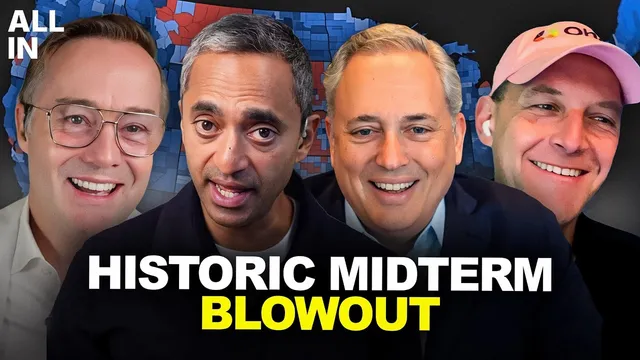
 All-In · Chamath Palihapitiya & Jason Calacanis & David Sacks & David Friedberg
- Sarah Friar is CFO of OpenAI.
The best minutes
- 8:27Compute shortages reach beyond chips and power6 min
- 15:57Falling compute costs can improve customer economics7 min
Also worth watching
- 0:46OpenAI sees an IPO as a funding option, not a finish line2 min
- 3:20OpenAI says one model across products compounds its advantage4 min
- 22:33OpenAI uses cloud partners to shift compute spending toward opex3 min
- 25:45OpenAI argues agent memory keeps models close to customers3 min
- 29:09OpenAI sees chat intent and memory as a basis for ads3 min
Full analysis · 6 min read
Real Alpha · Nov 8
Sarah Friar says $122 billion gives OpenAI funding flexibility
- OpenAI raised $122 billion in March to preserve funding flexibility.
- Friar said compute would remain insufficient in 2026 and limited in 2027.
- Boards should test partner-backed capacity against customer demand, unit costs and future cash needs.
Free with an account
Read the rest of the analysis
6 sections, the 6 other voices it tests Friar against, and what it means for you. Every episode we cut gets one.
Check your inbox
We sent a link to your address. Click it to finish signing up. Not there in a minute? Look in spam.
or
Signed up before? The same buttons sign you in. The episode, its moments and the transcript stay free.
The $122 billion bought options, not a compute count
Friar said OpenAI raised $122 billion in March to give the company maximum flexibility. She treats an IPO as another fundraising route, not an operating destination.
This distinction matters because a financing event does not specify what capacity it buys. The host cited an estimate of about $50 billion to build one gigawatt, including land, power, shell and chips.
Friar answered with partners and payment structure, not an OpenAI gigawatt count. So the $122 billion cannot be read as two gigawatts, or as proof OpenAI pays all build costs.
The transcript does not say how much capacity the raise alone secures, or how much OpenAI must fund directly. Friar also said OpenAI was not yet investment grade, making partner financing relevant.
In October 2026, Gil Luria told Prof G Markets that equity and debt investors have limits. That is a funding stress test, not evidence that OpenAI has exhausted those markets.
“it's a milestone. It is not a destination.”
Our read
The round buys choice, but not a demonstrated quantity of usable compute. Separate announced capital from contracted capacity and delivery timing.
Scarcity stretches from power to local consent
Friar said OpenAI would still lack enough compute in 2026 and saw 2027 as limited. Her list spans energy, land, regulation, chips, memory, talent and local trust. That makes usable capacity a chain, not simply a chip order.
For example, she described a one gigawatt data center in Saline, Michigan, tied to the Oracle complex. She said the project would protect local electricity bills, bring 2,500 union jobs and pay $1 billion in Michigan taxes.
She also described $45 million for education and Codex credits. These remain commitments she described, not outcomes verified in the interview. A promise about household bills does not establish a delivery date or local approval.
In October 2026, Evan Conrad told Upstarts he expected GPU scarcity to last at least four to five years. In November 2026, Chamath Palihapitiya said on All-In that permitting delays could strengthen hyperscalers.
Those later views widen the risk horizon, but do not confirm Friar's forecast. The operational point is that power, construction and community consent can delay capacity even when chips are available.
“if you want to buy more compute, good luck to you.”
 Evan Conrad · Upstarts · Oct 29Compute financing could become a US geopolitical lever
 Chamath Palihapitiya · All-In · Nov 7Data center bottlenecks could make hyperscalers kingmakers
Our read
OpenAI's constraint runs from equipment and power to permission and people. A plan counting only chips risks counting facilities that cannot serve customers on schedule.
Falling token costs do not prove better margins
Friar's margin case starts with customer value, then turns on cost per token. She said OpenAI raised prices for its newest model 2x. Customers were probably still getting about 20 to 30 percent lower cost per token, she said.
That rests on efficiency gains, not lower total compute expense. Power and memory were making compute more expensive per gigawatt. She said the previous model was large, expensive to serve, and a reason not to assume every model improves efficiency.
In October 2026, David Friedberg estimated on All-In that customers might get two to ten times the money they spend on AI. He flagged that return as an assumption, making it a benchmark rather than a verified customer result.
Lower token costs may support better gross margins, but customers must keep receiving enough value to accept higher prices. Measure realized task costs and customer outcomes, not model efficiency alone.
“there is a massive deflationary curve on cost.”

Our read
The cost curve supports a case for better margins, not a guarantee. Ask vendors to report realized savings alongside token prices and model-specific price changes.
Cloud partners shift bills, not the underlying build
Two years earlier, Friar said OpenAI had one cloud provider, one chip supplier, one product and one price. She described a deliberate shift toward multiple clouds and chips. Cloud providers move some capital spending to operating expense, paid as capacity is used.
She named Oracle, CoreWeave, Microsoft, GCP, AWS and smaller neoscalers. NVIDIA remained the priority, while AMD, Cerebras and a Broadcom chip effort broadened options. This gives OpenAI more routes to capacity, but does not make infrastructure free.
Friar described a bottoms-up 2026 and 2027 forecast using products, pricing, subscriptions, weekly and daily users, messages and advertising. She said the business was outperforming expectations, while outer-year planning worked backward from compute to approximate revenue.
She also said she did not know exactly where all outer-year revenue would come from. She gave no figures or contract details supporting that mapping. In October 2026, Sundar Pichai told Big Technology Podcast that Google plans around demand and committed revenue opportunities, while accepting possible overbuild.
That comparison is about planning discipline, not proof either forecast will be right. Track capacity, payment timing and customer demand together, rather than treating operating expense as risk-free.

Our read
Partners can ease OpenAI's upfront capital burden, but the transcript does not quantify the trade. The outer-year revenue path remains less specified than the near-term forecast.
One model must turn reach into repeat value
Friar's product strategy puts one model behind consumer, coding and enterprise interfaces. She reported over 900 million people using ChatGPT weekly and said Codex hit 5 million. She did not say what the Codex figure counts.
She said revenue was getting pretty balanced, about 50-50, across consumer and enterprise. Those figures support the breadth of the strategy, but they do not show paid conversion, retention or profit per customer.
Erik Bernhardsson told Unsupervised Learning in October 2026 that customers want multi-product tools rather than single-purpose token serving. That supports the platform logic, but does not establish OpenAI's economics.
Take Codex, which Friar said had gone from almost zero in January to 5 million by that weekend. The pace is striking, but without a defined unit it cannot anchor revenue per customer or compute needs.

Our read
One model across products could spread compute costs and deepen personalization. The test is whether usage becomes durable, profitable customer value across those products.
Memory may monetize intent, but trust sets limits
Friar connects agent memory to customer value, then conversational intent to advertising. She described a Codex memory file holding work preferences, role and personal context. She said that context could help a model reflect enterprise intuition, not just stored data.
That is a product thesis with economic stakes, because useful agents may sit near business workflows. Friar said ads must not affect model answers and OpenAI would keep an ad-free tier.
She also said ChatGPT had at least 11 percent of the search market, then compared different counting units. A Google page refresh counts once, she said, while a conversation with perhaps 50 questions also counts once. That makes the market-share comparison difficult to assess directly.
Friar gave no advertising yield, conversion rate or memory-control details. Memory could improve relevance, but unclear controls could undermine trust in the same customer relationship the ad model depends on.
“the best result based on the model, not by something that was sponsored.”
Our read
Ads could help fund broad access, but Friar supplied principles rather than revenue evidence. The test is whether sponsored placements stay separate from answers and users understand memory use.
What it means for you
- Capacity ledger. Track capacity by delivery date, cloud partner, chip type and the party funding each build. Compare those totals with the compute assumed in the business plan.
- Token margin bridge. Measure customer price per task against cost per token, including power and memory, across model versions. Keep price increases separate from efficiency gains.
- Customer payback. Choose two workflows and measure time saved, revenue added and model spend. Compare results with the two-to-ten-times estimate, treating it as a hypothesis.
- Memory and ads. Review what enterprise and consumer memory retains, what users can control and whether sponsored placements remain separate from answers. The episode gives principles, not implementation details.
What to watch
- Whether OpenAI unveils its consumer device by the end of this year and makes it available early next year.
- Whether compute remains constrained through 2027, especially around power, memory and local approvals.
- Whether higher prices, lower token costs and advertising show up in customer economics.
Send this to the CFO and infrastructure lead planning AI capacity.
Watch the minute where Friar gives the $122 billion figure
Written by Real Alpha from the episode's transcript and the other moments it links, then checked against the transcript. Quotes are the speaker's exact words.
Minute by minute
- 0:46An IPO is a fundraising milestone
Friar says an IPO is a milestone and another way to raise funds, not a destination. She says OpenAI raised $122 billion in March to give the company flexibility, and argues that building a durable business matters more than being first to list.
- 3:26OpenAI is building an AI layer
Asked about Anthropic's apparent gains, Friar says OpenAI is building an AI infrastructure layer with multiple interfaces. She cites more than 900 million weekly ChatGPT users and 5 million Codex users, and says a shared model can create compounding advantages across products. She also identifies compute access as a key competitive advantage.
- 5:58Consumer and enterprise both matter
Friar rejects the idea that OpenAI must choose between consumer and enterprise, saying revenue is about 50-50 and enterprise demand is strong. She says free users average about seven turns a day, the first paid tier about 15, and Plus or higher about three times as many turns as free users; Pro users average about 11 times as many.
- 7:40Compute scarcity drives infrastructure planning
Friar says OpenAI is facing a steep rise in demand and still will not have enough compute in 2026. She lists energy, land, regulation, chips, memory, talent and community trust as constraints. For a Michigan data center, she cites 2,500 union jobs, a billion dollars in taxes and $45 million for education.
- 13:05Inference needs global capacity
Friar says training mostly happens in the United States for national-security reasons, while inference should be global. She says compute availability in 2026 is extremely limited and remains limited in 2027. She adds that OpenAI had to make a difficult choice because video uses substantial compute, but says video and multimodal AI are not over.
- 14:34OpenAI plans a consumer device
Friar declines to identify OpenAI's planned consumer device, saying it will be unveiled by the end of the year and available early next year. She says she has tried it and describes Johnny Ive's design approach as natural and lovable. She says people who tried the device told her it feels seamless.
- 15:57Customer value anchors capital allocation
Friar says capital allocation starts with helping customers do something better, faster or more efficiently. She gives Thermo Fisher's effort to speed patient screening as an example, and says Codex adoption is growing quickly in OpenAI's go-to-market team. She says model efficiency can lower customers' cost per token even as compute demand grows.
- 21:07Long-range forecasts depend on compute
Friar says OpenAI can forecast 2026 and 2027 from products, prices, subscriptions and advertising, but relies more on the compute it has secured when estimating later years. She recalls presenting agentic software that could cost up to $2,000 a month, a price investors initially doubted.
- 23:08Multiple partners shift compute to OpEx
Friar says OpenAI has moved beyond its earlier reliance on one cloud provider, one chip supplier and one product. She says multiple cloud providers let OpenAI pay for capacity as it uses it, and lists NVIDIA, AMD, Cerebras and a Broadcom chip project among its chip relationships. She says a data center project with SoftBank Energy in Texas marks a move toward more build-to-suit infrastructure.
- 26:05Memory gives agents company context
Friar says AI companies want to stay close to customers and avoid being abstracted away. She argues that agents become more useful when a harness connects models to memory and context, including a company's data and institutional intuition. She says this can help businesses increase revenue or efficiency.
- 29:09Ads could fund broad free access
Friar says sponsored placements must not influence model results and that OpenAI will offer an ad-free tier. She says ChatGPT has at least 11% of the search market by one measure, and argues that user intent combined with memory and context could make it useful to advertisers. She frames advertising as one way to support access for a broad audience.
Published Jun 2, 2026.
Transcript · 26 min read
All-In, hosted by Chamath Palihapitiya, Jason Calacanis, David Sacks and David Friedberg, with Sarah Friar.
Transcribed by machine (Whisper) from the episode’s audio, so a word may be off here and there.
OpenAI's CFO, Sarah Fryer. We've got to get right to it. You have just completed what I regard as the most successful fundraising round in history. We're going to raise actually north of $120 billion. We think AI is the biggest era that we've seen to date. We're just starting to understand what it's going to mean for global productivity. And with that, hopefully more affluence, better lives for everyone. Luck is whatever the preparation meets opportunity, but you've got to grab it. Long-time listener, first-time caller, quite exciting to get to hang out with all the bros here. Hello. We weren't sure how to start this off, but I thought the best thing was to allow our erstwhile crypto czar to maybe save comments. I saw an article today, I think it might have been
“No one remembers who went first, Google or Yahoo, Lyft or Uber.”
It is hard balancing four interviewers at the same time. It's okay. This is my world, by the way, so I'm good with this. Jason. Anthropic just confidentially filed their S1. So does that mean you're third place in terms of the filing? It does not mean anything yet because you have to run now the gauntlet of the SEC and who knows how long that takes for anyone. Yeah. Is there
Read the whole transcript
“We think that because it's served up on one model, there's a compounding element of advantage that comes from that.”
something very influential. I think it was about 18 months ago for a lot of us in the industry where you framed a very simple economic trade-off, which was gigawatts to cash. And I think you said one gigawatt is roughly equivalent to about $10 billion a year of revenue to open.
AI. So comment number one was this one gigawatt equals $10 billion a year of revenue for you. But it's not just you, because you can probably extrapolate that to Anthropic and other folks, Gemini. But then you were really at the forefront of getting access to power and data centers and powered land. It seemed a little crazy, but now it looks like, hold on, there's a huge deficit of supply. Can you just unpack all of that and explain both the spectrum of where we are and then those specific economics and if that's changed?
“we're not going to raise your electricity bills. We're going to pay for our infrastructure and our power. It will not be the rate payer that has to pay.”
But that is going to need much more kind of real-time compute because it's an odd experience if I was talking to Jamath. And you're building with Johnny Ive this puck and these earpieces. So maybe tell us a little bit about that process. You've admitted it now. If I tell you it's a earpiece, Johnny will come and steal my teenage son.
I might give it to him. Give him to him. You do believe that there should be some... We're changing into a consumer substrate that I cannot tell you what it is, but by the end of this year, we will unveil it. Early next year, we'll be able to buy it. I have seen it. I've tried it. I am a hand talker. Right now, I'm sitting on my hands. Did you have an iPhone moment? Yeah, when you used it, was it like having an iPhone for the first time? It's very... What Johnny and team are really good at is bringing humanity to devices. And I don't really know how to explain that well, but when you see it, you feel it.
It feels natural in some way? It feels very natural, but it feels very lovable. Really? And I can't really explain what that emotion is. It's intimate in some way in terms of not taking your phone out. And it's seamless is what I've heard from people who played with it. Technology can be very mechanistic, but we all know great design just makes everything fade away. It's what, at the time, you know, the simple is hard job set. This story, just going back to their life.
“From chat GPT 5 to 5.4, I think the deprecation cost was something like 97”
“what CSPs do for us, in effect, is they shift CapEx into OpEx.”
“And that's where I think the models are now getting very connected to the memory and context and intuition of your company.”
And be flexible enough to pivot as you need to. If you want to hit. We have to wrap. Sorry, Jason. It's quite all right. It's been wonderful, and you've been so great with the details. One final detail question. Rapid fire.
“So imagine putting memory and context next to intent. You should have a very potent ad platform”
We'll be right back.